Van 't Hoff Institute for Molecular Sciences, University of Amsterdam, Science Park 904, 1098XH Amsterdam, The Netherlands.
Van der Waals-Zeeman Institute, Institute of Physics, University of Amsterdam, 1098XH Amsterdam, The Netherlands.
J Phys Chem Lett. 2023 Feb 2;14(4):940-946. doi: 10.1021/acs.jpclett.2c03109. Epub 2023 Jan 23.
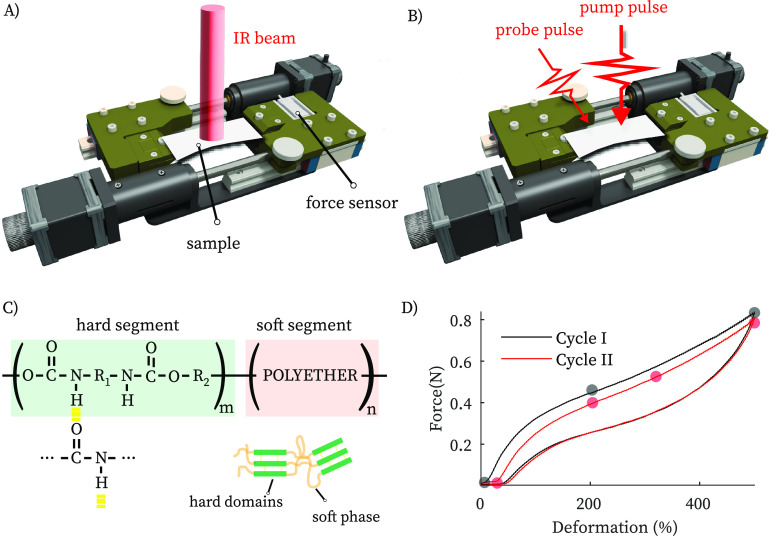
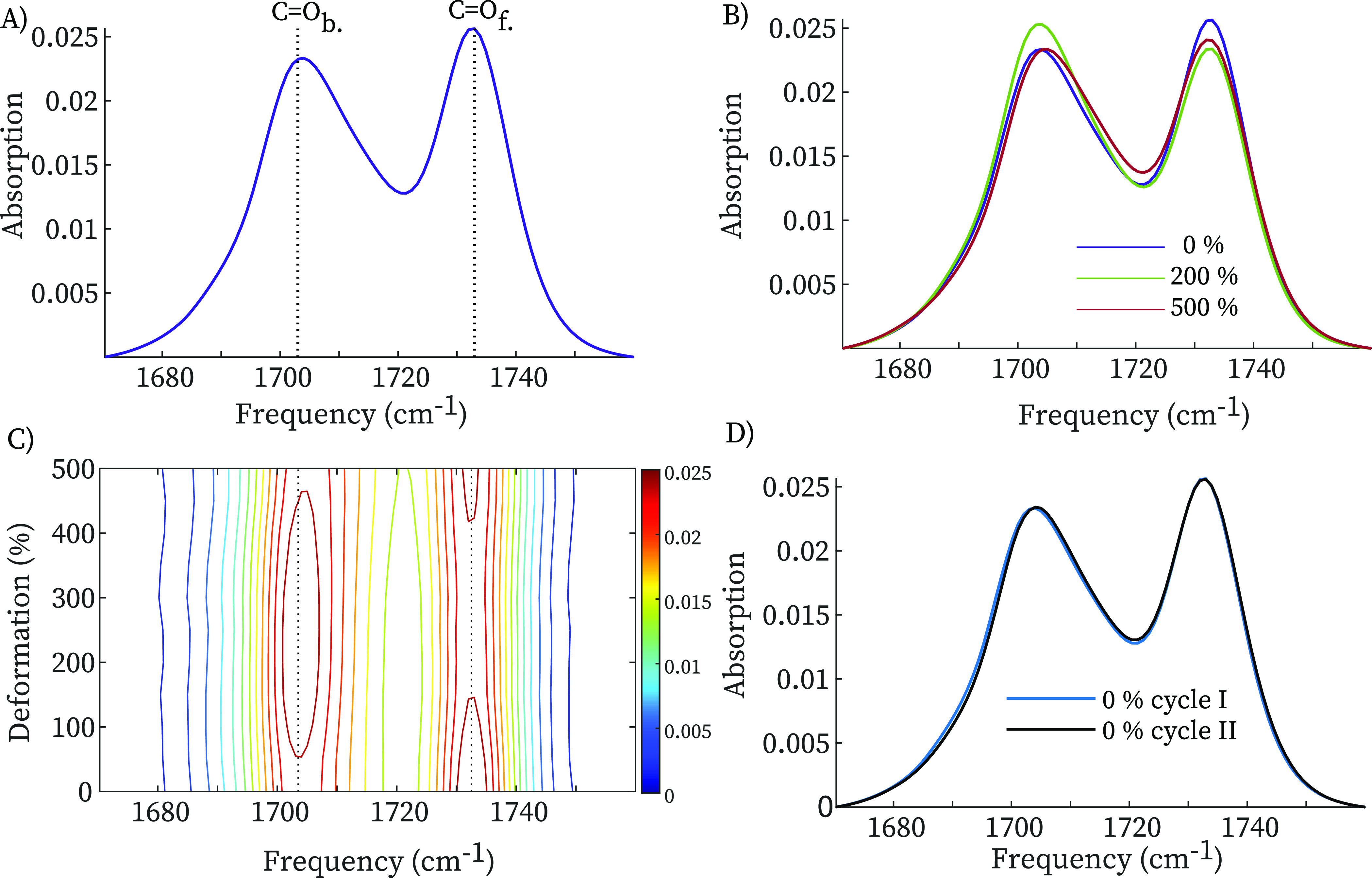
The remarkable elastic properties of polymers are ultimately due to their molecular structure, but the relation between the macroscopic and molecular properties is often difficult to establish, in particular for (bio)polymers that contain hydrogen bonds, which can easily rearrange upon mechanical deformation. Here we show that two-dimensional infrared spectroscopy on polymer films in a miniature stress tester sheds new light on how the hydrogen-bond structure of a polymer is related to its viscoelastic response. We study thermoplastic polyurethane, a block copolymer consisting of hard segments of hydrogen-bonded urethane groups embedded in a soft matrix of polyether chains. The conventional infrared spectrum shows that, upon deformation, the number of hydrogen bonds increases, a process that is largely reversible. However, the 2DIR spectrum reveals that the distribution of hydrogen-bond strengths becomes slightly narrower after a deformation cycle, due to the disruption of weak hydrogen bonds, an effect that could explain the strain-cycle induced softening (Mullins effect) of polyurethane. These results show how rheo-2DIR spectroscopy can bridge the gap between the molecular structure and the macroscopic elastic properties of (bio)polymers.
聚合物的显著弹性性能最终归因于其分子结构,但宏观和分子性质之间的关系通常很难建立,特别是对于含有氢键的(生物)聚合物,氢键在机械变形时很容易重新排列。在这里,我们展示了在微型应力测试仪中的聚合物薄膜的二维红外光谱如何揭示聚合物氢键结构与其粘弹性响应之间的关系。我们研究了热塑性聚氨酯,这是一种由氢键化的氨酯基团的硬段嵌入聚醚链的软基质组成的嵌段共聚物。常规的红外光谱表明,在变形时,氢键的数量增加,这是一个很大程度上是可逆的过程。然而,2DIR 光谱显示,在一个变形循环后,氢键强度的分布变得稍微变窄,这是由于弱氢键的破坏,这种效应可以解释聚氨酯的应变循环诱导软化(Mullins 效应)。这些结果表明流变学 2DIR 光谱如何在(生物)聚合物的分子结构和宏观弹性性质之间架起桥梁。