Sui T, Salvati E, Ying S, Sun G, Dolbnya I P, Dragnevski K, Prisacariu C, Korsunsky A M
MBLEM, Department of Engineering Science, University of Oxford, Parks Road, Oxford, OX1 3PJ, UK.
State Key Laboratory of Geomechanics and Geotechnical Engineering, Institute of Rock and Soil Mechanics, Chinese Academy of Sciences, Wuhan, Hubei, 430071, China.
Sci Rep. 2017 Apr 20;7(1):916. doi: 10.1038/s41598-017-00904-3.
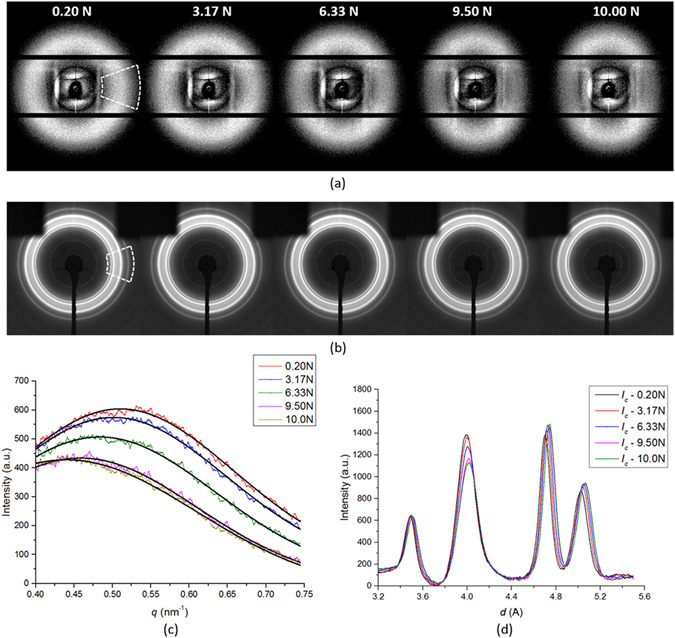
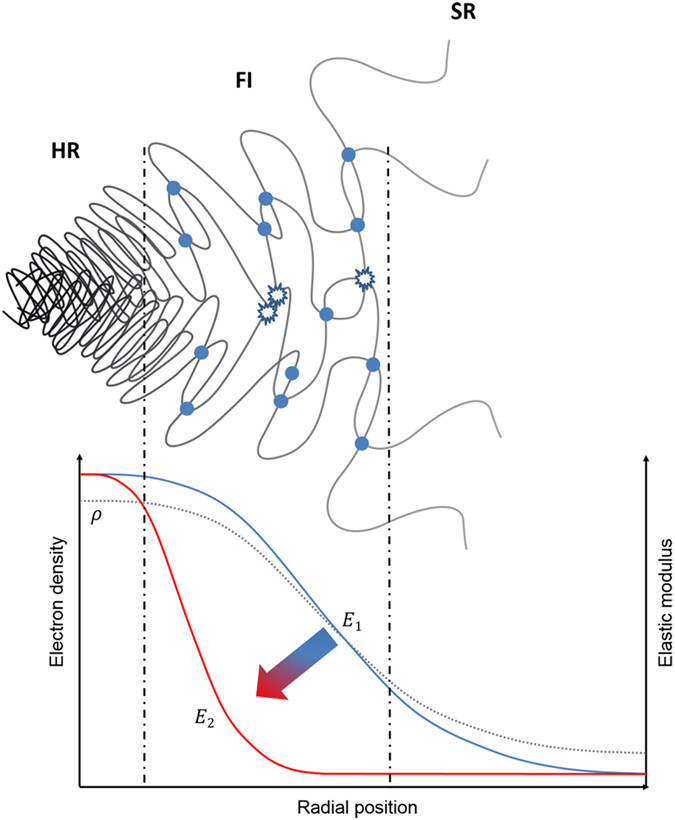
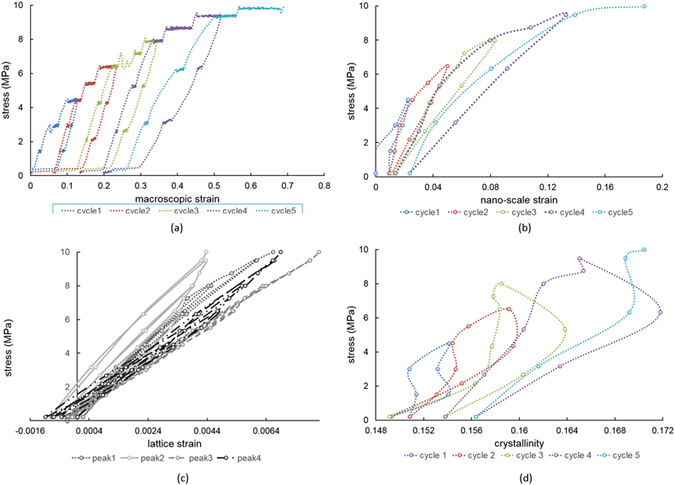
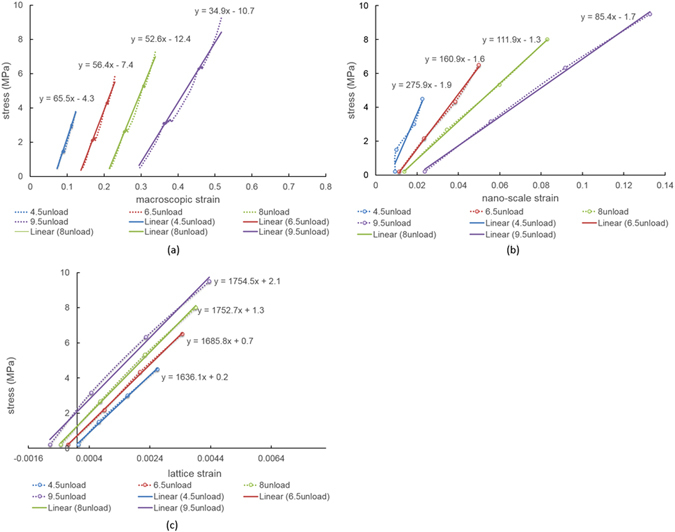
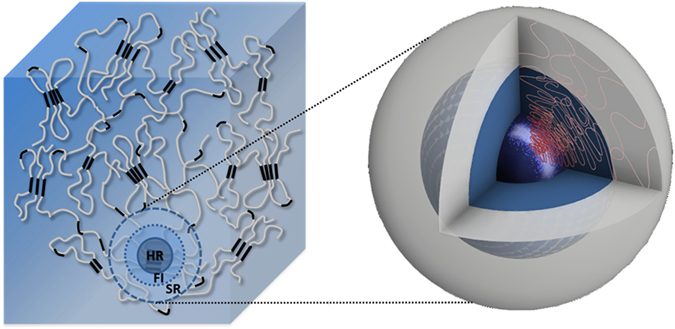
The strain-induced softening of thermoplastic polyurethane elastomers (TPUs), known as the Mullins effect, arises from their multi-phase structure. We used the combination of small- and wide- angle X-ray scattering (SAXS/WAXS) during in situ repeated tensile loading to elucidate the relationship between molecular architecture, nano-strain, and macro-scale mechanical properties. Insights obtained from our analysis highlight the importance of the 'fuzzy interface' between the hard and soft regions that governs the structure evolution at nanometre length scales and leads to macroscopic stiffness reduction. We propose a hierarchical Eshelby inclusion model of phase interaction mediated by the 'fuzzy interface' that accommodates the nano-strain gradient between hard and soft regions and undergoes tension-induced softening, causing the Mullins effect that becomes apparent in TPUs even at moderate tensile strains.
热塑性聚氨酯弹性体(TPU)的应变诱导软化,即穆林斯效应,源于其多相结构。我们在原位反复拉伸加载过程中结合小角和广角X射线散射(SAXS/WAXS),以阐明分子结构、纳米应变和宏观力学性能之间的关系。我们分析得出的见解突出了硬区和软区之间“模糊界面”的重要性,该界面控制着纳米尺度的结构演变,并导致宏观刚度降低。我们提出了一个由“模糊界面”介导的相相互作用的分层埃舍尔比夹杂模型,该模型考虑了硬区和软区之间的纳米应变梯度,并经历拉伸诱导软化,从而导致穆林斯效应,这种效应在TPU中即使在中等拉伸应变下也很明显。