Department of Hydrogeochemistry and Hydrogeology; Institute of Geology, Mineralogy and Geophysics, Ruhr-University Bochum, Universitaetsstr. 150, 44801, Bochum, Germany.
DICATECh Department of Civil, Environmental, Building Engineering, and Chemistry, Politecnico di Bari, Via Edoardo Orabona 4, 70125, Bari, Italy.
Nat Commun. 2023 Jan 23;14(1):362. doi: 10.1038/s41467-023-36034-w.
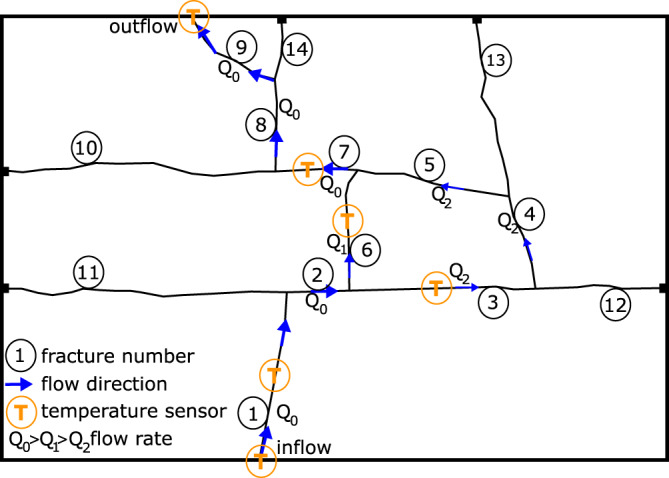
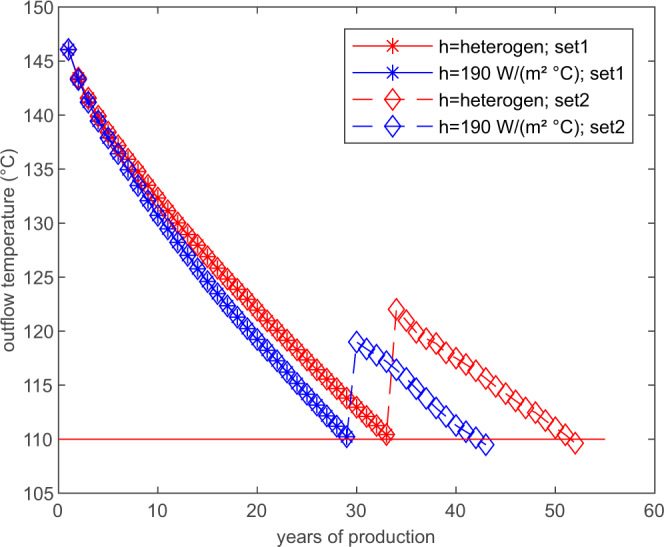
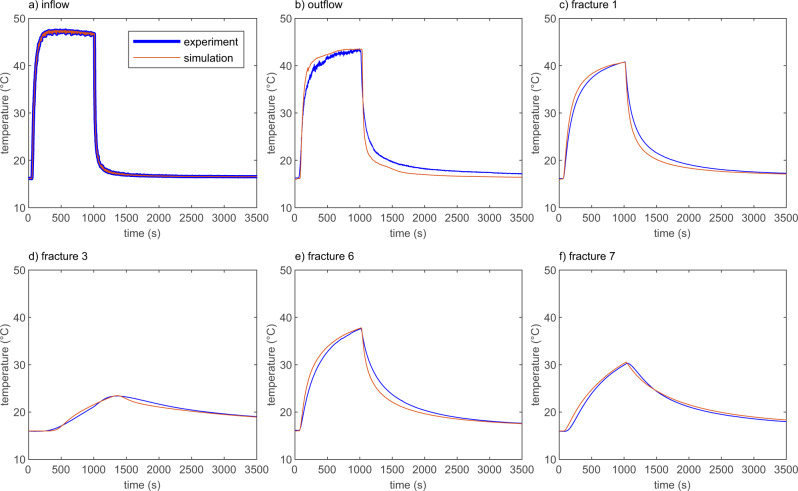
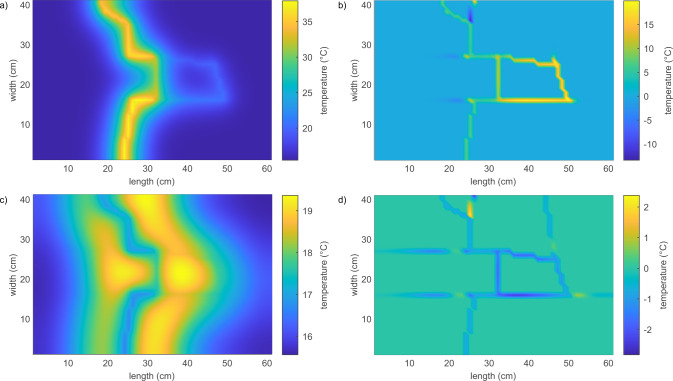
Heat transfer between a fluid and the surrounding rock in the subsurface is a crucial process not only, but most obviously, in geothermal systems. Heat transfer is described by Newton's law of cooling, relating the heat transferred to a coefficient, the specific surface area, and the temperature difference between rock and fluid. However, parameterizing the heat transfer coefficient in fracture networks poses a major challenge. Here we show that within a fracture network the heat transfer coefficient is strongly heterogeneous but that laboratory single fracture experiments can provide a reasonable estimate in dependence of flow rate. We investigate the distribution of the heat transfer coefficient experimentally as well as numerically and analyze the heat transfer at individual fractures. Our results improve the prediction of temperatures in engineered and natural geothermal systems and allow sustainable management and design of reservoirs considering the role of individual fractures.
地下流体与周围岩石之间的热量传递不仅在,而且最明显的是在地热系统中是一个关键过程。热量传递由牛顿冷却定律描述,该定律将传递的热量与一个系数、特定表面积和岩石与流体之间的温差联系起来。然而,在裂隙网络中参数化传热系数是一个主要的挑战。在这里,我们表明在裂隙网络内,传热系数是强烈不均匀的,但实验室单裂隙实验可以提供一个合理的估计,这取决于流速。我们实验和数值研究了传热系数的分布,并分析了单个裂隙的传热。我们的研究结果改善了工程和自然地热系统中温度的预测,并允许在考虑单个裂隙作用的情况下,对水库进行可持续的管理和设计。