
利用无人机多光谱植被指数和机器学习算法进行喀斯特植被覆盖度检测
Karst vegetation coverage detection using UAV multispectral vegetation indices and machine learning algorithm.
作者信息
Pan Wen, Wang Xiaoyu, Sun Yan, Wang Jia, Li Yanjie, Li Sheng
机构信息
Research Institute of Subtropical Forestry, Chinese Academy of Forestry, No. 73, Daqiao Road, Fuyang, Hangzhou, 311400, Zhejiang, China.
College of Forestry, Nanjing Forestry University, Nanjing, China.
出版信息
Plant Methods. 2023 Jan 23;19(1):7. doi: 10.1186/s13007-023-00982-7.
BACKGROUND
Karst vegetation is of great significance for ecological restoration in karst areas. Vegetation Indices (VIs) are mainly related to plant yield which is helpful to understand the status of ecological restoration in karst areas. Recently, karst vegetation surveys have gradually shifted from field surveys to remote sensing-based methods. Coupled with the machine learning methods, the Unmanned Aerial Vehicle (UAV) multispectral remote sensing data can effectively improve the detection accuracy of vegetation and extract the important spectrum features.
RESULTS
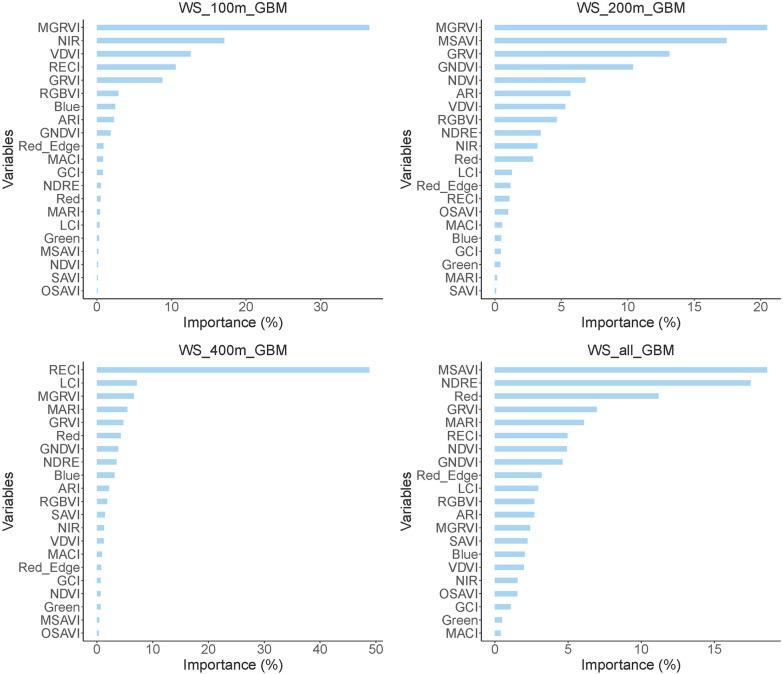
In this study, UAV multispectral image data at flight altitudes of 100 m, 200 m, and 400 m were collected to be applied for vegetation detection in a karst area. The resulting ground resolutions of the 100 m, 200 m, and 400 m data are 5.29, 10.58, and 21.16 cm/pixel, respectively. Four machine learning models, including Random Forest (RF), Support Vector Machine (SVM), Gradient Boosting Machine (GBM), and Deep Learning (DL), were compared to test the performance of vegetation coverage detection. 5 spectral values (Red, Green, Blue, NIR, Red edge) and 16 VIs were selected to perform variable importance analysis on the best detection models. The results show that the best model for each flight altitude has the highest accuracy in detecting its training data (over 90%), and the GBM model constructed based on all data at all flight altitudes yields the best detection performance covering all data, with an overall accuracy of 95.66%. The variables that were significantly correlated and not correlated with the best model were the Modified Soil Adjusted Vegetation Index (MSAVI) and the Modified Anthocyanin Content Index (MACI), respectively. Finally, the best model was used to invert the complete UAV images at different flight altitudes.
CONCLUSIONS
In general, the GBM_all model constructed based on UAV imaging with all flight altitudes was feasible to accurately detect karst vegetation coverage. The prediction models constructed based on data from different flight altitudes had a certain similarity in the distribution of vegetation index importance. Combined with the method of visual interpretation, the karst green vegetation predicted by the best model was in good agreement with the ground truth, and other land types including hay, rock, and soil were well predicted. This study provided a methodological reference for the detection of karst vegetation coverage in eastern China.
背景
喀斯特植被对喀斯特地区的生态恢复具有重要意义。植被指数(VIs)主要与植物产量相关,有助于了解喀斯特地区的生态恢复状况。近年来,喀斯特植被调查已逐渐从实地调查转向基于遥感的方法。结合机器学习方法,无人机(UAV)多光谱遥感数据能够有效提高植被检测精度并提取重要光谱特征。
结果
本研究收集了飞行高度为100米、200米和400米的无人机多光谱图像数据,用于喀斯特地区的植被检测。100米、200米和400米数据的地面分辨率分别为5.29、10.58和21.16厘米/像素。比较了随机森林(RF)、支持向量机(SVM)、梯度提升机(GBM)和深度学习(DL)这四种机器学习模型,以测试植被覆盖检测的性能。选择5个光谱值(红、绿、蓝、近红外、红边)和16个植被指数对最佳检测模型进行变量重要性分析。结果表明,每个飞行高度的最佳模型在检测其训练数据时具有最高的准确率(超过90%),基于所有飞行高度的所有数据构建的GBM模型在覆盖所有数据方面具有最佳检测性能,总体准确率为95.66%。与最佳模型显著相关和不相关的变量分别是修正土壤调节植被指数(MSAVI)和修正花青素含量指数(MACI)。最后,使用最佳模型对不同飞行高度的完整无人机图像进行反演。
结论
总体而言,基于所有飞行高度的无人机成像构建的GBM_all模型对于准确检测喀斯特植被覆盖是可行的。基于不同飞行高度数据构建的预测模型在植被指数重要性分布上具有一定相似性。结合目视解译方法,最佳模型预测的喀斯特绿色植被与地面实况吻合良好,对包括干草、岩石和土壤在内的其他土地类型也有较好的预测。本研究为中国东部喀斯特植被覆盖检测提供了方法参考。




 Zotero 插件