Pediatrics Department, Hospital Universitario Severo Ochoa, Avenida Orellana s/n, 28911, Leganés, Madrid, Spain.
Fundación para la Investigación Biomédica, Hospital Universitario Puerta de Hierro, Majadahonda, Spain.
Respir Res. 2023 Jan 24;24(1):26. doi: 10.1186/s12931-023-02323-7.
Severe bronchiolitis is often associated with subsequent respiratory morbidity, mainly recurrent wheezing and asthma. However, the underlying immune mechanisms remain unclear. The main goal of this study was to investigate the association of nasal detection of periostin and thymic stromal lymphopoietin (TSLP) during severe bronchiolitis with the development of asthma at 4 years of age.
Observational, longitudinal, post-bronchiolitis, hospital-based, follow-up study. Children hospitalized for bronchiolitis between October/2013 and July/2017, currently aged 4 years, included in a previous study to investigate the nasal airway secretion of TSLP and periostin during bronchiolitis, were included. Parents were contacted by telephone, and were invited to a clinical interview based on a structured questionnaire to obtain information on the respiratory evolution. The ISAAC questionnaire for asthma symptoms for 6-7-year-old children, was also employed.
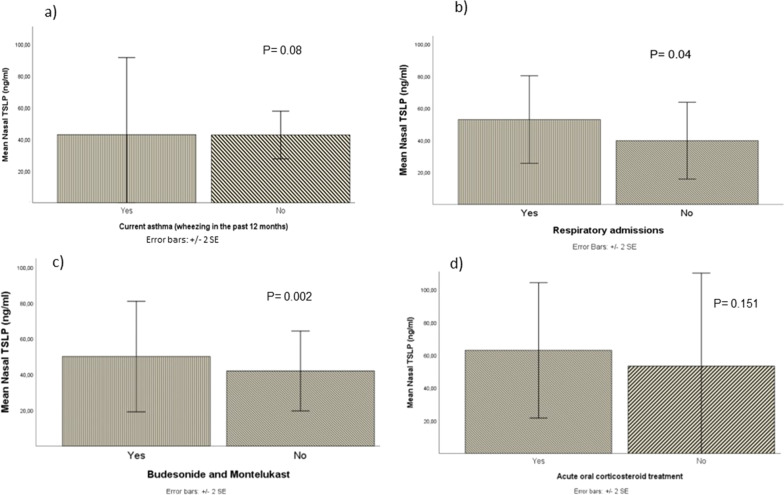
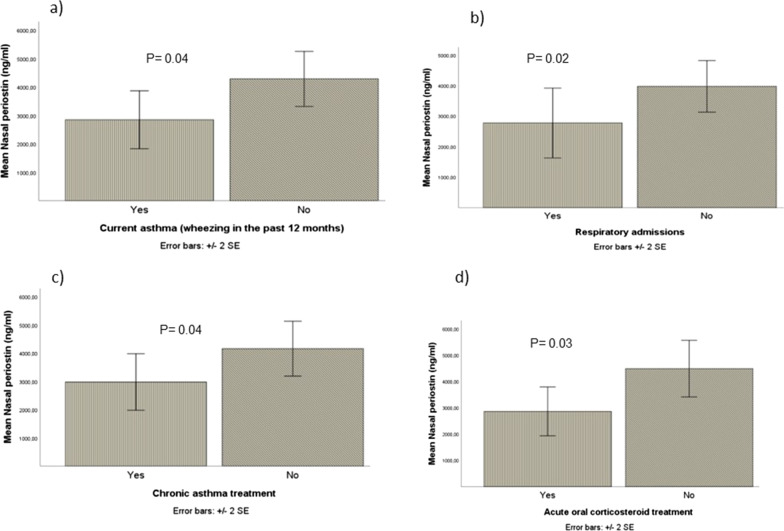
A total of 248 children were included (median age 4.4 years). The mean age at admission for bronchiolitis was 3.1 (IQR: 1.5-6.5) months. Overall, 21% had ever been diagnosed with asthma and 37% had wheezed in the last 12 months. Measurable nasal TSLP was detected at admission in 27(11%) cases and periostin in 157(63%). The detection of nasal TSLP was associated with the subsequent prescription of maintenance asthma treatment (p = 0.04), montelukast (p = 0.01), and the combination montelukast/inhaled glucocorticosteroids (p = 0.03). Admissions for asthma tended to be more frequent in children with TSLP detection (p = 0.07). In the multivariate analysis, adjusting for potential confounders, the detection of TSLP remained independently associated with chronic asthma treatment prescription (aOR:2.724; CI 1.051-7.063, p:0.04) and with current asthma (aOR:3.41; CI 1.20-9.66, p:0.02). Nasal detection of periostin was associated with lower frequency of ever use of short-acting beta2-agonists (SABA) (p = 0.04), lower prevalence of current asthma (p = 0.02), less prescription of maintenance asthma treatment in the past 12 months (p = 0.02, respectively). In the multivariate analysis, periostin was associated with lower risk of asthma at 4 years, independently of the atopic status (aOR:0.511 CI 95% 0.284-0.918, p:0.025).
Our results show a positive correlation between nasal TSLP detection in severe bronchiolitis and the presence of current asthma, prescription of asthma maintenance treatment and respiratory admissions up to the age of 4 years. By contrast, we found a protective association between nasal periostin detection and current asthma at 4 years, ever diagnosis of asthma, maintenance asthma treatment prescription, and respiratory admissions.
严重细支气管炎常与随后的呼吸道发病率相关,主要是反复喘息和哮喘。然而,潜在的免疫机制仍不清楚。本研究的主要目的是研究严重细支气管炎期间鼻内检测骨膜蛋白和胸腺基质淋巴生成素(TSLP)与 4 岁时哮喘发展之间的关系。
观察性、纵向、细支气管炎后、基于医院的随访研究。纳入了 2013 年 10 月至 2017 年 7 月期间因细支气管炎住院、目前年龄为 4 岁的儿童,并进行了之前的研究,以调查细支气管炎期间 TSLP 和骨膜蛋白在鼻气道分泌物中的作用。通过电话联系家长,并邀请他们参加基于结构化问卷的临床访谈,以获取呼吸演变的信息。还使用了针对 6-7 岁儿童哮喘症状的 ISAAC 问卷。
共纳入 248 名儿童(中位数年龄 4.4 岁)。细支气管炎入院时的平均年龄为 3.1(IQR:1.5-6.5)个月。总体而言,21%的儿童曾被诊断为哮喘,37%的儿童在过去 12 个月内喘息。在 27 例(11%)病例中可检测到鼻 TSLP,在 157 例(63%)病例中可检测到骨膜蛋白。鼻 TSLP 的检测与随后的维持性哮喘治疗(p=0.04)、孟鲁司特(p=0.01)和孟鲁司特/吸入糖皮质激素的联合治疗(p=0.03)有关。有 TSLP 检测的儿童因哮喘入院的趋势更为频繁(p=0.07)。在多变量分析中,调整了潜在的混杂因素后,TSLP 的检测仍然与慢性哮喘治疗处方(优势比:2.724;95%CI 1.051-7.063,p=0.04)和当前哮喘(优势比:3.41;95%CI 1.20-9.66,p=0.02)相关。骨膜蛋白的鼻检测与短效β2-激动剂(SABA)的使用频率较低(p=0.04)、当前哮喘的患病率较低(p=0.02)、过去 12 个月内维持性哮喘治疗的处方频率较低(p=0.02)相关。在多变量分析中,骨膜蛋白与 4 岁时哮喘的风险降低有关,与特应性状态无关(优势比:0.511,95%CI 0.284-0.918,p=0.025)。
我们的结果表明,严重细支气管炎中鼻 TSLP 的检测与当前哮喘的存在、哮喘维持治疗的处方以及 4 岁时的呼吸道入院有关。相比之下,我们发现鼻内骨膜蛋白的检测与 4 岁时的当前哮喘、哮喘的既往诊断、哮喘维持治疗的处方和呼吸道入院之间存在保护相关性。