Department of Respiratory Medicine, Children's Hospital of Soochow University, Jingde Road No. 303, Suzhou, 215003, China.
Department of Laboratory Medicine, Department of Clinical laboratory, Children's Hospital of Soochow University, Jingde Road No. 303, Suzhou, 215003, China.
BMC Infect Dis. 2021 Mar 10;21(1):250. doi: 10.1186/s12879-021-05937-8.
Infants with bronchiolitis have an increased risk of developing recurrent wheezing and asthma. However, the risk factors for the development of recurrent wheezing after bronchiolitis remains controversial. Our study was to investigate risk factors of post-bronchiolitis recurrent wheezing.
Infants with bronchiolitis were enrolled from November 2016 through March 2017. Nasopharyngeal aspirates were obtained for detection of respiratory viruses which were analyzed by reverse transcriptase polymerase chain reaction (RT-PCR) and direct immunofluorescent assay. Serum cytokines including TSLP, IL2, IL13, TIMP-1, MMP-9, IL33, IL5, IL4, IL25, TNF- α and MIP-1α were measured by flow cytometry. Patients were followed up every 3 months for a duration of 2 years by telephone or at outpatient appointments.
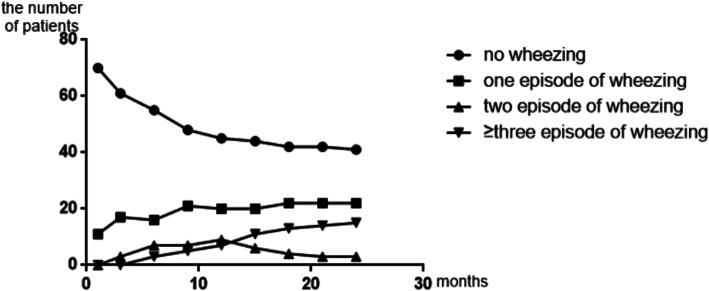
We enrolled 89 infants, of which 81 patients were successfully followed up. In total, 22.2% of patients experienced recurrent wheezing episodes. The proportion of patients with history of eczema, systemic glucocorticoid use and patients with moderate-to-severe disease were significantly higher in the recurrent wheezing group than the non-recurrent wheezing group (83.3% vs 52.4%; 66.7% vs 36.5%; 61.1% vs 33.3%, respectively, all P < 0.05); There were no significant differences between patients with and without recurrent wheezing episodes in the levels of TSLP, IL2, IL13, TIMP-1, MMP-9, IL33, IL5, IL4, IL25, TNF- α and MIP-1α (P > 0.05). Logistic regression analysis showed that history of eczema was an independent risk factor for post-bronchiolitis recurrent wheezing (odds ratio [OR] = 5.622; 95% confidence interval [CI], 1.3-24.9; P = 0.023).
The incidence of recurrent wheezing among infants after contracting bronchiolitis was 22.2% during a 2-year follow-up. History of eczema was the only independent risk factor identified and no correlation was found between the specific virus and disease severity in children with post-bronchiolitis recurrent wheezing.
毛细支气管炎患儿发生反复喘息和哮喘的风险增加。然而,毛细支气管炎后反复喘息的发病危险因素仍存在争议。本研究旨在探讨毛细支气管炎后反复喘息的危险因素。
2016 年 11 月至 2017 年 3 月,我们招募了患有毛细支气管炎的婴儿。通过逆转录聚合酶链反应(RT-PCR)和直接免疫荧光检测从鼻咽抽吸物中检测呼吸道病毒。通过流式细胞术测量 TSLP、IL2、IL13、TIMP-1、MMP-9、IL33、IL5、IL4、IL25、TNF-α和 MIP-1α 等血清细胞因子。通过电话或门诊随访,在 2 年内每 3 个月对患者进行一次随访。
我们共纳入 89 名婴儿,其中 81 名患者成功随访。共有 22.2%的患者出现反复喘息发作。在反复喘息组中,有特应性皮炎史、全身糖皮质激素使用史和中重度疾病的患者比例明显高于非反复喘息组(83.3%比 52.4%;66.7%比 36.5%;61.1%比 33.3%,均 P<0.05);反复喘息组和非反复喘息组患者的 TSLP、IL2、IL13、TIMP-1、MMP-9、IL33、IL5、IL4、IL25、TNF-α和 MIP-1α 水平无显著差异(P>0.05)。Logistic 回归分析显示,特应性皮炎史是毛细支气管炎后反复喘息的独立危险因素(比值比[OR] 5.622;95%置信区间 [CI] 1.3-24.9;P=0.023)。
在 2 年的随访中,患有毛细支气管炎的婴儿反复喘息的发生率为 22.2%。特应性皮炎史是唯一确定的独立危险因素,且在毛细支气管炎后反复喘息患儿中,特定病毒与疾病严重程度之间无相关性。