Nivel, Netherlands Institute for Health Services Research, Utrecht, Netherlands.
Tranzo, School of Social Sciences and Behavioural Research, Tilburg University, Tilburg, Netherlands.
J Med Internet Res. 2023 Jan 25;25:e38929. doi: 10.2196/38929.
In the nursing home sector, reusing routinely recorded data from electronic health records (EHRs) for knowledge development and quality improvement is still in its infancy. Trust in appropriate and responsible reuse is crucial for patients and nursing homes deciding whether to share EHR data for these purposes. A data governance framework determines who may access the data, under what conditions, and for what purposes. This can help obtain that trust. Although increasing attention is being paid to data governance in the health care sector, little guidance is available on development and implementation of a data governance framework in practice.
This study aims to describe the development process of a governance framework for the "Registry Learning from Data in Nursing Homes," a national registry for EHR data on care delivered by nursing home physicians (in Dutch: specialist ouderengeneeskunde) in Dutch nursing homes-to allow data reusage for research and quality improvement of care.
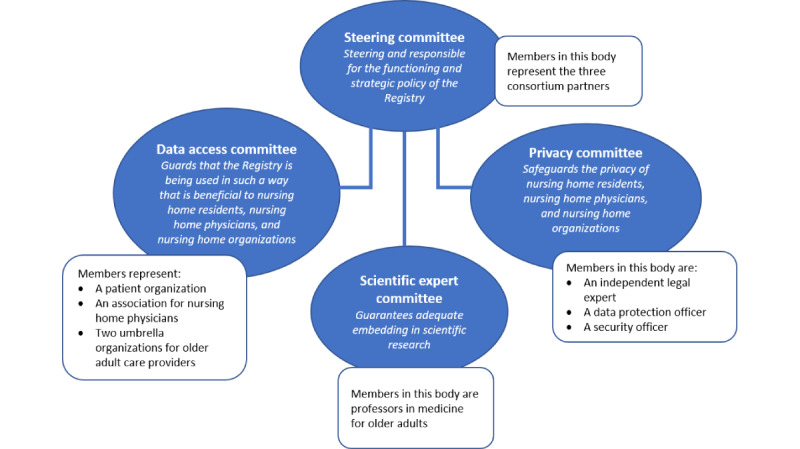
Relevant stakeholders representing practices, policies, and research in the nursing home sector were identified. Semistructured interviews were conducted with 20 people from 14 stakeholder organizations. The main aim of the interviews was to explore stakeholders' perspectives regarding the Registry's aim, data access criteria, and governing bodies' tasks and composition. Interview topics and analyses were guided by 8 principles regarding governance for reusing health data, as described in the literature. Interview results, together with legal advice and consensus discussions by the Registry's consortium partners, were used to shape the rules, regulations, and governing bodies of the governance framework.
Stakeholders valued the involvement of nursing home residents and their representatives, nursing home physicians, nursing homes' boards of directors, and scientists and saw this as a prerequisite for a trustworthy data governance framework. For the Registry, involvement of these groups can be achieved through a procedure in which residents can provide their consent or objection to the reuse of the data, transparency about the decisions made, and providing them a position in a governing body. In addition, a data request approval procedure based on predefined assessment criteria indicates that data reuse by third parties aligns with the aims of the Registry, benefits the nursing home sector, and protects the privacy of data subjects.
The stakeholders' views, expertise, and knowledge of other frameworks and relevant legislation serve to inform the application of governance principles to the contexts of both the nursing home sector and the Netherlands. Many different stakeholders were involved in the development of the Registry Learning from Data in Nursing Homes' governance framework and will continue to be involved. Engagement of the full range of stakeholders in an early stage of governance framework development is important to generate trust in appropriate and responsible data reuse.
在养老院领域,对电子健康记录(EHR)中常规记录的数据进行知识开发和质量改进的再利用仍处于起步阶段。患者和养老院是否决定为这些目的共享 EHR 数据,关键在于对适当和负责任的再利用的信任。数据治理框架确定谁可以访问数据、在什么条件下以及出于什么目的访问数据。这有助于获得这种信任。尽管医疗保健领域越来越关注数据治理,但关于实践中数据治理框架的开发和实施几乎没有指导。
本研究旨在描述一个治理框架的开发过程,该治理框架用于“养老院数据学习注册中心”,这是一个针对养老院医生(荷兰语:specialist ouderengeneeskunde)提供的护理 EHR 数据的全国性注册中心,以便对数据进行再利用,用于研究和护理质量改进。
确定了代表养老院领域实践、政策和研究的相关利益相关者。对来自 14 个利益相关者组织的 20 人进行了半结构化访谈。访谈的主要目的是探讨利益相关者对注册中心目标、数据访问标准以及管理机构任务和组成的看法。访谈主题和分析以文献中描述的 8 项关于健康数据再利用的治理原则为指导。访谈结果,以及来自注册中心联盟合作伙伴的法律建议和共识讨论,被用于塑造治理框架的规则、法规和管理机构。
利益相关者重视养老院居民及其代表、养老院医生、养老院董事会以及科学家的参与,并将其视为值得信赖的数据治理框架的前提。对于注册中心来说,可以通过一个程序来实现这些群体的参与,即居民可以对数据的再利用表示同意或反对,对所做的决策保持透明,并在管理机构中为他们提供一个职位。此外,基于预设评估标准的数据请求审批程序表明,第三方对数据的再利用符合注册中心的目标,有利于养老院行业,并保护数据主体的隐私。
利益相关者的意见、专业知识以及对其他框架和相关法规的了解,为将治理原则应用于养老院领域和荷兰的情况提供了信息。许多不同的利益相关者参与了“养老院数据学习注册中心”治理框架的开发,并将继续参与。在治理框架的早期阶段让所有利益相关者参与进来,对于建立对适当和负责任的数据再利用的信任非常重要。