Inomata Koya, Naganawa Yuki, Wang Zhi An, Sakamoto Kei, Matsumoto Kazuhiro, Sato Kazuhiko, Nakajima Yumiko
Interdisciplinary Research Center for Catalytic Chemistry, National Institute of Advanced Industrial Science and Technology (AIST), Tsukuba, Ibaraki, Japan.
Graduate School of Pure and Applied Sciences, University of Tsukuba, Tsukuba, Ibaraki, Japan.
Commun Chem. 2021 May 11;4(1):63. doi: 10.1038/s42004-021-00502-5.
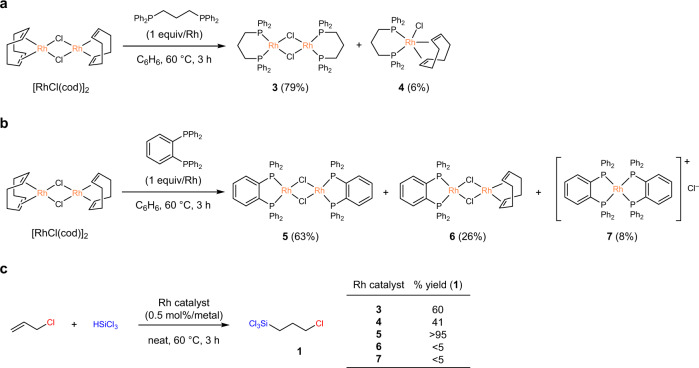
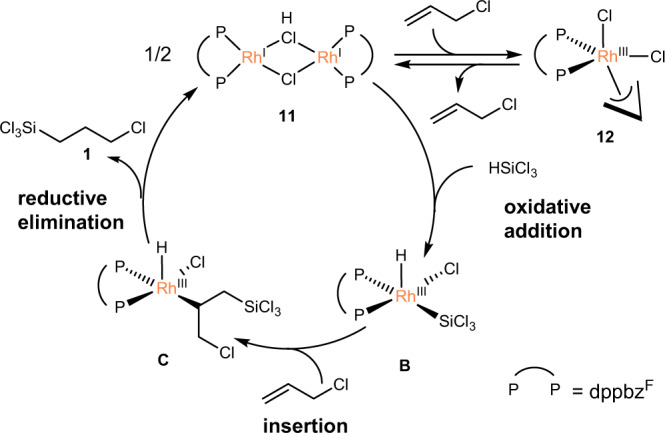
The transition-metal-catalysed hydrosilylation reaction of alkenes is one of the most important catalytic reactions in the silicon industry. In this field, intensive studies have been thus far performed in the development of base-metal catalysts due to increased emphasis on environmental sustainability. However, one big drawback remains to be overcome in this field: the limited functional group compatibility of the currently available Pt hydrosilylation catalysts in the silicon industry. This is a serious issue in the production of trichloro(3-chloropropyl)silane, which is industrially synthesized on the order of several thousand tons per year as a key intermediate to access various silane coupling agents. In the present study, an efficient hydrosilylation reaction of allyl chloride with trichlorosilane is achieved using the Rh(I) catalyst [RhCl(dppbz)] (dppbz = 1,2-bis(diphenylphosphino)-3,4,5,6-tetrafluorobenzene) to selectively form trichloro(3-chloropropyl)silane. The catalyst enables drastically improved efficiency (turnover number, TON, 140,000) and selectivity (>99%) to be achieved compared to conventional Pt catalysts.
烯烃的过渡金属催化硅氢化反应是硅工业中最重要的催化反应之一。在该领域,由于对环境可持续性的日益重视,目前已对贱金属催化剂的开发进行了深入研究。然而,该领域仍有一个重大缺点有待克服:目前硅工业中可用的铂硅氢化催化剂的官能团兼容性有限。这在三氯(3-氯丙基)硅烷的生产中是一个严重问题,三氯(3-氯丙基)硅烷作为获取各种硅烷偶联剂的关键中间体,每年的工业合成量达数千吨。在本研究中,使用铑(I)催化剂[RhCl(dppbz)](dppbz = 1,2-双(二苯基膦基)-3,4,5,6-四氟苯)实现了烯丙基氯与三氯硅烷的高效硅氢化反应,以选择性地形成三氯(3-氯丙基)硅烷。与传统铂催化剂相比,该催化剂能显著提高效率(周转数,TON,140,000)和选择性(>99%)。