Qian Jing, Zhang Yiding, Betensky Rebecca A, Hyman Bradley T, Serrano-Pozo Alberto
University of Massachusetts School of Public Health & Health Sciences (J.Q., Y.Z.), Amherst; Massachusetts General Hospital Biostatistics Center (J.Q.), Boston; New York University School of Global Public Health (R.A.B.); New York University Alzheimer's Disease Research Center (R.A.B.); Massachusetts General Hospital Neurology Department (B.T.H., A.S.-P.), Boston; Massachusetts Alzheimer's Disease Research Center (B.T.H., A.S.-P.), Charlestown; and Harvard Medical School (B.T.H., A.S.-P.), Boston, MA.
Neurol Genet. 2023 Jan 20;9(1):e200055. doi: 10.1212/NXG.0000000000200055. eCollection 2023 Feb.
We previously found that the genotype affects the rate of cognitive decline in mild-to-moderate Alzheimer disease (AD) dementia independently of its effects on AD neuropathologic changes (ADNC) and copathologies. In this study, we tested the hypothesis that the alleles differentially affect the rate of cognitive decline at the normal aging-early AD continuum and that this association is independent of their effects on classical ADNC and copathologies.
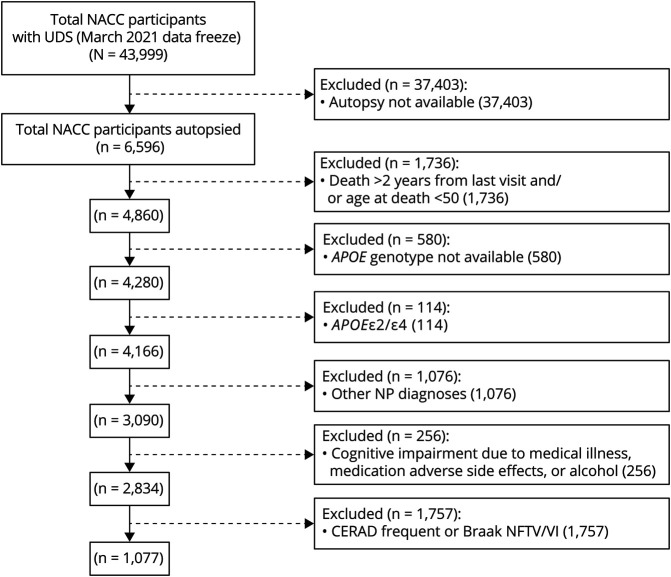
We analyzed associations with the cognitive trajectories (Clinical Dementia Rating scale Sum of Boxes [CDR-SOB] and Mini-Mental State Examination [MMSE]) of more than 1,000 individuals from a national clinicopathologic sample who had either no, mild (sparse neuritic plaques and the Braak neurofibrillary tangle [NFT] stage I/II), or intermediate (moderate neuritic plaques and the Braak NFT stage III/IV) ADNC levels at autopsy via 2 latent classes reverse-time longitudinal modeling.
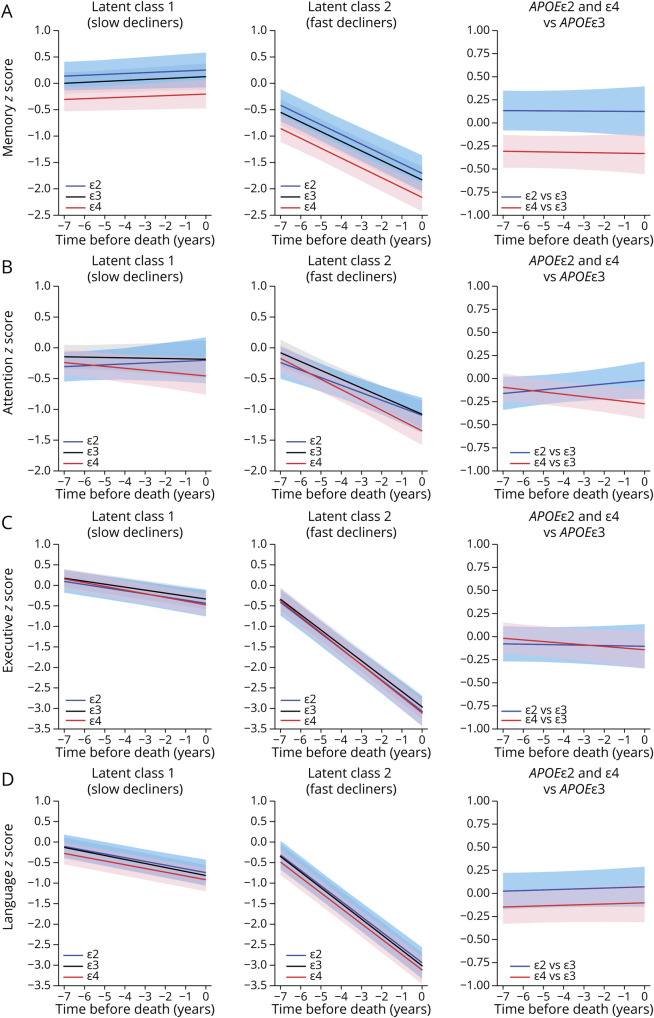
Carrying the ε4 allele was associated with a faster rate of cognitive decline by both CDR-SOB and MMSE relative to ε3 homozygotes. This association remained statistically significant after adjusting for ADNC severity, comorbid pathologies, and the effects of ADNC on the slope of cognitive decline. Our modeling strategy identified 2 latent classes in which ε4 carriers declined faster than ε3 homozygotes, with latent class 1 members representing slow decliners (CDR-SOB: 76.7% of individuals, 0.195 vs 0.146 points/y in ε4 vs ε3/ε3; MMSE: 88.6% of individuals, -0.303 vs -0.153 points/y in ε4 vs ε3/ε3), whereas latent class 2 members were fast decliners (CDR-SOB: 23.3% of participants, 1.536 vs 1.487 points/y in ε4 vs ε3/ε3; MMSE: 11.4% of participants, -2.538 vs -2.387 points/y in ε4 vs ε3/ε3). Compared with slow decliners, fast decliners were more likely to carry the ε4 allele, younger at initial visit and death, more impaired at initial and last visits, and more likely to have intermediate (vs none or mild) ADNC levels, as well as concurrent Lewy bodies and hippocampal sclerosis at autopsy.
In a large national sample selected to represent the normal aging-early AD continuum, the ε4 allele is associated with a modest but statistically significant acceleration of the cognitive decline rate even after controlling for its effects on ADNC and comorbid pathologies.
我们之前发现,该基因型独立于其对阿尔茨海默病(AD)神经病理改变(ADNC)和共病的影响,影响轻度至中度AD痴呆的认知衰退速率。在本研究中,我们检验了以下假设:该等位基因在正常衰老至早期AD连续体中对认知衰退速率有不同影响,且这种关联独立于其对经典ADNC和共病的影响。
我们通过2种潜在类别反向时间纵向模型,分析了来自一个全国性临床病理样本的1000多名个体的认知轨迹(临床痴呆评定量表方框总和[CDR-SOB]和简易精神状态检查表[MMSE])与该等位基因的关联,这些个体在尸检时ADNC水平分别为无、轻度(稀疏神经炎性斑块和Braak神经原纤维缠结[NFT] I/II期)或中度(中度神经炎性斑块和Braak NFT III/IV期)。
与ε3纯合子相比,携带ε4等位基因与CDR-SOB和MMSE评估的更快认知衰退速率相关。在调整ADNC严重程度、共病情况以及ADNC对认知衰退斜率的影响后,这种关联仍具有统计学意义。我们的建模策略识别出2种潜在类别,其中ε4携带者比ε3纯合子衰退更快,潜在类别1成员代表衰退缓慢者(CDR-SOB:个体的76.7%,ε4携带者为每年0.195分,ε3/ε3携带者为每年0.146分;MMSE:个体的88.6%,ε4携带者为每年-0.303分,ε3/ε3携带者为每年-0.153分),而潜在类别2成员为衰退快速者(CDR-SOB:参与者的23.3%,ε4携带者为每年1.536分,ε3/ε3携带者为每年1.487分;MMSE:参与者的11.4%,ε4携带者为每年-2.538分,ε3/ε3携带者为每年-2.387分)。与衰退缓慢者相比,衰退快速者更可能携带ε4等位基因,初诊和死亡时更年轻,初诊和末次就诊时受损更严重,更可能有中度(而非无或轻度)ADNC水平,以及尸检时并发路易小体和海马硬化。
在一个为代表正常衰老至早期AD连续体而选取的大型全国性样本中,即使在控制了ε4等位基因对ADNC和共病的影响后,它仍与认知衰退速率的适度但具有统计学意义的加速相关。