Department of Neurosciences, University of California, San Diego, San Diego, California.
Veterans Affairs San Diego Healthcare System, San Diego, California.
Ann Neurol. 2022 Sep;92(3):425-438. doi: 10.1002/ana.26438. Epub 2022 Jul 11.
Primary age-related tauopathy (PART) refers to tau neurofibrillary tangles restricted largely to the medial temporal lobe in the absence of significant beta-amyloid plaques. PART has been associated with cognitive impairment, but contributions from concomitant limbic age-related TDP-43 encephalopathy neuropathologic change (LATE-NC) are underappreciated.
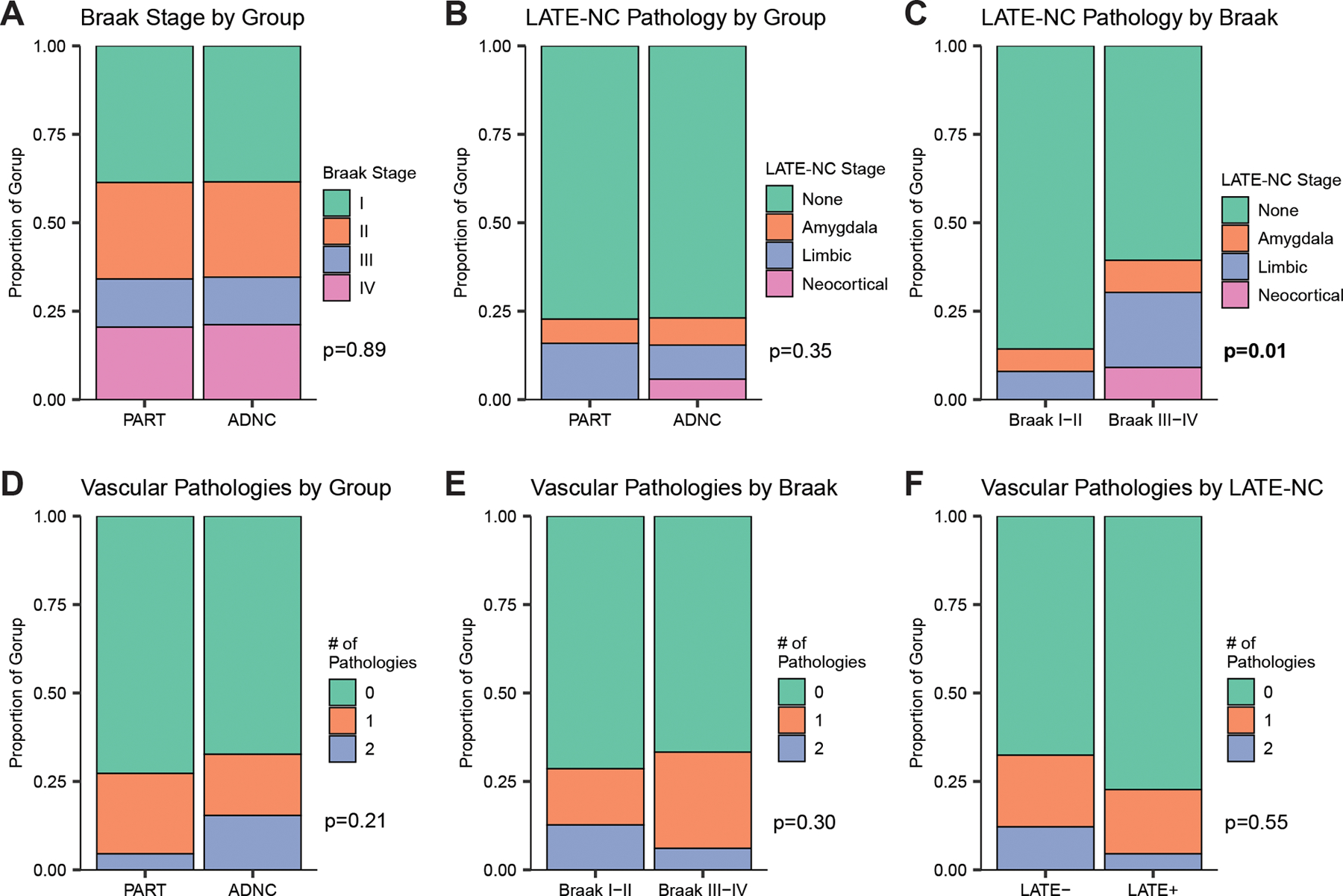
We compare prevalence of LATE-NC and vascular copathologies in age- and Braak-matched patients with PART (n = 45, Braak stage I-IV, Thal phase 0-2) or early stage Alzheimer disease neuropathologic change (ADNC; n = 51, Braak I-IV, Thal 3-5), and examine their influence on clinical and cognitive decline.
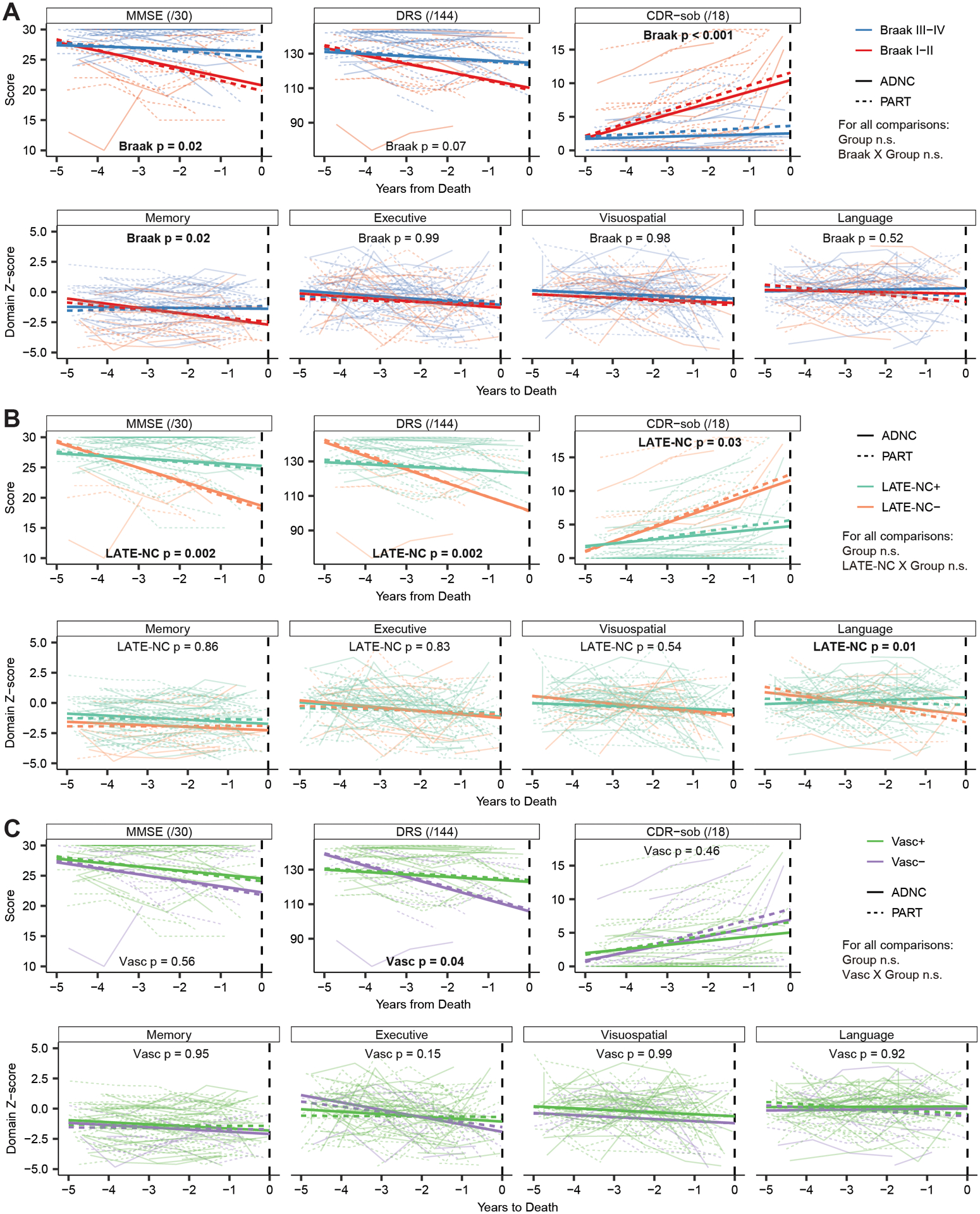
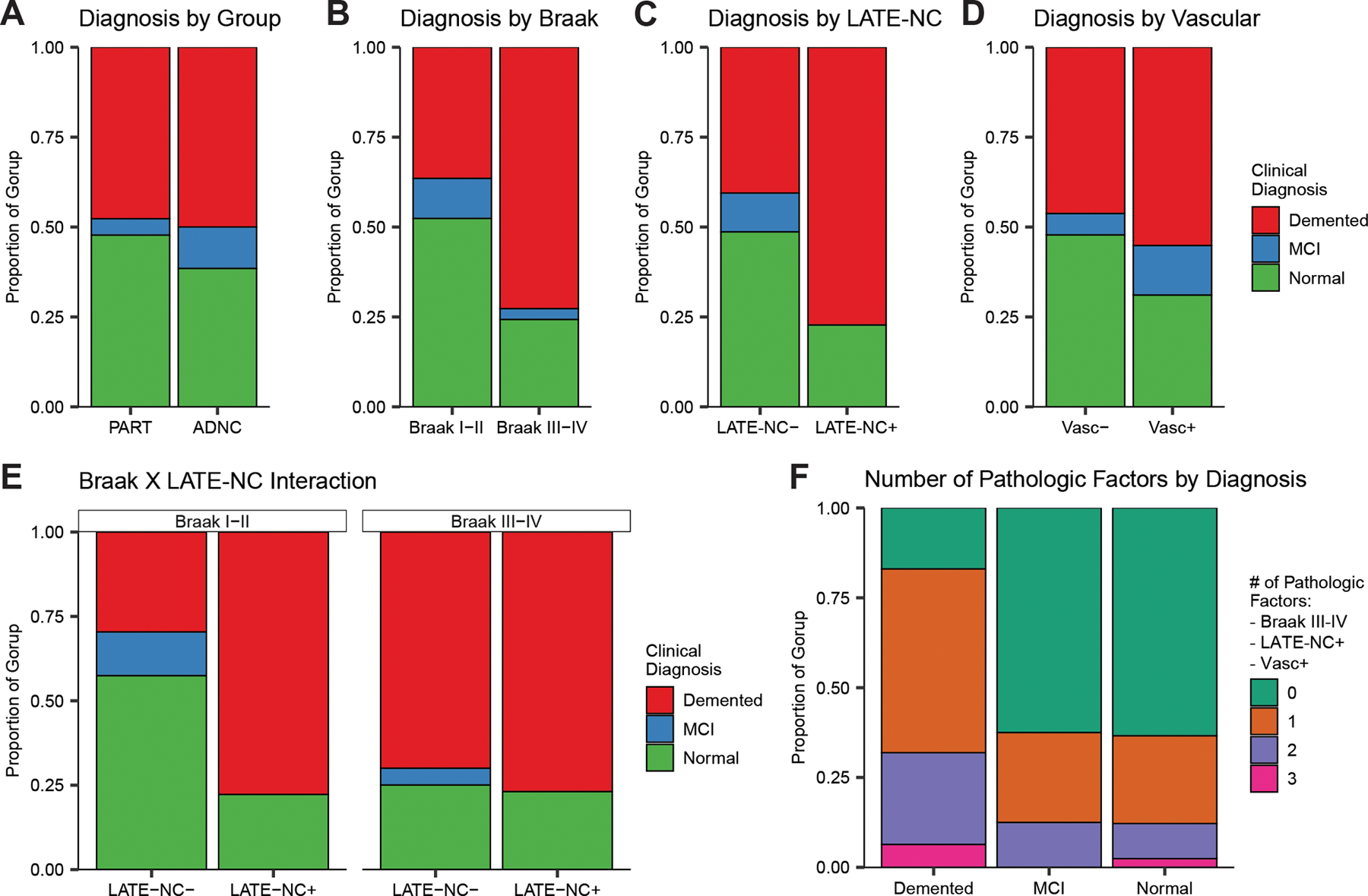
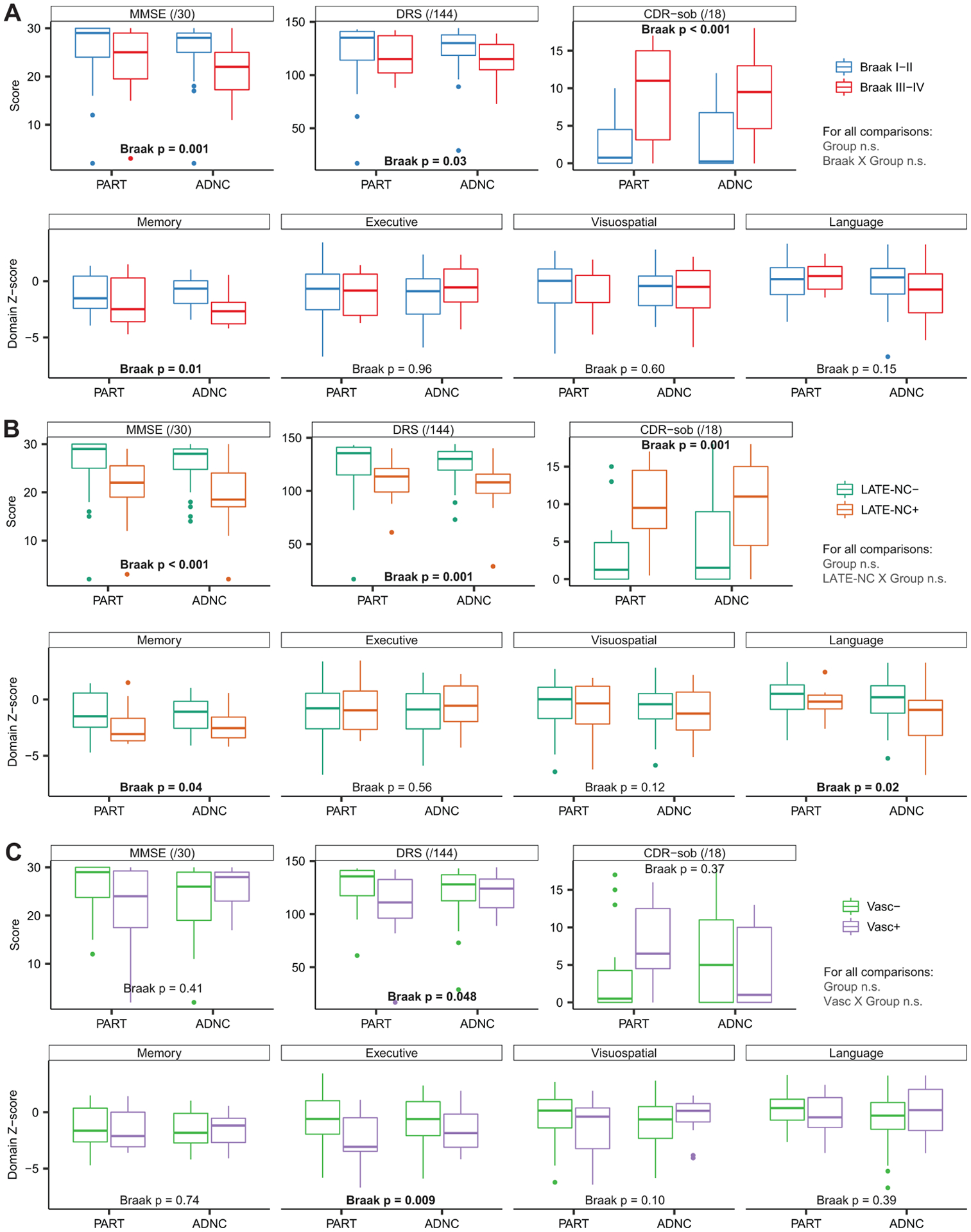
Concomitant LATE-NC and vascular pathology were equally common, and cognition was equally impaired, in PART (Mini-Mental State Examination [MMSE] = 24.8 ± 6.9) and ADNC (MMSE = 24.2 ± 6.0). Patients with LATE-NC were more impaired than those without LATE-NC on the MMSE (by 5.8 points, 95% confidence interval [CI] = 3.0-8.6), Mattis Dementia Rating Scale (DRS; 17.5 points, 95% CI = 7.1-27.9), Clinical Dementia Rating, sum of boxes scale (CDR-sob; 5.2 points, 95% CI = 2.1-8.2), memory composite (0.8 standard deviations [SD], 95% CI = 0.1-1.6), and language composite (1.1 SD, 95% CI = 0.2-2.0), and more likely to receive a dementia diagnosis (odds ratio = 4.8, 95% CI = 1.5-18.0). Those with vascular pathology performed worse than those without on the DRS (by 10.2 points, 95% CI = 0.1-20.3) and executive composite (1.3 SD, 95% CI = 0.3-2.3). Cognition declined similarly in PART and ADNC over the 5 years preceding death; however, LATE-NC was associated with more rapid decline on the MMSE (β = 1.9, 95% CI = 0.9-3.0), DRS (β = 7.8, 95% CI = 3.4-12.7), CDR-sob (β = 1.9, 95% CI = 0.4-3.7), language composite (β = 0.5 SD, 95% CI = 0.1-0.8), and vascular pathology with more rapid decline on the DRS (β = 5.2, 95% CI = 0.6-10.2).
LATE-NC, and to a lesser extent vascular copathology, exacerbate cognitive impairment and decline in PART and early stage ADNC. ANN NEUROL 2022;92:425-438.
原发性年龄相关性 tau 病(PART)是指主要局限于内侧颞叶的 tau 神经纤维缠结,而无明显的β-淀粉样斑块。PART 与认知障碍有关,但同时存在的边缘性年龄相关性 TDP-43 脑炎神经病理改变(LATE-NC)的贡献被低估了。
我们比较了年龄和 Braak 匹配的 PART 患者(n=45,Braak Ⅰ-Ⅳ期,Thal 0-2 期)或早期阿尔茨海默病神经病理改变(ADNC;n=51,Braak Ⅰ-Ⅳ期,Thal 3-5 期)患者中 LATE-NC 和血管共病的患病率,并检查了它们对临床和认知衰退的影响。
PART(简易精神状态检查 [MMSE] = 24.8±6.9)和 ADNC(MMSE = 24.2±6.0)中同时存在 LATE-NC 和血管病理学的情况同样常见,认知功能同样受损。与无 LATE-NC 的患者相比,有 LATE-NC 的患者在 MMSE 上的评分(下降 5.8 分,95%置信区间 [CI] = 3.0-8.6)、Mattis 痴呆评定量表(DRS;17.5 分,95%CI = 7.1-27.9)、临床痴呆评定量表,总分(CDR-sob;5.2 分,95%CI = 2.1-8.2)、记忆综合评分(0.8 个标准差 [SD],95%CI = 0.1-1.6)和语言综合评分(1.1 SD,95%CI = 0.2-2.0)上的评分更差,更有可能被诊断为痴呆(优势比 [OR] = 4.8,95%CI = 1.5-18.0)。有血管共病的患者在 DRS(下降 10.2 分,95%CI = 0.1-20.3)和执行综合评分(1.3 SD,95%CI = 0.3-2.3)上的表现更差。PART 和 ADNC 在死亡前 5 年的认知功能下降相似;然而,LATE-NC 与 MMSE(β=1.9,95%CI = 0.9-3.0)、DRS(β=7.8,95%CI = 3.4-12.7)、CDR-sob(β=1.9,95%CI = 0.4-3.7)、语言综合评分(β=0.5 SD,95%CI = 0.1-0.8)和血管共病的认知功能下降(β=5.2,95%CI = 0.6-10.2)更快有关。
LATE-NC 以及在较小程度上的血管共病,会使 PART 和早期 ADNC 中的认知障碍和认知衰退恶化。