Abolins-Abols Mikus, Peterson Mark, Studer Brett, Hale Mattison, Hanley Daniel, Bentley George, Hauber Mark E
Department of Biology University of Louisville Louisville Kentucky USA.
Life-Science Innovations Willmar Minnesota USA.
Ecol Evol. 2023 Jan 18;13(1):e9691. doi: 10.1002/ece3.9691. eCollection 2023 Jan.
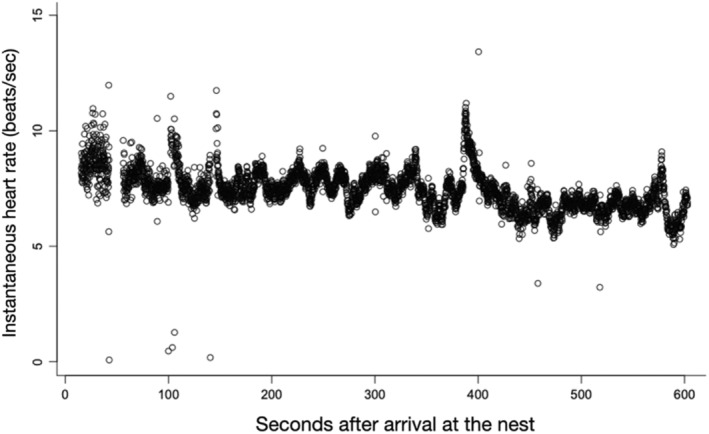
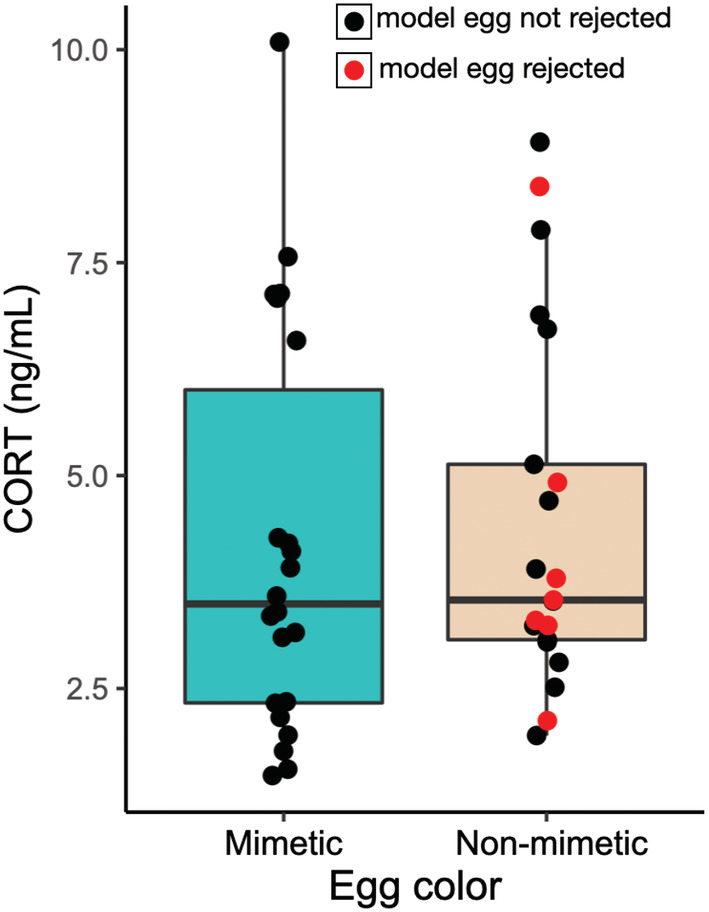
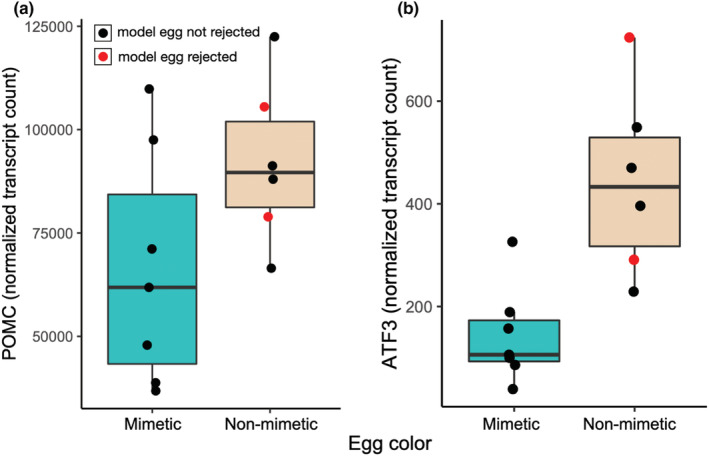
One of the most effective defenses of avian hosts against obligate brood parasites is the ejection of parasitic eggs from the nests. Despite the clear fitness benefits of this behavior, individuals within so-called "egg-rejecter" host species still show substantial variation in their propensity to eliminate foreign eggs from the nest. We argue that this variation can be further understood by studying the physiological mechanisms of host responses to brood parasitic egg stimuli: independent lines of research increasingly support the hypothesis that stress-related physiological response to parasitic eggs may trigger egg rejection. The "stress-mediated egg rejection" hypothesis requires that hosts activate the stress-response when responding to parasitic egg stimuli. We tested this prediction by asking whether hosts showed differential stress response when exposed to host-like (mimetic) or parasite-like (non-mimetic) eggs. We experimentally parasitized incubating American robins , a robust egg-rejecter host to obligate brood parasitic brown-headed cowbirds with mimetic or non-mimetic model eggs. To assess the stress response, we measured the heart rate in incubating females immediately after experimental parasitism. We also measured plasma corticosterone and, in a subset of birds, used RNA-sequencing to analyze the expression of proopiomelanocortin (POMC), a precursor of adrenocorticotropic hormone, 2 h after experimental parasitism. We found that egg type had no effect on heart rate. Two hours following experimental parasitism, plasma corticosterone did not differ between the differently-colored model egg treatments or between rejecter and accepter females within the non-mimetic treatment. However, females exposed to non-mimetic eggs showed an upregulation of POMC gene expression (before FDR correction) in the pituitary compared with females treated with mimetic eggs. Our findings suggest that in an egg-rejecter host species, non-mimetic parasitic eggs may increase the activity of the stress-related hypothalamic-pituitary-adrenal axis compared with mimetic eggs, although the temporal dynamics of this response are not yet understood.
鸟类宿主对抗专性巢寄生者最有效的防御手段之一是将寄生卵从巢中逐出。尽管这种行为具有明显的适应性益处,但在所谓的“弃卵者”宿主物种中,个体在从巢中清除外来卵的倾向方面仍表现出很大差异。我们认为,通过研究宿主对巢寄生卵刺激的生理反应机制,可以进一步理解这种差异:越来越多的独立研究支持这样一种假说,即对寄生卵的应激相关生理反应可能引发弃卵行为。“应激介导的弃卵”假说要求宿主在对寄生卵刺激做出反应时激活应激反应。我们通过询问宿主在接触类似宿主(拟态)或类似寄生虫(非拟态)的卵时是否表现出不同的应激反应来检验这一预测。我们用拟态或非拟态模型卵对正在孵卵的美洲知更鸟进行了实验性寄生,美洲知更鸟是专性巢寄生的褐头牛鹂的一种强健的弃卵宿主。为了评估应激反应,我们在实验性寄生后立即测量了正在孵卵的雌鸟的心率。我们还测量了血浆皮质酮,并且在一部分鸟类中,在实验性寄生2小时后,使用RNA测序分析促肾上腺皮质激素前体阿黑皮素原(POMC)的表达。我们发现卵的类型对心率没有影响。实验性寄生两小时后,不同颜色模型卵处理组之间或非拟态处理组中弃卵雌鸟和接受卵雌鸟之间的血浆皮质酮没有差异。然而,与接受拟态卵处理的雌鸟相比,接触非拟态卵的雌鸟垂体中POMC基因表达上调(在错误发现率校正之前)。我们的研究结果表明,在一个弃卵宿主物种中,与拟态卵相比,非拟态寄生卵可能会增加应激相关的下丘脑 - 垂体 - 肾上腺轴的活性,尽管这种反应的时间动态尚不清楚。