
癌症治疗会诱发小鼠的神经炎症和行为缺陷。
Cancer treatment induces neuroinflammation and behavioral deficits in mice.
作者信息
Demos-Davies Kimberly, Lawrence Jessica, Rogich Allison, Lind Erin, Seelig Davis
机构信息
Department of Veterinary Clinical Sciences, University of Minnesota College of Veterinary Medicine, Saint Paul, MN, United States.
Masonic Cancer Center, University of Minnesota, Minneapolis, MN, United States.
出版信息
Front Behav Neurosci. 2023 Jan 9;16:1067298. doi: 10.3389/fnbeh.2022.1067298. eCollection 2022.
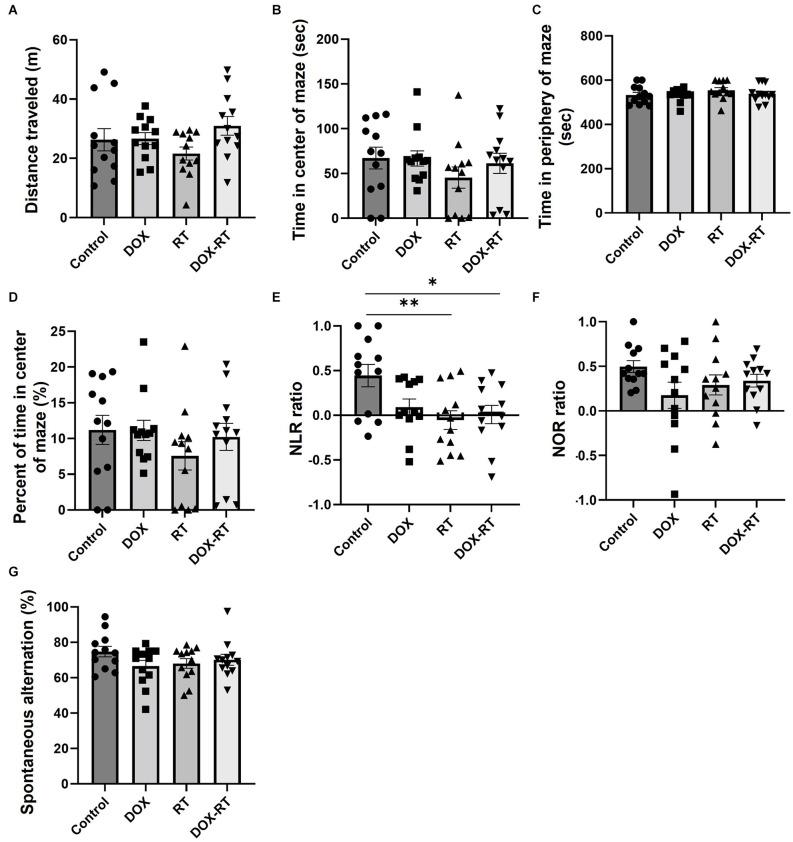
Cancer survivors are increasingly diagnosed with a syndrome of neurocognitive dysfunction termed cancer-related cognitive impairment (CRCI). Chemotherapy and radiation therapy have been implicated in CRCI; however, its underlying pathogenesis remains unclear, hindering effective prevention or treatment. We used the hairless strain SKH1 (11-12-week-old) and treated the mice with radiation to the right hindlimb, doxorubicin (a chemotherapy agent), concurrent radiation, and doxorubicin, or no treatment (control). Neurocognition was evaluated standardized behavioral testing following treatment. Mice were subsequently humanely euthanized, and plasma and brains were collected to identify inflammatory changes. Mice treated with radiation, doxorubicin, or both radiation and doxorubicin demonstrated equivalent hippocampal dependent memory deficits and significant increases in activated microglia and astrocytes compared to control mice. Doxorubicin-treated mice had significantly increased plasma IL-6 and failed to gain weight compared to control mice over the study period. This study demonstrates that non-brain directed radiation induces both gliosis and neurocognitive deficits. Moreover, this work presents the first characterization of SKH1 mice as a relevant and facile animal model of CRCI. This study provides a platform from which to build further studies to identify potential key targets that contribute to CRCI such that strategies can be developed to mitigate unintended neuropathologic consequences associated with anticancer treatment.
癌症幸存者越来越多地被诊断出患有一种称为癌症相关认知障碍(CRCI)的神经认知功能障碍综合征。化疗和放疗与CRCI有关;然而,其潜在的发病机制仍不清楚,这阻碍了有效的预防或治疗。我们使用无毛品系SKH1(11 - 12周龄)小鼠,对其右后肢进行辐射、给予阿霉素(一种化疗药物)、同时进行辐射和阿霉素治疗,或不进行治疗(对照)。治疗后通过标准化行为测试评估神经认知。随后对小鼠实施安乐死,并收集血浆和大脑以确定炎症变化。与对照小鼠相比,接受辐射、阿霉素或辐射与阿霉素联合治疗的小鼠表现出同等程度的海马依赖性记忆缺陷,并且活化的小胶质细胞和星形胶质细胞显著增加。在研究期间,与对照小鼠相比,接受阿霉素治疗的小鼠血浆白细胞介素 - 6显著增加且体重未增加。这项研究表明,非脑定向辐射会诱导胶质增生和神经认知缺陷。此外,这项工作首次将SKH1小鼠表征为CRCI相关且简便的动物模型。该研究提供了一个平台,可在此基础上开展进一步研究,以确定导致CRCI的潜在关键靶点,从而制定策略减轻与抗癌治疗相关的意外神经病理后果。




 Zotero 插件