Projeto Tintureira-Associação MarBrasil, Pontal do Paraná, Brazil.
Programa de Pós-graduação em Zoologia-Universidade Federal do Paraná, Curitiba, Paraná.
PeerJ. 2023 Jan 20;11:e14750. doi: 10.7717/peerj.14750. eCollection 2023.
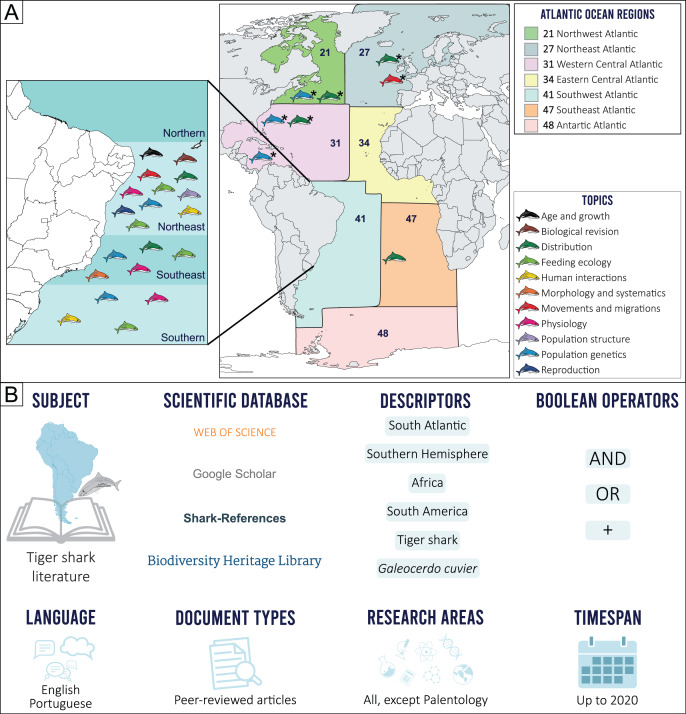
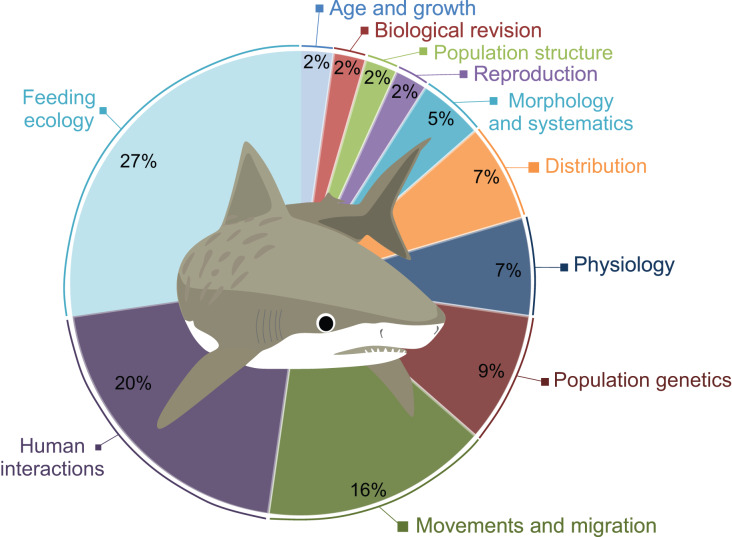
The tiger shark () has been relatively well assessed concerning biology and ecology aspects in both Atlantic and Pacific North America and in Caribbean waters. The amount of data in these regions has led to the species protection under capture quotas and with the creation of sanctuaries. The reality in developing countries, however, is the exact opposite, with scarce information on the species in the southern hemisphere, namely South American and African waters. In these regions, protection measures are insufficient, and studies on tiger shark biology and ecology are scarce, significantly hindering conservation and management efforts. Thus, the aim of this study was to compile scientific literature on the tiger shark in the South Atlantic and discuss the impact of these data (or lack thereof) distributed within a total of ten research categories for guiding management plans. In total, 41 scientific publications on different biology and ecology aspects were obtained. The most studied topics were Feeding Ecology ( = 12), followed by Human Interactions ( = 8), and Movements and Migration ( = 7). Northeastern Brazil (Southwest Atlantic) was the most researched area, probably due to the higher coastal abundance of tiger sharks in this area, alongside a high number of recorded attacks, justifying funding for studies in the region. No studies carried out in other South American or African countries were found. It is important to mention that even though some research topics are relatively well covered, a severe knowledge gap is noted for risk assessments and fisheries management, with a proposition for the implementation of sanctuaries noted. This is, however, particularly worrisome, as the South Atlantic is mostly unexplored in this regard for tiger sharks. It is also important to note how different the attention given to this species is in the North Atlantic when compared to the South region. Lastly, we highlight that the existence of sub-populations, the lack of migratory corridors geographically connecting distinct areas used by the species, and the lack of fisheries statistics on tiger shark landings, all increase the vulnerability of this species in the South Atlantic.
虎鲨()在北大西洋和太平洋以及加勒比海域的生物学和生态学方面已经得到了相对较好的评估。这些地区的数据量导致了该物种在捕捞配额和创建保护区下得到保护。然而,发展中国家的现实情况却恰恰相反,南半球,即南美和非洲水域的物种信息稀缺。在这些地区,保护措施不足,关于虎鲨生物学和生态学的研究也很少,这严重阻碍了保护和管理工作。因此,本研究旨在汇编南大西洋虎鲨的科学文献,并讨论这些数据(或缺乏数据)在总共十个研究类别中的分布情况,为指导管理计划提供依据。共获得了 41 篇关于不同生物学和生态学方面的科学出版物。研究最多的主题是摄食生态学(= 12),其次是人类互动(= 8)和运动和迁徙(= 7)。东北巴西(西南大西洋)是研究最多的地区,这可能是由于该地区虎鲨的沿海数量较多,同时记录了大量的袭击事件,为该地区的研究提供了资金。在其他南美或非洲国家没有发现进行的研究。值得一提的是,即使一些研究主题得到了相对较好的涵盖,但风险评估和渔业管理方面仍存在严重的知识差距,并提出了建立保护区的建议。然而,这尤其令人担忧,因为在这方面,南大西洋对虎鲨的探索还很不充分。还需要注意的是,与南大西洋相比,北大西洋对该物种的关注程度是不同的。最后,我们强调,存在亚种群、缺乏地理上连接该物种使用的不同区域的迁徙走廊以及缺乏关于虎鲨上岸的渔业统计数据,这增加了该物种在南大西洋的脆弱性。