Nethersole School of Nursing, The Chinese University of Hong Kong, Hong Kong, Hong Kong.
School of Nursing, Sun Yat-Sen University, Guangzhou, China.
PLoS One. 2023 Jan 26;18(1):e0280925. doi: 10.1371/journal.pone.0280925. eCollection 2023.
A progressive approach to quitting smoking has been a popular strategy for motivating smokers who are reluctant to quit. However, whether this strategy can effectively achieve complete cessation or is as successful as quitting immediately remains unresolved. This study aimed to determine whether quitting immediately or progressively was more effective in achieving complete cessation among smokers in Hong Kong who presented at emergency departments.
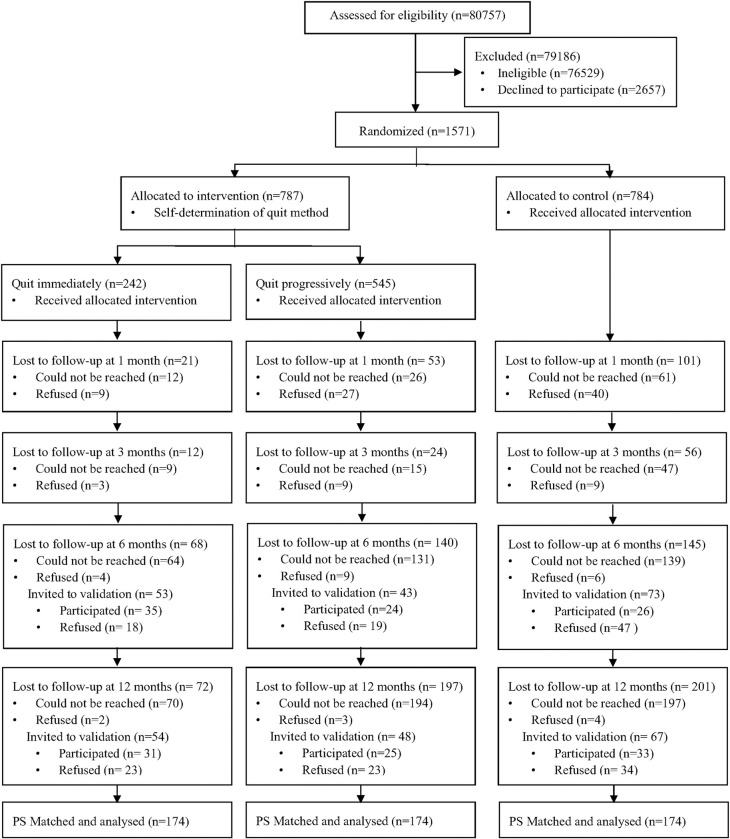
A posteriori analysis of a single-blinded, multicenter, randomized controlled trial was performed. The original trials was conducted at emergency departments of four major acute hospitals in different districts of Hong Kong. In total, 1571 smokers 18 years or older who presented at 4 major emergency departments between July 4, 2015 and March 17, 2017 were randomized into an intervention group (n = 787) and a control group (n = 784). The intervention group received brief advice (about 1 minute) and could choose their own quit schedules (immediate or progressive, labeled QI and QP, respectively). The control group received a smoking cessation leaflet. Follow-ups were conducted at 1, 3, 6 and 12 months. The primary outcomes, by intention-to-treat, were biochemically validated abstinence between the QI subgroup and control group; between the QP subgroup and control group, and between the QI subgroup and QP subgroup at 6 months. After the propensity sore matching, the biochemically validated abstinence was statistically significantly higher in the QI subgroup than the control group at 6 months (12.1% vs 3.4%, P = 0.003; adjusted odds ratio [aOR] 4.34, 95% CI 1.63-11.52) and higher in the QP subgroup than the control group at 6 months (9.8% vs 3.4%, P = 0.02; aORs 2.95, 95% CI: 1.04-8.39). No statistically significant differences of biochemically validated abstinence at both 6 month (12.1% vs 9.8%, P = 0.49; aORs 1.50, 95% CI: 0.71-3.19) were found in the comparison between QI and QP subgroups.
This study demonstrates that the strategy of quitting progressively is effective, especially for smokers who lack motivation or find it difficult to quit. If adopted routinely, such an approach can help achieve a greater level of smoking abstinence in the community.
ClinicalTrials.gov: NCT02660957.
渐进式戒烟策略是一种促使不愿意戒烟的吸烟者戒烟的流行策略。然而,这种策略是否能有效地实现完全戒烟,或者是否与立即戒烟一样成功,仍然存在争议。本研究旨在确定在香港急诊科就诊的吸烟者中,立即戒烟还是渐进式戒烟更能有效地实现完全戒烟。
对一项单盲、多中心、随机对照试验进行了事后分析。原始试验在香港四个不同地区的四家主要急症医院的急症室进行。共有 1571 名 18 岁或以上在 2015 年 7 月 4 日至 2017 年 3 月 17 日期间在 4 家主要急症科就诊的吸烟者被随机分为干预组(n = 787)和对照组(n = 784)。干预组接受简短的建议(约 1 分钟),并可选择自己的戒烟时间表(立即或渐进,分别标记为 QI 和 QP)。对照组接受戒烟传单。随访在 1、3、6 和 12 个月进行。主要结局,意向治疗,是 QI 亚组和对照组之间、QP 亚组和对照组之间以及 QI 亚组和 QP 亚组之间 6 个月时的生物化学验证的戒烟率。在倾向评分匹配后,QI 亚组在 6 个月时的生物化学验证的戒烟率明显高于对照组(12.1%对 3.4%,P = 0.003;调整后的优势比[aOR]4.34,95%CI 1.63-11.52),QP 亚组在 6 个月时也明显高于对照组(9.8%对 3.4%,P = 0.02;aORs 2.95,95%CI:1.04-8.39)。在 QI 和 QP 亚组之间,6 个月时的生物化学验证的戒烟率没有统计学上的显著差异(12.1%对 9.8%,P = 0.49;aORs 1.50,95%CI:0.71-3.19)。
本研究表明,渐进式戒烟策略是有效的,特别是对于那些缺乏动力或觉得难以戒烟的吸烟者。如果常规采用这种方法,可以帮助社区实现更高水平的戒烟率。
ClinicalTrials.gov:NCT02660957。