Tan Xiaoyi, Chen Hai, Gu Chunkai, Zang Jiachen, Zhang Tuo, Wang Hongfei, Zhao Guanghua
College of Food Science and Nutritional Engineering, China Agricultural University, Key Laboratory of Functional Dairy, Ministry of Education, 100083, Beijing, China.
Key Laboratory of Chemical Biology and Molecular Engineering of Education Ministry, Institute of Molecular Science, Shanxi University, 030006, Taiyuan, China.
Commun Chem. 2020 Nov 2;3(1):151. doi: 10.1038/s42004-020-00394-x.
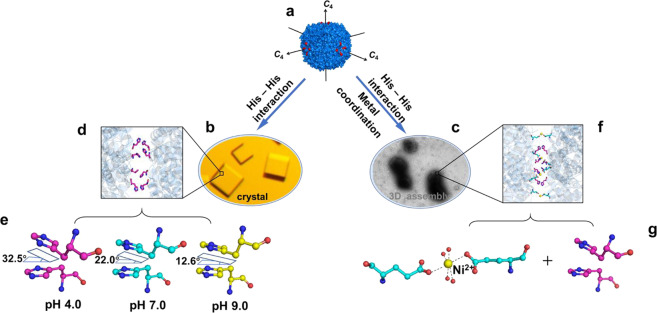
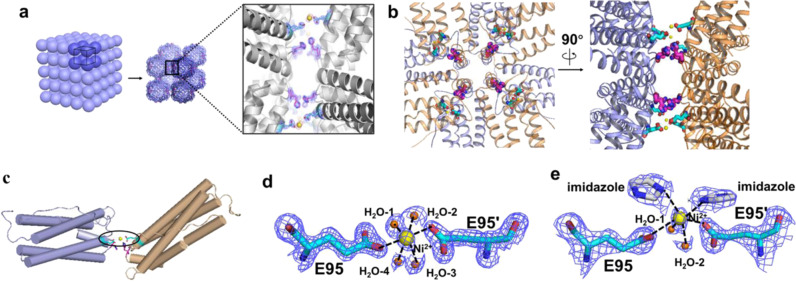
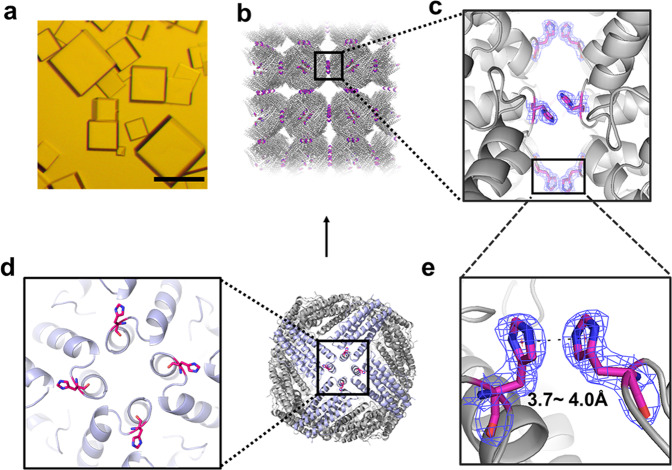
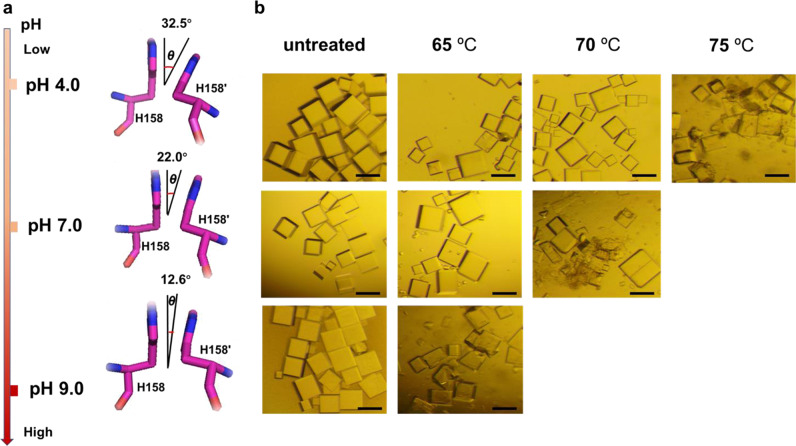
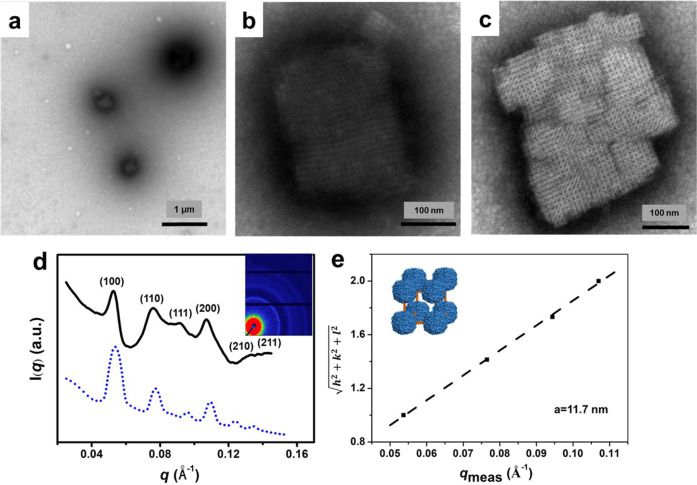
Histidine (His) residues represent versatile motifs for designing protein-protein interactions because the protonation state of the imidazole group of His is the only moiety in protein to be significantly pH dependent under physiological conditions. Here we show that, by the designed His motifs nearby the C axes, ferritin nanocages arrange in crystals with a simple cubic stacking pattern. The X-ray crystal structures obtained at pH 4.0, 7.0, and 9.0 in conjunction with thermostability analyses reveal the strength of the π-π interactions between two adjacent protein nanocages can be fine-tuned by pH. By using the crystal structural information as a guide, we constructed 3D protein frameworks in solution by a combination of the relatively weak His-His interaction and Ni-participated metal coordination with Glu residues from two adjacent protein nanocages. These findings open up a new way of organizing protein building blocks into 3D protein crystalline frameworks.
组氨酸(His)残基是设计蛋白质-蛋白质相互作用的通用基序,因为在生理条件下,His咪唑基团的质子化状态是蛋白质中唯一显著依赖pH的部分。在此我们表明,通过在C轴附近设计His基序,铁蛋白纳米笼以简单立方堆积模式排列成晶体。在pH 4.0、7.0和9.0下获得的X射线晶体结构以及热稳定性分析表明,两个相邻蛋白质纳米笼之间的π-π相互作用强度可通过pH进行微调。以晶体结构信息为指导,我们通过相对较弱的His-His相互作用以及镍参与的与两个相邻蛋白质纳米笼中Glu残基的金属配位作用,在溶液中构建了三维蛋白质框架。这些发现为将蛋白质构建块组织成三维蛋白质晶体框架开辟了一条新途径。