
诱导多能干细胞作为携带miR-199b-5p的外泌体治疗脊髓损伤的天然生物工厂。
Induced pluripotent stem cells as natural biofactories for exosomes carrying miR-199b-5p in the treatment of spinal cord injury.
作者信息
Li Jun, Jing Yingli, Bai Fan, Wu Ying, Wang Limiao, Yan Yitong, Jia Yunxiao, Yu Yan, Jia Benzhi, Ali Fawad
机构信息
Department of Spinal and Neural Functional Reconstruction, China Rehabilitation Research Center, Beijing, China.
School of Rehabilitation Medicine, Capital Medical University, Beijing, China.
出版信息
Front Pharmacol. 2023 Jan 10;13:1078761. doi: 10.3389/fphar.2022.1078761. eCollection 2022.
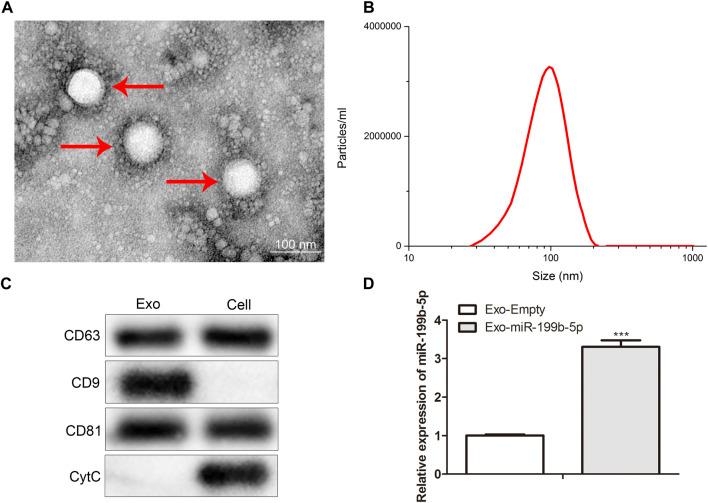
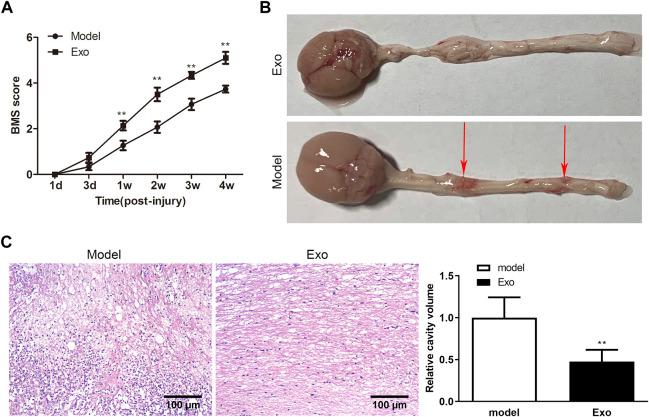
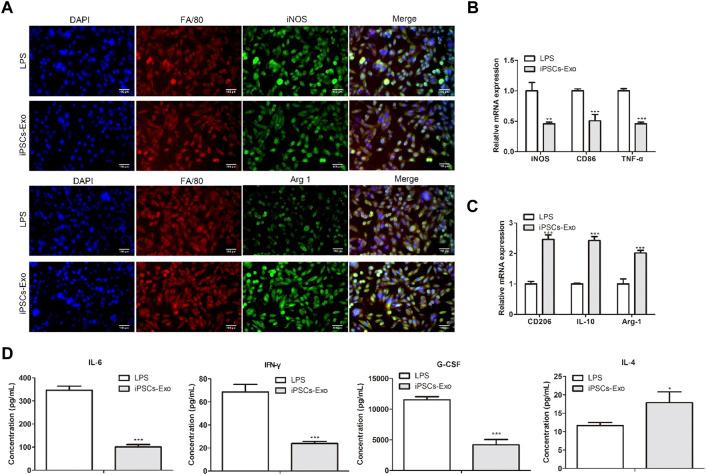
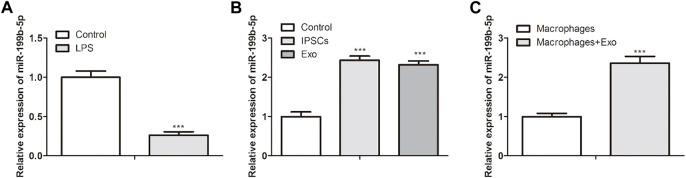
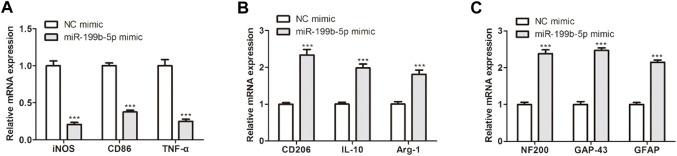
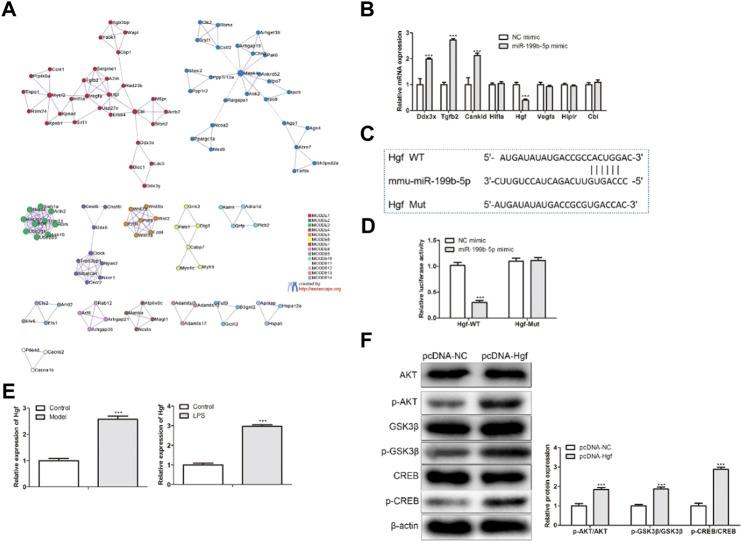
Induced pluripotent stem cells-derived exosomes (iPSCs-Exo) can effectively treat spinal cord injury (SCI) in mice. But the role of iPSCs-Exo in SCI mice and its molecular mechanisms remain unclear. This research intended to study the effects and molecular mechanism of iPSCs-Exo in SCI mice models. The feature of iPSCs-Exo was determined by transmission electron microscope (TEM), nanoparticle tracking analysis (NTA), and western blot. The effects of iPSCs-Exo in the SCI mice model were evaluated by Basso Mouse Scale (BMS) scores and H&E staining. The roles of iPSCs-Exo and miR-199b-5p in LPS-treated BMDM were verified by immunofluorescence, RT-qPCR, and Cytokine assays. The target genes of miR-199b-5p were identified, and the function of miR-199b-5p and its target genes on LPS-treated BMDM was explored by recuse experiment. iPSCs-Exo improved motor function in SCI mice model , shifted the polarization from M1 macrophage to M2 phenotype, and regulated related inflammatory factors expression to accelerate the SCI recovery in LPS-treated BMDM . Meanwhile, miR-199b-5p was a functional player of iPSCs-Exo, which could target hepatocyte growth factor (Hgf). Moreover, miR-199b-5p overexpression polarized M1 macrophage into M2 phenotype and promoted neural regeneration in SCI. The rescue experiments confirmed that miR-199b-5p induced macrophage polarization and SCI recovery by regulating Hgf and Phosphoinositide 3-kinase (PI3K) signaling pathways. The miR-199b-5p-bearing iPSCs-Exo might become an effective method to treat SCI.
诱导多能干细胞衍生的外泌体(iPSCs-Exo)可有效治疗小鼠脊髓损伤(SCI)。但iPSCs-Exo在SCI小鼠中的作用及其分子机制仍不清楚。本研究旨在探讨iPSCs-Exo在SCI小鼠模型中的作用及分子机制。通过透射电子显微镜(TEM)、纳米颗粒跟踪分析(NTA)和蛋白质免疫印迹法确定iPSCs-Exo的特征。通过Basso小鼠评分(BMS)和苏木精-伊红(H&E)染色评估iPSCs-Exo在SCI小鼠模型中的作用。通过免疫荧光、逆转录-定量聚合酶链反应(RT-qPCR)和细胞因子检测验证iPSCs-Exo和miR-199b-5p在脂多糖(LPS)处理的骨髓来源巨噬细胞(BMDM)中的作用。鉴定miR-199b-5p的靶基因,并通过拯救实验探索miR-199b-5p及其靶基因对LPS处理的BMDM的功能。iPSCs-Exo改善了SCI小鼠模型的运动功能,使巨噬细胞从M1表型向M2表型转变,并调节相关炎症因子表达,以加速LPS处理的BMDM中的SCI恢复。同时,miR-199b-5p是iPSCs-Exo的功能发挥者,其可靶向肝细胞生长因子(Hgf)。此外,miR-199b-5p过表达使M1巨噬细胞极化为M2表型,并促进SCI中的神经再生。拯救实验证实miR-199b-5p通过调节Hgf和磷脂酰肌醇3-激酶(PI3K)信号通路诱导巨噬细胞极化和SCI恢复。携带miR-199b-5p的iPSCs-Exo可能成为治疗SCI的有效方法。

 Zotero 插件