Elias Sean C, Muthumbi Esther, Mwanzu Alfred, Wanjiku Perpetual, Mutiso Agnes, Simon Raphael, MacLennan Calman A
Jenner Institute, Nuffield Department of Medicine, University of Oxford, UK.
KEMRI-Wellcome Trust Research Programme, Kilifi, Kenya.
Heliyon. 2022 Dec 15;9(1):e12071. doi: 10.1016/j.heliyon.2022.e12071. eCollection 2023 Jan.
Immuno-epidemiological studies of orally acquired, enteric pathogens such as nontyphoidal (NTS) often focus on serological measures of immunity, ignoring potentially relevant oral mucosal responses. In this study we sought to assess the levels and detectability of both oral fluid and serum IgG and IgA to NTS antigens, in endemic and non-endemic populations.
IgG and IgA antibodies specific for Typhimurium and Enteritidis O antigen and phase 1 flagellin were assessed using Enzyme Linked Immunosorbent Assay (ELISA). Paired oral fluid and serum samples were collected from groups of 50 UK adults, Kenyan adults and Kenyan infants. Additionally, oral fluid alone was collected from 304 Kenyan individuals across a range of ages.
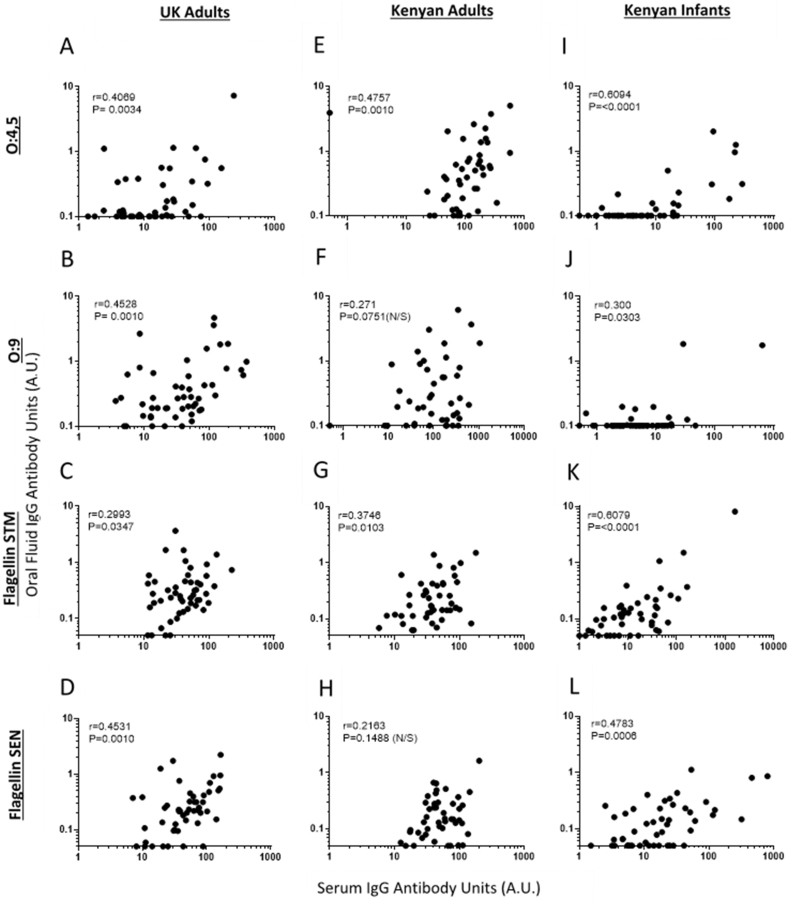
Antigen-specific IgG and IgA was detectable in the oral fluid of both adults and infants. Oral fluid antibody increased with age, peaking in adulthood for both IgG and IgA but a separate peak was also observed for IgA in infants. Oral fluid and serum responses correlated for IgG but not IgA. Despite standardised collection the relationship between oral fluid volume and antibody levels varied with age and country of origin.
Measurement of NTS-specific oral fluid antibody can be used to complement measurement of serum antibody. For IgA in particular, oral fluid may offer insights into how protective immunity to NTS changes as individuals transition with age, from maternal to acquired systemic and mucosal immunity. This may prove useful in helping to guide future vaccine design.
对口服感染的肠道病原体(如非伤寒沙门氏菌,NTS)进行免疫流行病学研究时,通常侧重于免疫的血清学指标,而忽略了潜在相关的口腔黏膜反应。在本研究中,我们试图评估地方性和非地方性人群中口腔液和血清中针对NTS抗原的IgG和IgA水平及可检测性。
使用酶联免疫吸附测定(ELISA)评估针对鼠伤寒沙门氏菌和肠炎沙门氏菌O抗原及1相鞭毛蛋白的特异性IgG和IgA抗体。从50名英国成年人、肯尼亚成年人和肯尼亚婴儿组中采集配对的口腔液和血清样本。此外,还从304名不同年龄段的肯尼亚个体中单独采集了口腔液。
在成人和婴儿的口腔液中均可检测到抗原特异性IgG和IgA。口腔液抗体随年龄增加,IgG和IgA在成年期达到峰值,但婴儿的IgA也观察到一个单独的峰值。口腔液和血清中IgG的反应相关,但IgA不相关。尽管采集方法标准化,但口腔液体积与抗体水平之间的关系因年龄和原籍国而异。
测量NTS特异性口腔液抗体可用于补充血清抗体的测量。特别是对于IgA,口腔液可能有助于深入了解个体随着年龄从母体免疫过渡到获得性全身和黏膜免疫时,对NTS的保护性免疫是如何变化的。这可能对指导未来疫苗设计有用。