Zancheta Ricardo Camila, Duran Ana Clara, Grilo Mariana Fagundes, Rebolledo Natalia, Díaz-Torrente Ximena, Reyes Marcela, Corvalán Camila
Doctoral Program in Public Health, School of Public Health, University of Chile, Santiago, Chile.
Center for Food Studies and Research, University of Campinas, Campinas, Brazil.
Front Nutr. 2023 Jan 10;9:1046463. doi: 10.3389/fnut.2022.1046463. eCollection 2022.
Increasing consumption of ultra-processed foods (UPF), defined by the NOVA classification, has been associated with obesity and other health outcomes. However, some authors have criticized the UPF definition because it is somewhat subjective. Most studies identify UPF using food descriptions; nevertheless, NOVA developers described a list of ingredients, including substances not commonly used for cooking and "cosmetic additives" that could be used to identify UPF. Assessing the impact of the use of different UPF definitions is particularly relevant with respect to children's diet, because several dietary policies target this age group. Thus, our study compared the frequency of UPF among foods and beverages and their share in the diet of Chilean preschoolers using three different methods of identifying UPF.
We used cross-sectional 24-h dietary recall data from 962 preschoolers enrolled in the Food and Environment Chilean Cohort (FECHIC) in 2016. All foods and beverages consumed were classified according to NOVA, considering their description (classic method), the presence of ingredients markers of UPF (ingredient marker method), and the presence of markers plus all cosmetic additives (food additive method). We also estimated the caloric share and quintiles of UPF consumption using the three methods. We used kappa coefficients, consistency-of-agreement intra-class correlation (CA-ICC), absolute agreement intra-class correlation (AA-ICC), and weighted kappa coefficients for assessing agreement between methods.
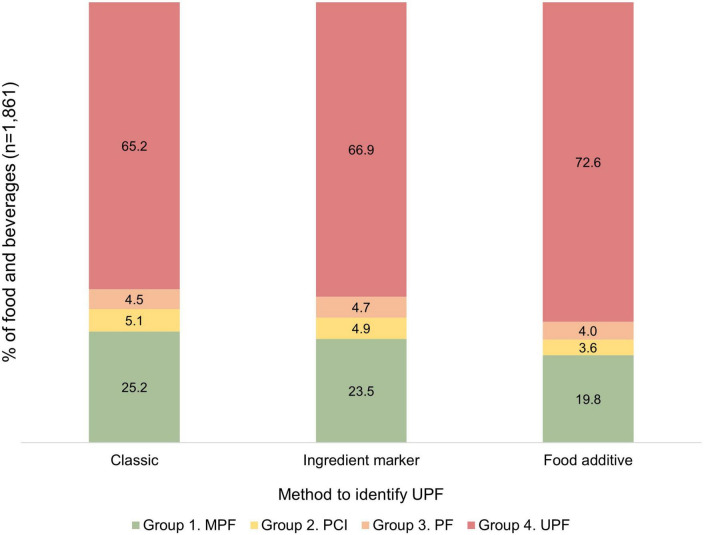
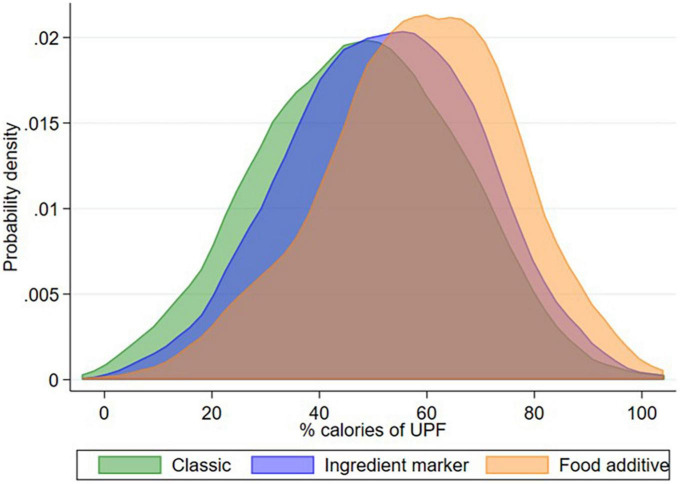
The proportion of UPF products were 65% in the "classic," 67% in the "ingredient marker," and 73% in the "food additive" method, and kappa coefficients between methods varied from 0.79 to 0. 91. The caloric share of UPF was 47, 52, and 58% with "classic," "ingredient marker," and "food additive" methods, respectively. Consistency-of-agreement was higher than the absolute agreement between the methods (CA-ICC = 0.81; AA-ICC = 0.74). For quintiles of UPF consumption, we found weighted kappa of 0.65 as measure of agreement between "classic" and "ingredient marker," and 0.51 between "classic" and "food additive" methods.
Searching for all possible markers of UPF in the list of ingredients increased the proportion of food products identified as UPF compared to the classic method. These differences affected the estimated caloric share of UPF in Chilean preschoolers' diets.
根据新诺瓦(NOVA)分类法定义,超加工食品(UPF)的消费不断增加,这与肥胖及其他健康结果相关。然而,一些作者批评了UPF的定义,因为它有点主观。大多数研究通过食品描述来识别UPF;尽管如此,新诺瓦分类法的开发者列出了一份成分清单,包括不常用于烹饪的物质和可用于识别UPF的“化妆品添加剂”。评估使用不同UPF定义的影响对于儿童饮食尤为重要,因为多项饮食政策针对的就是这个年龄组。因此,我们的研究使用三种不同的识别UPF的方法,比较了智利学龄前儿童食品和饮料中UPF的出现频率及其在饮食中的占比。
我们使用了2016年参与智利食品与环境队列研究(FECHIC)的962名学龄前儿童的24小时横断面饮食回忆数据。根据新诺瓦分类法,考虑食品和饮料的描述(经典方法)、UPF成分标记的存在情况(成分标记法)以及标记加上所有化妆品添加剂的存在情况(食品添加剂法),对所有消费的食品和饮料进行分类。我们还使用这三种方法估计了UPF消费的热量占比和五分位数。我们使用卡帕系数、一致性协议组内相关系数(CA - ICC)、绝对一致性组内相关系数(AA - ICC)和加权卡帕系数来评估方法之间的一致性。
在“经典”方法中,UPF产品的比例为65%,“成分标记”方法中为67%,“食品添加剂”方法中为73%,方法之间的卡帕系数在0.79至0.91之间。“经典”、“成分标记”和“食品添加剂”方法中UPF的热量占比分别为47%、52%和58%。一致性协议高于方法之间的绝对一致性(CA - ICC = 0.81;AA - ICC = 0.74)。对于UPF消费的五分位数,我们发现“经典”和“成分标记”方法之间的加权卡帕值为0.65,“经典”和“食品添加剂”方法之间为0.51。
与经典方法相比,在成分清单中寻找UPF的所有可能标记会增加被识别为UPF的食品产品比例。这些差异影响了智利学龄前儿童饮食中UPF估计的热量占比。