Division of Rheumatology, Department of Internal Medicine III, Medical University of Vienna, Austria.
Department of Pathology, Medical University of Vienna, Vienna, Austria.
J Autoimmun. 2023 Feb;135:102981. doi: 10.1016/j.jaut.2022.102981. Epub 2022 Dec 22.
A 3 COVID-19 vaccination is currently recommended for patients under immunosuppression. However, a fast decline of antibodies against the SARS-CoV-2 receptor-binding domain (RBD) of the spike protein has been observed. Currently it remains unclear whether immunosuppressive therapy affects kinetics of humoral and cellular immune responses.
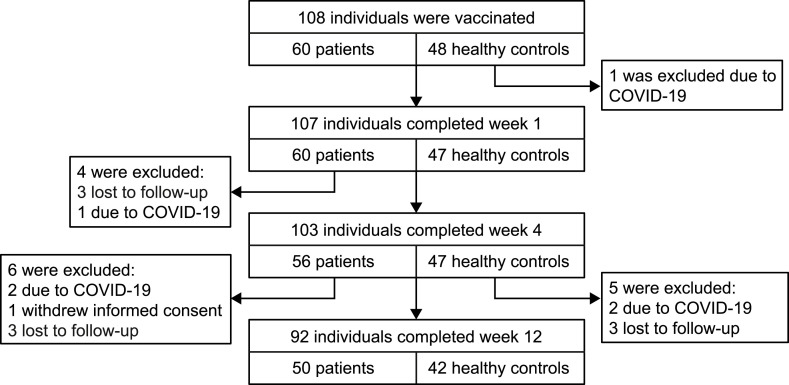
50 patients under immunosuppression and 42 healthy controls (HCs) received a 3 dose of an mRNA-based vaccine and were monitored over a 12-weeks period. Humoral immune response was assessed 4 and 12 weeks after 3 dose. Antibodies were quantified using the Elecsys Anti-SARS-CoV-2 Spike immunoassay against the receptor-binding domain (RBD) of the spike protein. SARS-CoV-2-specific T cell responses were quantified by IFN-γ ELISpot assays. Adverse events, including SARS-CoV-2 infections, were monitored over a 12-week period.
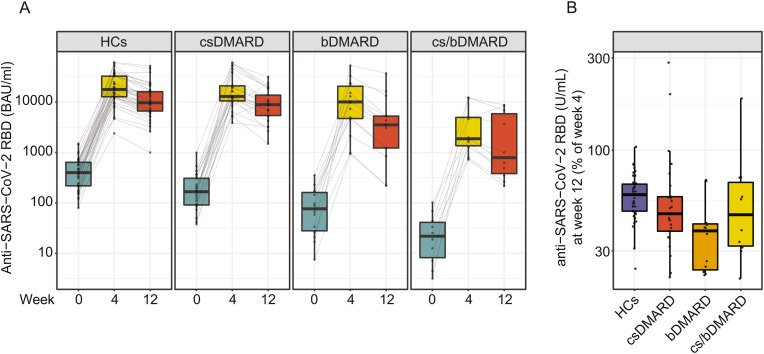
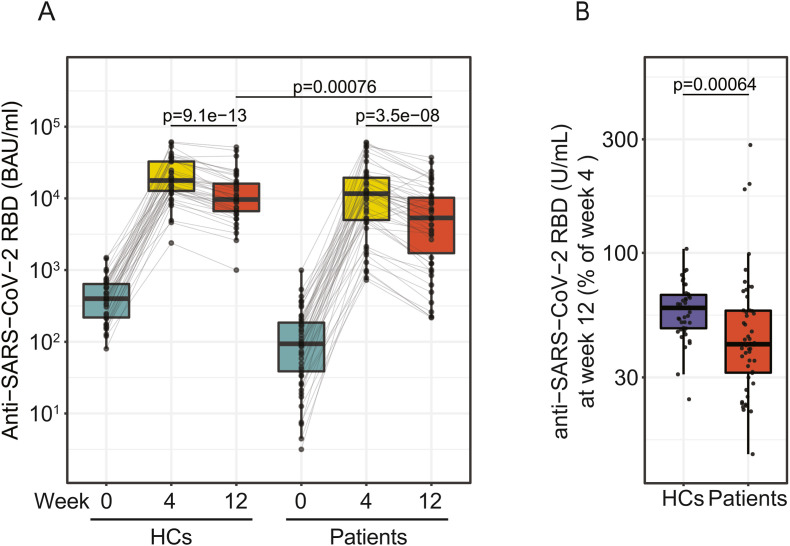
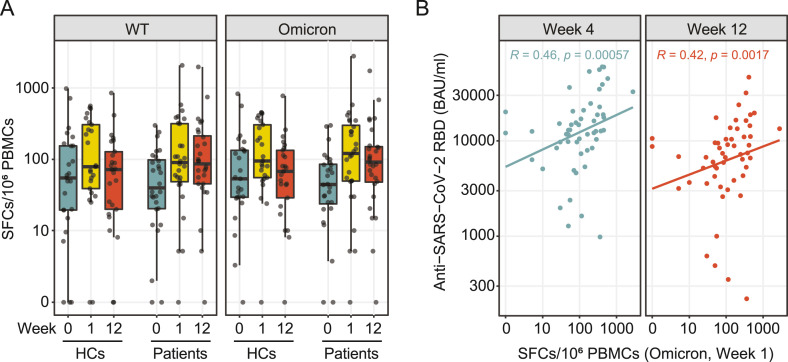
At week 12, reduced anti-RBD antibody levels were observed in IMID patients as compared to HCs (median antibody level 5345 BAU/ml [1781-10,208] versus 9650 BAU/ml [6633-16,050], p < 0.001). Reduction in relative antibody levels was significantly higher in IMID patients as compared to HCs at week 12 (p < 0.001). Lowest anti-RBD antibody levels were detected in IMID patients who received biological disease-modifying anti-rheumatic drugs (DMARDs) or a combination therapy with conventional synthetic and biological DMARDs. Number of SARS-CoV-2-specific T cells against wildtype and Omicron variants remained stable over 12 weeks in IMID patients. No serious adverse events were reported.
Due to a fast decline in anti-RBD antibodies in IMID patients an early 4 vaccination should be considered in this vulnerable group of patients.
目前建议免疫抑制患者接种 3 剂 COVID-19 疫苗。然而,已经观察到针对刺突蛋白受体结合域(RBD)的抗体快速下降。目前尚不清楚免疫抑制治疗是否会影响体液和细胞免疫反应的动力学。
50 名免疫抑制患者和 42 名健康对照(HC)接受了 3 剂基于 mRNA 的疫苗,并在 12 周的时间内进行了监测。在接种 3 剂后 4 周和 12 周评估体液免疫反应。使用针对刺突蛋白 RBD 的 Elecsys Anti-SARS-CoV-2 Spike 免疫测定法定量抗体。通过 IFN-γ ELISpot 测定法定量 SARS-CoV-2 特异性 T 细胞反应。在 12 周的时间内监测不良事件,包括 SARS-CoV-2 感染。
在第 12 周时,与 HCs 相比,IMID 患者的抗 RBD 抗体水平降低(中位数抗体水平 5345 BAU/ml [1781-10208] 与 9650 BAU/ml [6633-16050],p<0.001)。与 HCs 相比,IMID 患者在第 12 周时抗体水平下降幅度明显更高(p<0.001)。接受生物疾病修饰抗风湿药物(DMARDs)或常规合成和生物 DMARDs 联合治疗的 IMID 患者检测到的抗 RBD 抗体水平最低。在 12 周内,IMID 患者针对野生型和奥密克戎变异株的 SARS-CoV-2 特异性 T 细胞数量保持稳定。未报告严重不良事件。
由于 IMID 患者的抗 RBD 抗体快速下降,因此应考虑在这一脆弱人群中早期接种第 4 剂疫苗。