Wiedenmann Tim, Held Steffen, Rappelt Ludwig, Grauduszus Martin, Spickermann Sofie, Donath Lars
Department of Intervention Research in Exercise Training, Institute of Exercise Training and Sport Informatics, Am Sportpark Müngersdorf 6, 50933 Cologne, German Sport University Cologne, Cologne, Germany.
Eur Rev Aging Phys Act. 2023 Jan 28;20(1):1. doi: 10.1186/s11556-023-00311-w.
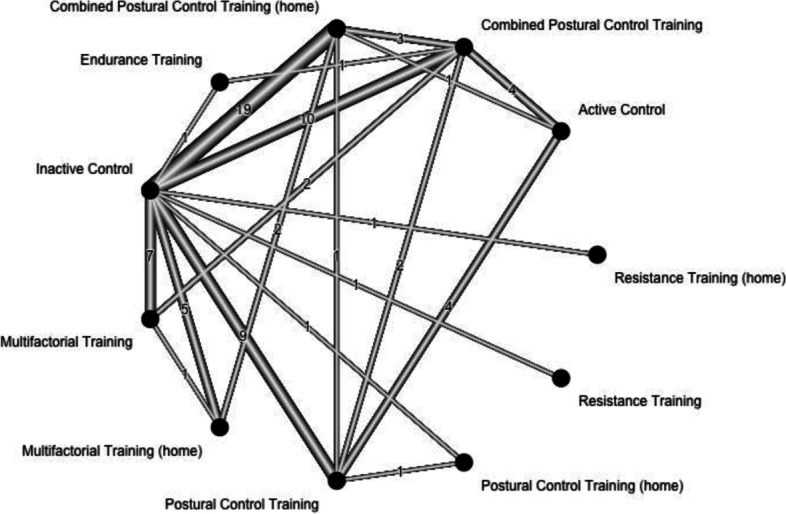
Traditional meta-analyses with pairwise direct comparison revealed that a variety of exercise-based training interventions can prevent falls in community-dwelling older adults. This network meta-analysis adds value by comparing and ranking different exercise training strategies based on their effects on fall risk reductions determined by analysis of direct and indirect comparisons.
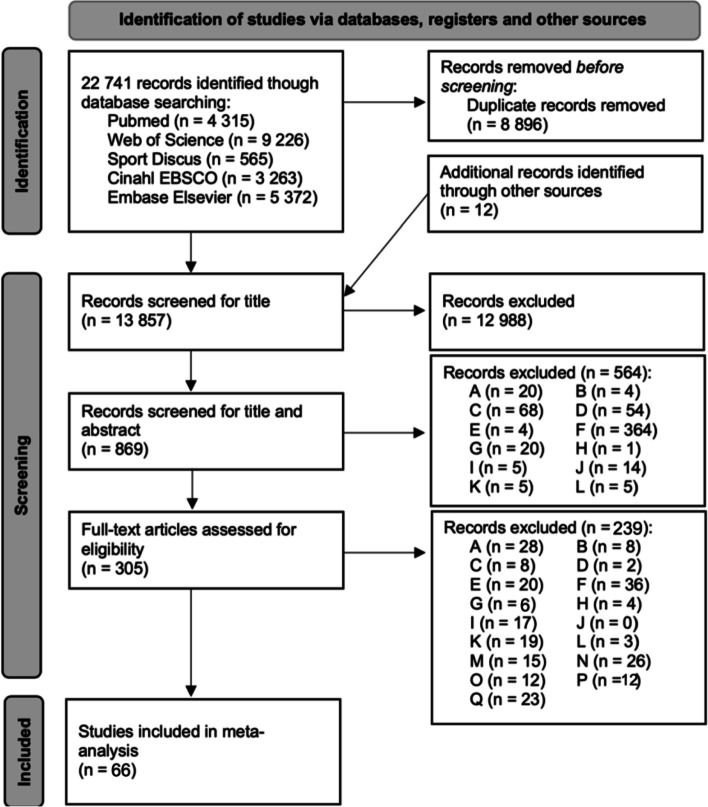
The studies included in this network meta-analysis were identified through a comprehensive search in five biomedical databases (PubMed, SportDiscus, CINAHL, Web of Science and EMBASE). We included (randomized) controlled trials (RCTs) that compared the occurance of fall events in older adults who received different interventional treatments.
Seventy six comparisons from 66 RCTs with 47.420 (61% male / 39% female) participants aged 77 ± 4 (68 - 88) years were included in this network meta-analysis. The network model revealed low heterogeneity (I = 28.0, 95%CI 1.0 to 47.7%) and inconsistency (Q between designs = 15.1, p = 0.37). Postural control training was found to be most effective in preventing falls (Postural Control Training: (home): Risk Ratio (RR) = 0.66, 95%-CI [0.49; 0.88], P-score = 0.97;Postural Control Training: RR = 0.82, 95%-CI [0.75; 0.91], P-score = 0.82). Combined and multifactorial interventions also display a robust but smaller effect (RR = 0.88-0.93, P-score = 0.65-0.47).
Physical activity that includes balance training presents itself to be the most effective. Multifactorial approaches are well investigated but could be slightly less effective than isolated postural control training.
传统的成对直接比较荟萃分析表明,多种基于运动的训练干预措施可预防社区居住的老年人跌倒。本网络荟萃分析通过基于直接和间接比较分析确定的不同运动训练策略对降低跌倒风险的影响进行比较和排序,增加了价值。
本网络荟萃分析纳入的研究通过在五个生物医学数据库(PubMed、SportDiscus、CINAHL、Web of Science和EMBASE)中进行全面检索来确定。我们纳入了(随机)对照试验(RCT),这些试验比较了接受不同干预治疗的老年人跌倒事件的发生率。
本网络荟萃分析纳入了来自66项RCT的76项比较,共47420名参与者(61%为男性/39%为女性),年龄为77±4岁(68 - 88岁)。网络模型显示异质性较低(I = 28.0,95%CI 1.0至47.7%)且不一致性较低(设计间Q = 15.1,p = 0.37)。发现姿势控制训练在预防跌倒方面最有效(姿势控制训练:(在家中)风险比(RR)= 0.66,95%可信区间[0.49;0.88],P分数 = 0.97;姿势控制训练:RR = 0.82,95%可信区间[0.75;0.91],P分数 = 0.82)。综合和多因素干预也显示出较强但较小的效果(RR = 0.88 - 0.93,P分数 = 0.65 - 0.47)。
包括平衡训练的体育活动似乎是最有效的。多因素方法已得到充分研究,但可能比单独的姿势控制训练效果稍差。