Program in MPE Molecular Pathological Epidemiology, Department of Pathology, Brigham and Women's Hospital and Harvard Medical School, Boston, Massachusetts, USA.
Department of Epidemiology, Harvard T.H. Chan School of Public Health, Boston, Massachusetts, USA.
Am J Gastroenterol. 2023 Apr 1;118(4):712-726. doi: 10.14309/ajg.0000000000002171. Epub 2022 Dec 30.
Early-onset colorectal cancer diagnosed before the age of 50 years has been increasing. Likely reflecting the pathogenic role of the intestinal microbiome, which gradually changes across the entire colorectal length, the prevalence of certain tumor molecular characteristics gradually changes along colorectal subsites. Understanding how colorectal tumor molecular features differ by age and tumor location is important in personalized patient management.
Using 14,004 cases with colorectal cancer including 3,089 early-onset cases, we examined microsatellite instability (MSI), CpG island methylator phenotype (CIMP), and KRAS and BRAF mutations in carcinomas of the cecum, ascending colon, transverse colon, descending colon, sigmoid colon, and rectum and compared early-onset cases with later-onset cases.
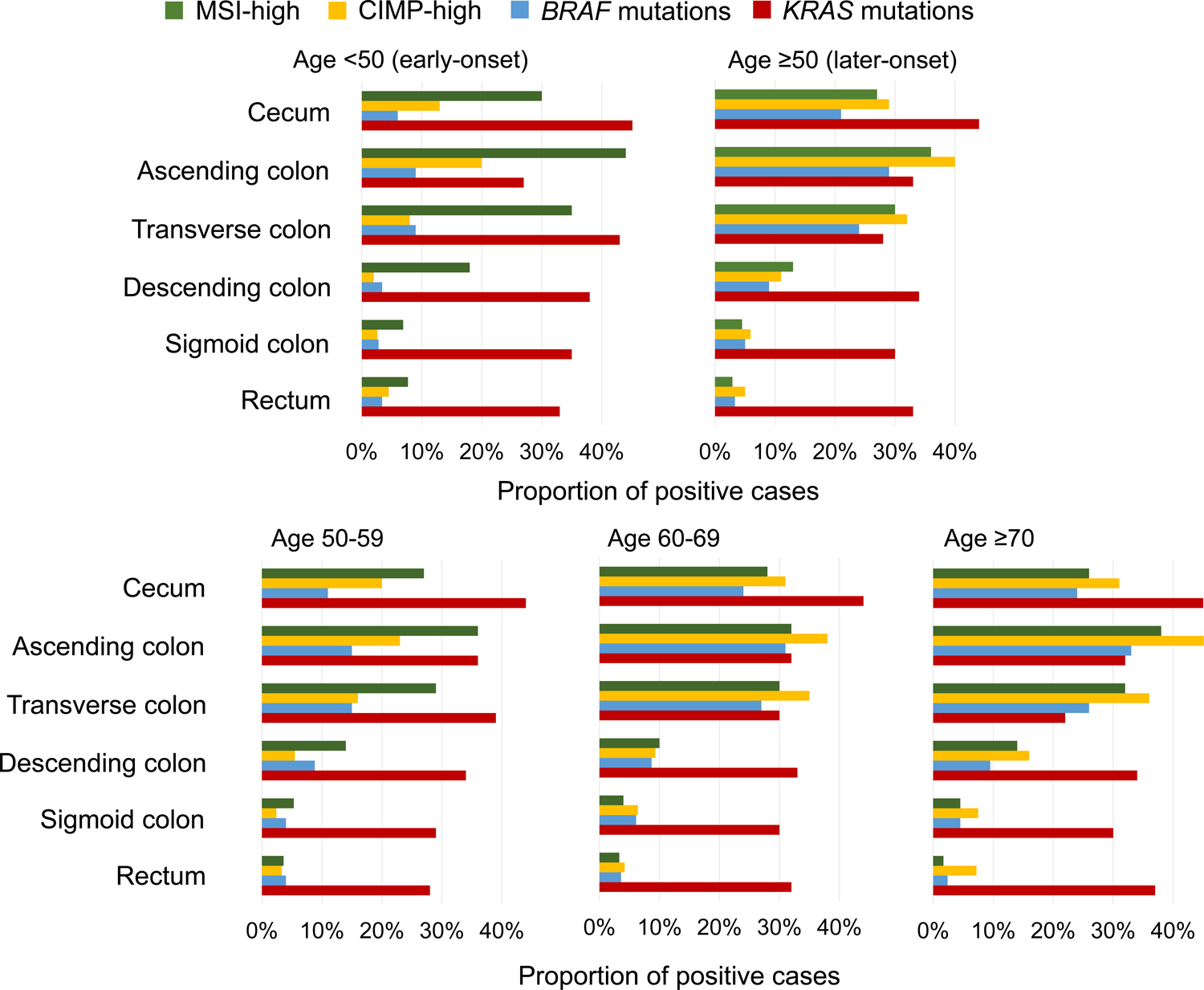
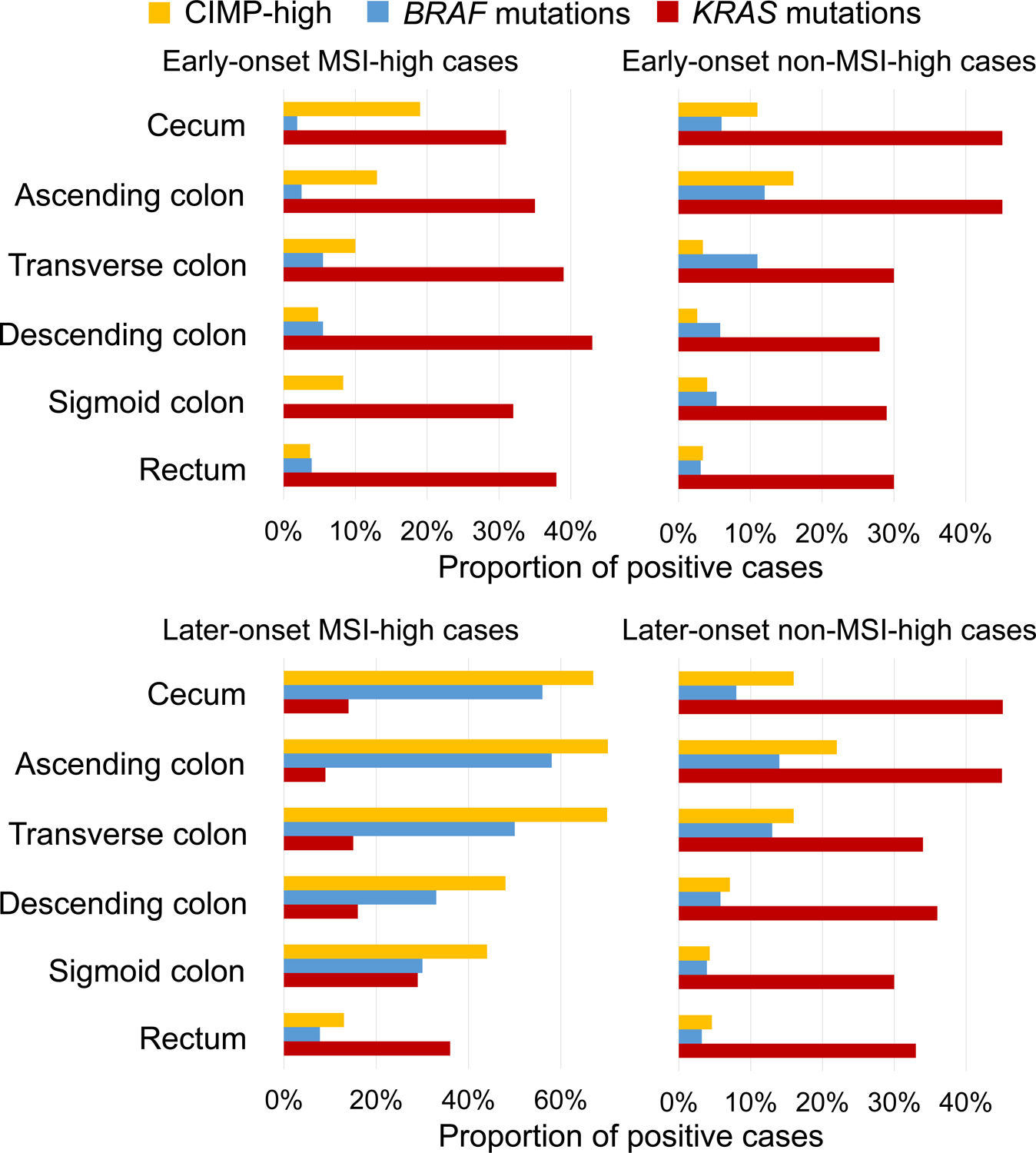
The proportions of MSI-high, CIMP-high, and BRAF -mutated early-onset tumors were lowest in the rectum (8.8%, 3.4%, and 3.5%, respectively) and highest in the ascending colon (46% MSI-high; 15% CIMP-high) or transverse colon (8.6% BRAF -mutated) (all Ptrend <0.001 across the rectum to ascending colon). Compared with later-onset tumors, early-onset tumors showed a higher prevalence of MSI-high status and a lower prevalence of CIMP-high status and BRAF mutations in most subsites. KRAS mutation prevalence was higher in the cecum compared with that in the other subsites in both early-onset and later-onset tumors ( P < 0.001). Notably, later-onset MSI-high tumors showed a continuous decrease in KRAS mutation prevalence from the rectum (36%) to ascending colon (9%; Ptrend <0.001), followed by an increase in the cecum (14%), while early-onset MSI-high cancers showed no such trend.
Our findings support biogeographical and pathogenic heterogeneity of colorectal carcinomas in different colorectal subsites and age groups.
50 岁以下诊断的早发性结直肠癌的发病率一直在增加。可能反映了肠道微生物组的致病作用,该作用逐渐改变整个结直肠的长度,某些肿瘤分子特征的流行程度也逐渐沿着结直肠亚部位发生变化。了解结直肠肿瘤分子特征在年龄和肿瘤位置上的差异对于患者的个体化管理很重要。
我们使用包括 3089 例早发性病例在内的 14004 例结直肠癌病例,检查了盲肠、升结肠、横结肠、降结肠、乙状结肠和直肠腺癌中的微卫星不稳定性(MSI)、CpG 岛甲基化表型(CIMP)和 KRAS 和 BRAF 突变,并比较了早发性病例和晚发性病例。
MSI-高、CIMP-高和 BRAF 突变的早发性肿瘤在直肠中的比例最低(分别为 8.8%、3.4%和 3.5%),在升结肠或横结肠中最高(MSI-高分别为 46%和 8.6% BRAF 突变)(所有趋势 P 值<0.001,从直肠到升结肠)。与晚发性肿瘤相比,早发性肿瘤在大多数亚部位中,MSI-高状态的发生率更高,CIMP-高状态和 BRAF 突变的发生率更低。在早发性和晚发性肿瘤中,盲肠的 KRAS 突变发生率均高于其他亚部位( P <0.001)。值得注意的是,晚发性 MSI-高肿瘤的 KRAS 突变率从直肠(36%)到升结肠(9%;趋势 P 值<0.001)逐渐降低,随后在盲肠中增加(14%),而早发性 MSI-高癌症则没有这种趋势。
我们的研究结果支持不同结直肠亚部位和年龄组结直肠癌的生物地理和发病机制异质性。