Armstrong David A, Hudson Taylor R, Hodge Christine A, Hampton Thomas H, Howell Alexandra L, Hayden Matthew S
Research Service, V.A. Medical Center, White River Junction, VT, USA, 05001.
Department of Dermatology, Dartmouth Health, Lebanon, NH, USA, 03756.
bioRxiv. 2023 Jan 2:2023.01.02.522476. doi: 10.1101/2023.01.02.522476.
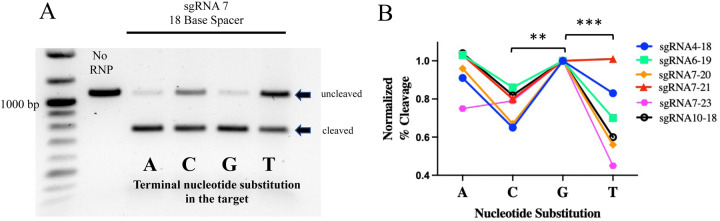
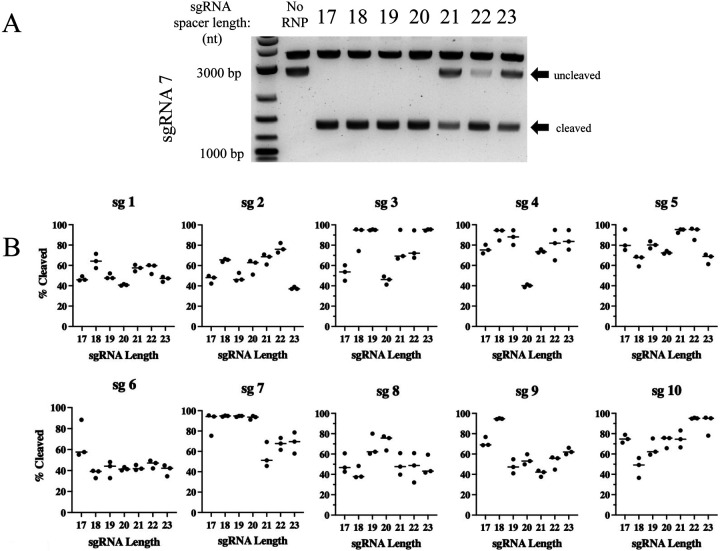
CRISPR/Cas is under development as a therapeutic tool for the cleavage, excision, and/or modification of genes in eukaryotic cells. While much effort has focused on CRISPR/Cas from (SpCas9) and (SaCas9), alternative CRISPR systems have been identified using metagenomic datasets from non-pathogenic microbes, including previously unknown class 2 systems, adding to a diverse toolbox of gene editors. The Cas12e (CasX1, CasX2) endonucleases from non-pathogenic Deltaproteobacteria (DpeCas12e) and Planctomycetes (PlmCas12e) are more compact than SpCas9, have a more selective protospacer adjacent motif (PAM) requirement, and deliver a staggered cleavage cut with 5-7 base overhangs. We investigated varying guide RNA (spacer) lengths and alternative PAM sequences to determine optimal conditions for PlmCas12e cleavage of the cellular gene (CC-Chemokine receptor-5). encodes one of two chemokine coreceptors required by HIV-1 to infect target cells, and a mutation of (delta-32) is responsible for HIV-1 resistance and reported cures following bone marrow transplantation. Consequently, has been an important target for gene editing utilizing CRISPR, TALENs, and ZFNs. We determined that cleavage activity varied with the target site, guide RNA length, and the terminal nucleotide in the PAM sequence. Our analyses demonstrated a PlmCas12e PAM preference for purines (A, G) over pyrimidines (T, C) in the fourth position of the CasX2 PAM (TTCN). These analyses have contributed to a better understanding of CasX2 cleavage requirements and will position us more favorably to develop a therapeutic that creates the delta-32 mutation in the gene in hematopoietic stem cells.
CRISPR/Cas作为一种用于真核细胞中基因切割、切除和/或修饰的治疗工具正在研发中。虽然很多工作都集中在来自酿脓链球菌(SpCas9)和金黄色葡萄球菌(SaCas9)的CRISPR/Cas上,但已利用来自非致病性微生物的宏基因组数据集鉴定出了其他CRISPR系统,包括以前未知的2类系统,这增加了基因编辑的多样化工具库。来自非致病性δ变形菌纲(DpeCas12e)和浮霉菌门(PlmCas12e)的Cas12e(CasX1、CasX2)核酸内切酶比SpCas9更紧凑,对原间隔序列邻近基序(PAM)的要求更具选择性,并产生具有5-7个碱基突出端的交错切割。我们研究了不同的向导RNA(间隔序列)长度和替代PAM序列,以确定PlmCas12e切割细胞基因CC趋化因子受体5(CCR5)的最佳条件。CCR5编码HIV-1感染靶细胞所需的两种趋化因子共受体之一,CCR5(δ-32)突变导致HIV-1抗性,并在骨髓移植后实现了治愈。因此,CCR5一直是利用CRISPR、转录激活因子样效应物核酸酶(TALENs)和锌指核酸酶(ZFNs)进行基因编辑的重要靶点。我们确定CCR5切割活性随靶位点、向导RNA长度和PAM序列中的末端核苷酸而变化。我们的分析表明,在CasX2 PAM(TTCN)的第四个位置,PlmCas12e对嘌呤(A、G)的PAM偏好高于嘧啶(T、C)。这些分析有助于更好地理解CasX2的切割要求,并将使我们更有优势开发一种在造血干细胞中产生CCR5基因δ-32突变的疗法。