Haas Andreas D, Kunzekwenyika Cordelia, Manzero Josphat, Hossmann Stefanie, Limacher Andreas, van Dijk Janneke H, Manhibi Ronald, von Groote Per, Hobbins Michael A, Verhey Ruth, Egger Matthias
Institute of Social & Preventive Medicine (ISPM), University of Bern, Bern, Switzerland.
SolidarMed, Masvingo, Zimbabwe.
medRxiv. 2023 Jan 22:2023.01.21.23284784. doi: 10.1101/2023.01.21.23284784.
Common mental disorders (CMD) are prevalent in people living with HIV and associated with suboptimal antiretroviral therapy (ART) adherence.
To assess the effect of a lay health worker-led psychological intervention on adherence to ART, virologic suppression and mental health symptoms.
Pragmatic cluster trial with block randomization of health facilities. Treatment assignment was known to participants, providers, evaluators, and data analysts. Recruitment started in October 2018 and the last follow-up visit was done in December 2020. Participants were followed up for 12 months.
Sixteen public health care facilities in Bikita, a rural district in Masvingo Province, about 300 km south of Harare.
Men and non-pregnant women aged 18 years or older who spoke English or Shona, screened positive for CMD (Shona Symptoms Questionnaire [SSQ]-14 score ≥9), had received first-line ART for at least six months, had no WHO clinical stage 4 disease, no psychotic symptoms, and gave informed consent.
The Friendship Bench, a lay health worker-led intervention consisting of six weekly individual counselling sessions of problem-solving therapy and optional peer-led group support.
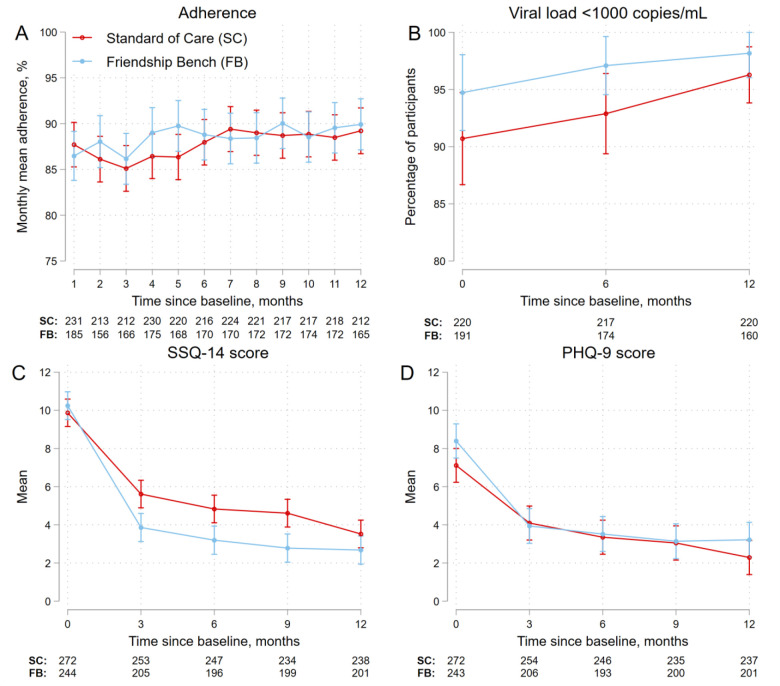
The primary outcome was Medication Event Monitoring System (MEMS) mean adherence between 2-6 months of follow-up. Secondary outcomes included mean adherence between 1-12 months, change from baseline SSQ-14 and Patient Health Questionnaire (PHQ-9) score at 3, 6, 9, and 12 months and change in viral load suppression (viral load <1000 copies per mL) at months 6 and 12.
We recruited 516 participants, 244 in Friendship bench and 272 in standard care facilities. The mean age was 45.6 years (SD 10.9), and most participants were women (84.9%). In the Friendship Bench group, 88.1% of participants attended all six individual counselling sessions. Rates of adherence (>85%) and virologic suppression (>90%) were high in both groups. The intervention had no statistically significant effect on adherence or viral suppression. Declines in SSQ-14 scores from baseline to 3 months (-1.65, 95% CI -3.07 to -0.24), 6 months (-1.57, 95% CI -2.98 to -0.15), and 9 months (-1.63, 95% CI -3.05 to -0.22) were greater in the Friendship Bench than the standard care group (p<0.05). There were no differences in the decline in the SSQ-14 scores from baseline to 12 months and in declines in PHQ-9 scores from baseline to 3, 6, 9, and 12 months.
The Friendship Bench intervention is a feasible and acceptable approach to closing the treatment gap in mental health care in rural Zimbabwe. The intervention improved CMD symptoms but the intervention effect was smaller than previously shown in an urban setting. The intervention had no effect on adherence and viral suppression, possibly due to the absence of skill-based adherence training and ceiling effect.
ClinicalTrials.gov Identifier: NCT03704805.
Does the Friendship Bench intervention improve antiretroviral therapy (ART) adherence, viral suppression and mental health symptoms in people living with HIV in rural Zimbabwe? In this cluster-randomized trial, participants in the intervention group had a significantly greater decrease in symptoms of common mental disorders than those in the control group, but the intervention showed no significant effect on antiretroviral therapy (ART) adherence or viral suppression. The intervention did not affect adherence and viral suppression and the effect of the intervention on mental health symptoms was smaller than previously shown.
常见精神障碍(CMD)在艾滋病毒感染者中普遍存在,且与抗逆转录病毒疗法(ART)依从性欠佳相关。
评估由非专业卫生工作者主导的心理干预对ART依从性、病毒学抑制及心理健康症状的影响。
对卫生设施进行整群随机分组的实用型整群试验。参与者、提供者、评估者及数据分析人员均知晓治疗分配情况。招募工作于2018年10月开始,最后一次随访于2020年12月进行。对参与者进行了12个月的随访。
位于马斯温戈省一个农村地区比基塔的16家公共卫生保健机构,该地区位于哈拉雷以南约300公里处。
年龄在18岁及以上、会说英语或绍纳语、CMD筛查呈阳性(绍纳症状问卷[SSQ]-14评分≥9)、接受一线ART至少6个月、无世界卫生组织临床4期疾病、无精神病症状且签署知情同意书的男性及非孕女性。
“友谊长椅”,这是一种由非专业卫生工作者主导的干预措施,包括为期六周的每周一次的解决问题疗法个体咨询以及可选的同伴主导的小组支持。
主要结局是随访2至6个月期间药物事件监测系统(MEMS)的平均依从性。次要结局包括1至12个月期间的平均依从性、第3、6、9和12个月时SSQ-14和患者健康问卷(PHQ-9)评分相对于基线的变化以及第6和12个月时病毒载量抑制情况(病毒载量<1000拷贝/毫升)的变化。
我们招募了516名参与者,其中244名参与“友谊长椅”干预,272名在标准护理机构。平均年龄为45.6岁(标准差10.9),大多数参与者为女性(84.9%)。在“友谊长椅”组中,88.1%的参与者参加了全部六次个体咨询。两组的依从率(>85%)和病毒学抑制率(>90%)都很高。该干预对依从性或病毒抑制无统计学显著影响。从基线到第3个月(-1.65,95%置信区间-3.07至-0.24)、第6个月(-1.57,95%置信区间-2.98至-0.15)和第9个月(-1.63,95%置信区间-3.05至-0.22),“友谊长椅”组的SSQ-14评分相对于基线的下降幅度大于标准护理组(p<0.05)。从基线到第12个月SSQ-14评分的下降以及从基线到第3、6、9和12个月PHQ-9评分的下降无差异。
“友谊长椅”干预是缩小津巴布韦农村地区精神卫生保健治疗差距的一种可行且可接受的方法。该干预改善了CMD症状,但干预效果小于此前在城市环境中显示的效果。该干预对依从性和病毒抑制无影响,可能是由于缺乏基于技能的依从性培训以及天花板效应。
ClinicalTrials.gov标识符:NCT03704805。
“友谊长椅”干预能否改善津巴布韦农村地区艾滋病毒感染者的抗逆转录病毒疗法(ART)依从性、病毒抑制及心理健康症状?在这项整群随机试验中,干预组参与者常见精神障碍症状的减轻幅度显著大于对照组,但该干预对抗逆转录病毒疗法(ART)依从性或病毒抑制无显著影响。该干预未影响依从性和病毒抑制,且其对心理健康症状的影响小于此前显示的效果。