Gosling Rebecca C, Gunn Eleanor, Wei Hua Liang, Gu Yuanlin, Rammohan Vignesh, Hughes Timothy, Hose David Rodney, Lawford Patricia V, Gunn Julian P, Morris Paul D
Department of Infection, Immunity and Cardiovascular Disease, Medical School, Beech Hill Road, Sheffield, S102TN, UK.
Department of Cardiology, Sheffield Teaching Hospitals NHS Foundation Trust, Herries Road, Sheffield, S57AU, UK.
Eur Heart J Digit Health. 2022 Sep 5;3(3):481-488. doi: 10.1093/ehjdh/ztac045. eCollection 2022 Sep.
Angiography-derived fractional flow reserve (angio-FFR) permits physiological lesion assessment without the need for an invasive pressure wire or induction of hyperaemia. However, accuracy is limited by assumptions made when defining the distal boundary, namely coronary microvascular resistance (CMVR). We sought to determine whether machine learning (ML) techniques could provide a patient-specific estimate of CMVR and therefore improve the accuracy of angio-FFR.
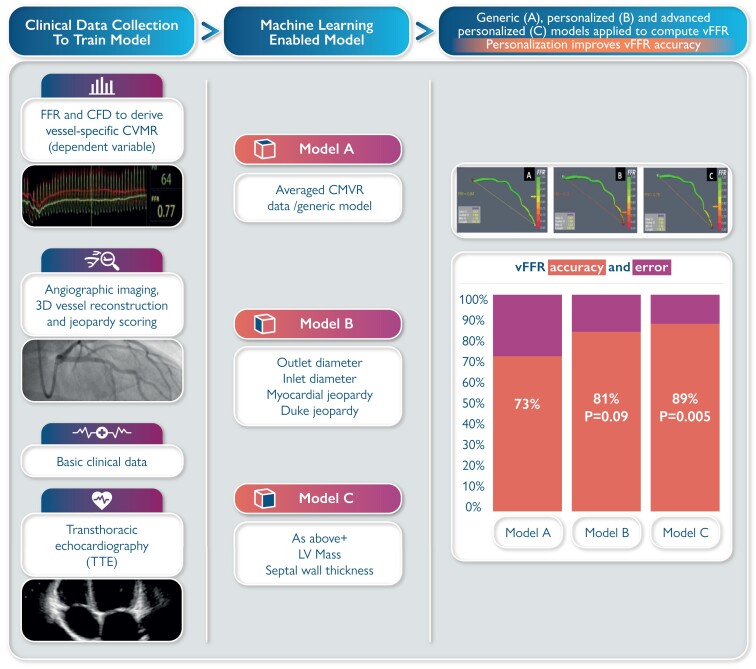
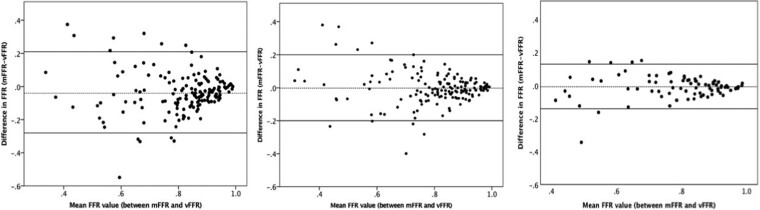
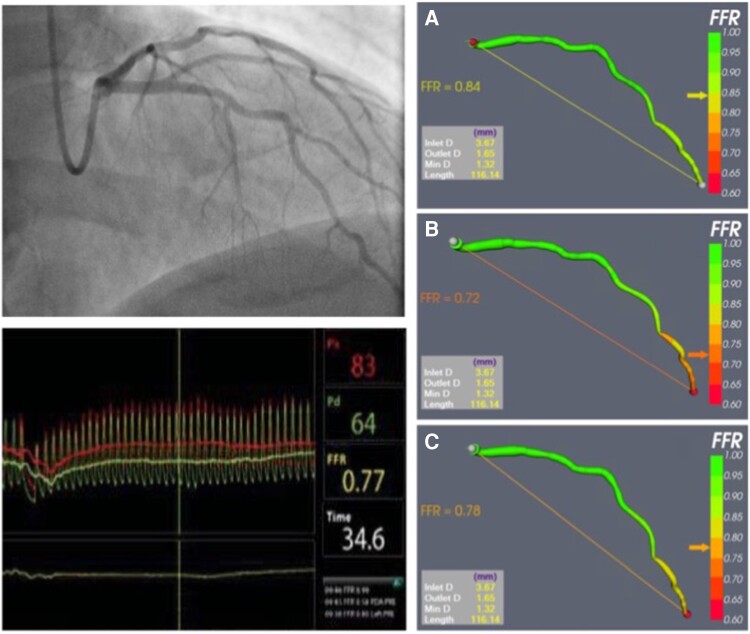
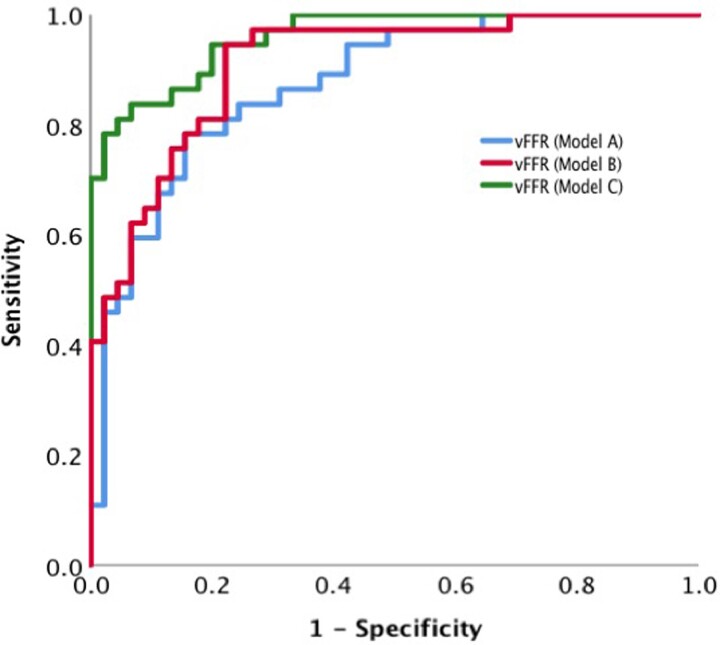
Patients with chronic coronary syndromes underwent coronary angiography with FFR assessment. Vessel-specific CMVR was computed using a three-dimensional computational fluid dynamics simulation with invasively measured proximal and distal pressures applied as boundary conditions. Predictive models were created using non-linear autoregressive moving average with exogenous input (NARMAX) modelling with computed CMVR as the dependent variable. Angio-FFR (VIRTUheart™) was computed using previously described methods. Three simulations were run: using a generic CMVR value (Model A); using ML-predicted CMVR based upon simple clinical data (Model B); and using ML-predicted CMVR also incorporating echocardiographic data (Model C). The diagnostic (FFR ≤ or >0.80) and absolute accuracies of these models were compared. Eighty-four patients underwent coronary angiography with FFR assessment in 157 vessels. The mean measured FFR was 0.79 (±0.15). The diagnostic and absolute accuracies of each personalized model were: (A) 73% and ±0.10; (B) 81% and ±0.07; and (C) 89% and ±0.05, < 0.001.
The accuracy of angio-FFR was dependent in part upon CMVR estimation. Personalization of CMVR from standard clinical data resulted in a significant reduction in angio-FFR error.
血管造影衍生的血流储备分数(血管造影-FFR)允许在无需侵入性压力导丝或诱发充血的情况下进行生理性病变评估。然而,准确性受到定义远端边界时所做假设的限制,即冠状动脉微血管阻力(CMVR)。我们试图确定机器学习(ML)技术是否能够提供患者特异性的CMVR估计值,从而提高血管造影-FFR的准确性。
患有慢性冠状动脉综合征的患者接受了冠状动脉造影及FFR评估。使用三维计算流体动力学模拟,将有创测量的近端和远端压力作为边界条件,计算血管特异性CMVR。使用以计算出的CMVR作为因变量的具有外部输入的非线性自回归移动平均(NARMAX)建模创建预测模型。使用先前描述的方法计算血管造影-FFR(VIRTUheart™)。进行了三次模拟:使用通用CMVR值(模型A);使用基于简单临床数据的ML预测CMVR(模型B);以及使用还纳入了超声心动图数据的ML预测CMVR(模型C)。比较了这些模型的诊断(FFR≤或>0.80)和绝对准确性。84例患者在157支血管中接受了冠状动脉造影及FFR评估。测得的平均FFR为0.79(±0.15)。每个个性化模型的诊断和绝对准确性分别为:(A)73%和±0.10;(B)81%和±0.07;以及(C)89%和±0.05,P<0.001。
血管造影-FFR的准确性部分取决于CMVR估计。根据标准临床数据对CMVR进行个性化处理可显著降低血管造影-FFR误差。