Dellepiane Sergio, Paranjpe Ishan, Rajagopal Madhumitha, Kamat Samir, O'Hagan Ross, Gulamali Faris, Rein Joshua L, Charney Alexander W, Do Ron, Coca Steven, Glicksberg Benjamin S, Nadkarni Girish N
Mount Sinai Clinical Intelligence Center (MSCIC), Icahn School of Medicine at Mount Sinai, New York, NY.
Hasso Plattner Institute for Digital Health at Mount Sinai, Icahn School of Medicine at Mount Sinai, New York, NY.
Kidney Med. 2022 Dec 11;5(2):100582. doi: 10.1016/j.xkme.2022.100582. eCollection 2023 Feb.
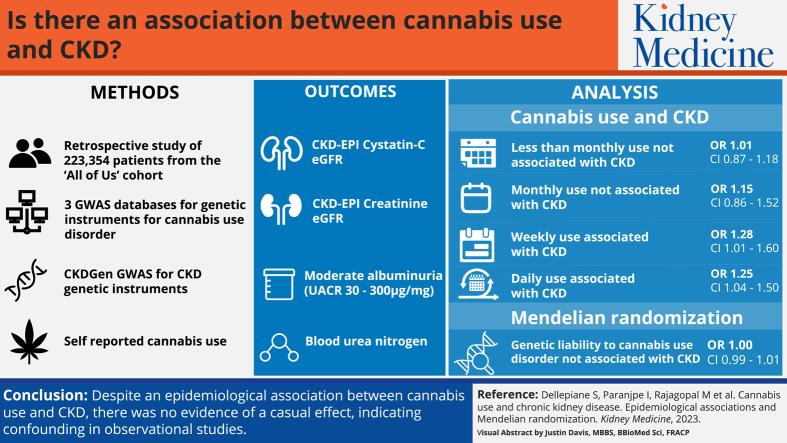
RATIONALE & OBJECTIVE: The association between cannabis use and chronic kidney disease (CKD) is controversial. We aimed to assess association of CKD with cannabis use in a large cohort study and then assess causality using Mendelian randomization with a genome-wide association study (GWAS).
Retrospective cohort study and genome-wide association study.
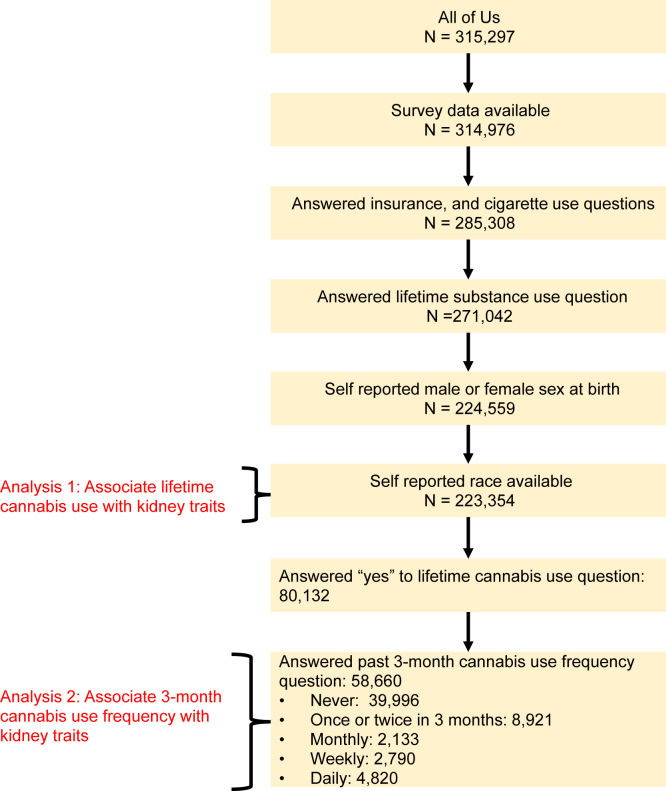
SETTING & PARTICIPANTS: The retrospective study was conducted on the All of Us cohort (N=223,354). Genetic instruments for cannabis use disorder were identified from 3 GWAS: the Psychiatric Genomics Consortium Substance Use Disorders, iPSYCH, and deCODE (N=384,032). Association between genetic instruments and CKD was investigated in the CKDGen GWAS (N > 1.2 million).
Cannabis consumption.
CKD outcomes included: cystatin-C and creatinine-based kidney function, proteinuria, and blood urea nitrogen.
We conducted association analyses to test for frequency of cannabis use and CKD. To evaluate causality, we performed a 2-sample Mendelian randomization.
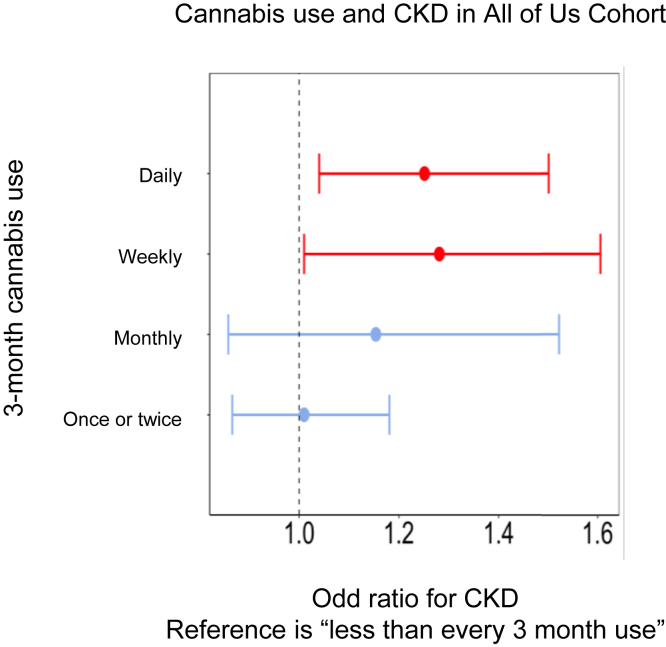
In the retrospective study, compared to former users, less than monthly (OR, 1.01; 95% CI, 0.87-1.18; = 0.87) and monthly cannabis users (OR, 1.15; 95% CI, 0.86-1.52; = 0.33) did not have higher CKD odds. Conversely, weekly (OR, 1.28; 95% CI, 1.01-1.60; = 0.04) and daily use (OR, 1.25; 95% CI, 1.04-1.50; = 0.02) was significantly associated with CKD, adjusted for multiple confounders. In Mendelian randomization, genetic liability to cannabis use disorder was not associated with increased odds for CKD (OR, 1.00; 95% CI, 0.99-1.01; = 0.96). These results were robust across different Mendelian randomization techniques and multiple kidney traits.
Likely underreporting of cannabis use. In Mendelian randomization, genetic instruments were identified in the GWAS that included individuals primarily of European ancestry.
Despite the epidemiological association between cannabis use and CKD, there was no evidence of a causal effect, indicating confounding in observational studies.
大麻使用与慢性肾脏病(CKD)之间的关联存在争议。我们旨在通过一项大型队列研究评估CKD与大麻使用之间的关联,然后使用全基因组关联研究(GWAS)的孟德尔随机化方法评估因果关系。
回顾性队列研究和全基因组关联研究。
回顾性研究在“我们所有人”队列(N = 223,354)中进行。从3项GWAS中确定了大麻使用障碍的遗传工具:精神基因组学联盟物质使用障碍研究、iPSYCH研究和deCODE研究(N = 384,032)。在CKDGen GWAS(N>120万)中研究了遗传工具与CKD之间的关联。
大麻消费。
CKD结局包括:基于胱抑素C和肌酐的肾功能、蛋白尿和血尿素氮。
我们进行了关联分析,以检验大麻使用频率与CKD之间的关系。为了评估因果关系,我们进行了两样本孟德尔随机化分析。
在回顾性研究中,与既往使用者相比,每月使用少于一次(OR,1.01;95%CI,0.87 - 1.18;P = 0.87)和每月使用一次的大麻使用者(OR,1.15;95%CI,0.86 - 1.52;P = 0.33)的CKD患病几率并未更高。相反,每周使用(OR,1.28;95%CI,1.01 - 1.60;P = 0.04)和每天使用(OR,1.25;95%CI,1.04 - 1.50;P = 0.02)与CKD显著相关,对多个混杂因素进行了校正。在孟德尔随机化分析中,大麻使用障碍的遗传易感性与CKD患病几率增加无关(OR,1.00;95%CI,0.99 - 1.01;P = 0.96)。这些结果在不同的孟德尔随机化技术和多个肾脏特征中均具有稳健性。
大麻使用情况可能报告不足。在孟德尔随机化分析中,遗传工具是在主要包括欧洲血统个体的GWAS中确定的。
尽管大麻使用与CKD之间存在流行病学关联,但没有因果效应的证据,这表明观察性研究中存在混杂因素。