Huang Xue-Yan, Xue Lu-Lu, Chen Ting-Bao, Huangfu Li-Ren, Wang Ting-Hua, Xiong Liu-Lin, Yu Chang-Yin
Department of Neurology, Affiliated Hospital of Zunyi Medical University, Zunyi, Guizhou, China.
State Key Laboratory of Biotherapy, Sichuan University, Chengdu, Sichuan, China.
Front Pharmacol. 2023 Jan 11;13:1080753. doi: 10.3389/fphar.2022.1080753. eCollection 2022.
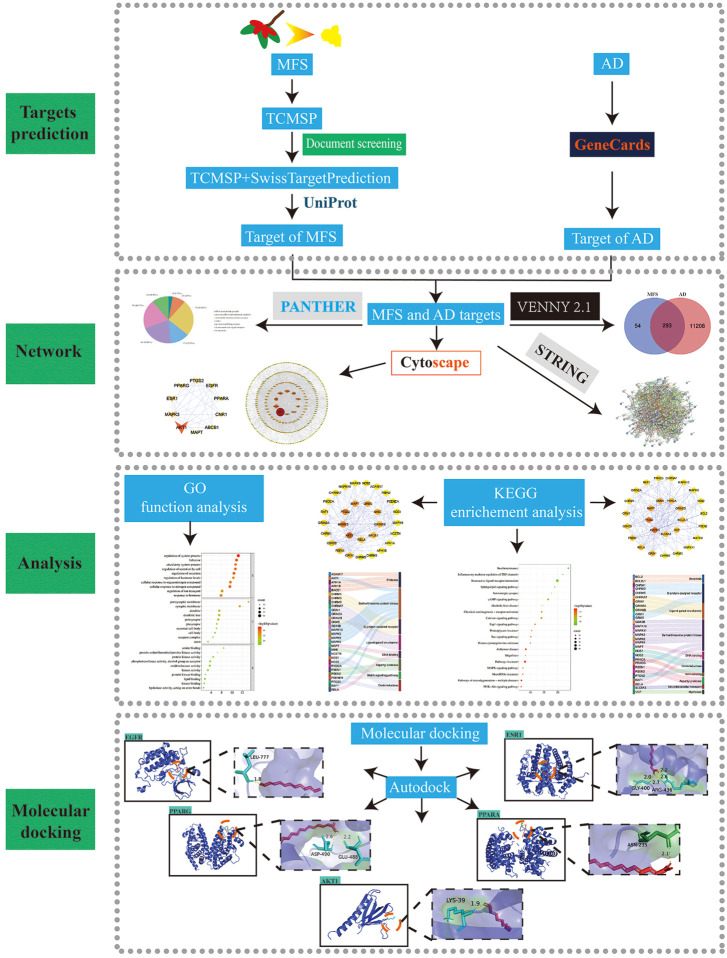
Currently, the treatment of Alzheimer's disease (AD) is still at the stage of symptomatic treatment due to lack of effective drugs. The research on miracle fruit seeds (MFSs) has focused on lipid-lowering and antidiabetic effects, but no therapeutic effects have been reported in AD. The purpose of this study was to provide data resources and a potential drug for treatment of AD. An AD mouse model was established and treated with MFSs for 1 month. The Morris water maze test was used to assess learning memory function in mice. Nissl staining was used to demonstrate histopathological changes. MFSs were found to have therapeutic implications in the AD mouse model, as evidenced by improved learning memory function and an increase in surviving neurons. To explore the mechanism of MFSs in treating AD, network pharmacological approaches, Gene Ontology (GO), Kyoto Encyclopedia of Genes and Genomes (KEGG), and molecular docking studies were carried out. Based on the network pharmacology strategy, 74 components from MFS corresponded to 293 targets related to the AD pathology. Among these targets, AKT1, MAPK3, ESR1, PPARG, PTGS2, EGFR, PPARA, CNR1, ABCB1, and MAPT were identified as the core targets. According to the relevant number of core targets, cis-8-octadecenoic acid, cis-10-octadecenoic acid, 2-dodecenal, and tetradecane are likely to be highly correlated with MFS for AD. Enrichment analysis indicated the common targets mainly enriched in AD and the neurodegeneration-multiple disease signaling pathway. The molecular docking predictions showed that MFSs were stably bound to core targets, specifically AKT1, EGFR, ESR1, PPARA, and PPARG. MFSs may play a therapeutic role in AD by affecting the insulin signaling pathway and the Wnt pathway. The findings of this study provide potential possibilities and drug candidates for the treatment of AD.
目前,由于缺乏有效药物,阿尔茨海默病(AD)的治疗仍处于对症治疗阶段。对奇迹果种子(MFSs)的研究主要集中在降脂和抗糖尿病作用方面,但尚未有其对AD治疗作用的报道。本研究旨在为AD的治疗提供数据资源和潜在药物。建立AD小鼠模型并用MFSs治疗1个月。采用莫里斯水迷宫试验评估小鼠的学习记忆功能。用尼氏染色法显示组织病理学变化。结果发现MFSs对AD小鼠模型具有治疗作用,表现为学习记忆功能改善和存活神经元数量增加。为探究MFSs治疗AD的机制,开展了网络药理学方法、基因本体论(GO)、京都基因与基因组百科全书(KEGG)以及分子对接研究。基于网络药理学策略,MFSs中的74种成分对应于293个与AD病理相关的靶点。在这些靶点中,AKT1、MAPK3、ESR1、PPARG、PTGS2、EGFR、PPARA、CNR1、ABCB1和MAPT被确定为核心靶点。根据核心靶点的相关数量,顺式-8-十八碳烯酸、顺式-10-十八碳烯酸、2-十二碳烯醛和十四烷可能与MFSs治疗AD高度相关。富集分析表明,共同靶点主要富集于AD和神经退行性变-多种疾病信号通路。分子对接预测显示,MFSs与核心靶点,特别是AKT1、EGFR、ESR1、PPARA和PPARG稳定结合。MFSs可能通过影响胰岛素信号通路和Wnt通路在AD中发挥治疗作用。本研究结果为AD的治疗提供了潜在的可能性和候选药物。