Hosseini Mahmoud, Boskabady Mohammad Hossein, Khazdair Mohammad Reza
Division of Neurocognitive Sciences, Psychiatry and Behavioral Sciences Research Center, Mashhad University of Medical Sciences, Mashhad, Iran.
Applied Biomedical Research Center, Mashhad University of Medical Sciences, Mashhad, Iran.
Avicenna J Phytomed. 2021 Sep-Oct;11(5):436-450. doi: 10.22038/AJP.2021.55681.2786.
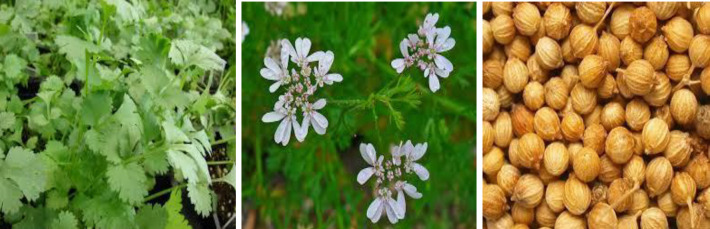
Coriander ( L.) is an annual herb belonging to the Apiaceae (Umbellifera) family that is used as food additives traditionally. This plant is called "" in Persian and is native to Mediterranean regions but it is currently cultivated in several countries. All parts of coriander are edible and have been traditionally used to treat different disorders, including digestive problems, flatulence, diarrhea, colic and other gastrointestinal diseases.
The databases PubMed, Web of Science, Google Scholar and Scopus were considered. The search terms were "" or "linalool" and "anti-anxiety", "sedative", "antioxidant effect", "anticonvulsant" and "neuroprotective effect".
Antioxidant, diuretic, cholesterol lowering, anxiolytic, sedative-hypnotic and anticonvulsant activities were reported for the seeds and leaves of the plant. Furthermore, linalool as the main component of coriander has different neuropharmacological effects, including anti-anxiety, sedative, anticonvulsant and anti-Alzheimer's disease activities.
Various neuropharmacological effects of and its component which have antioxidant and anti-inflammatory effects, have been summarized in the current review article.
芫荽(Coriandrum sativum L.)是一种一年生草本植物,属于伞形科,传统上用作食品添加剂。这种植物在波斯语中被称为“”,原产于地中海地区,但目前在多个国家种植。芫荽的所有部分都可食用,传统上用于治疗不同疾病,包括消化问题、肠胃胀气、腹泻、绞痛和其他胃肠道疾病。
考虑了PubMed、科学网、谷歌学术和Scopus数据库。检索词为“”或“芳樟醇”以及“抗焦虑”“镇静”“抗氧化作用”“抗惊厥”和“神经保护作用”。
报道了该植物种子和叶子具有抗氧化、利尿、降胆固醇、抗焦虑、镇静催眠和抗惊厥活性。此外,作为芫荽主要成分的芳樟醇具有不同的神经药理学作用,包括抗焦虑、镇静、抗惊厥和抗阿尔茨海默病活性。
本综述文章总结了芫荽及其具有抗氧化和抗炎作用的成分的各种神经药理学作用。