Paintsil Vivian, Ally Mwashungi, Isa Hezekiah, Anie Kofi A, Mgaya Josephine, Nkanyemka Malula, Nembaware Victoria, Oppong-Mensah Yaa Gyamfua, Ndobho Flora, Chirande Lulu, Makubi Abel, Nnodu Obiageli, Wonkam Ambroise, Makani Julie, Ohene-Frempong Kwaku
Department of Child Health, School of Medicine and Dentistry, Kwame Nkrumah University of Science and Technology, Kumasi, Ghana.
Directorate of Child Health, Komfo Anokye Teaching Hospital, Kumasi, Ghana.
Front Genet. 2023 Jan 12;13:1052179. doi: 10.3389/fgene.2022.1052179. eCollection 2022.
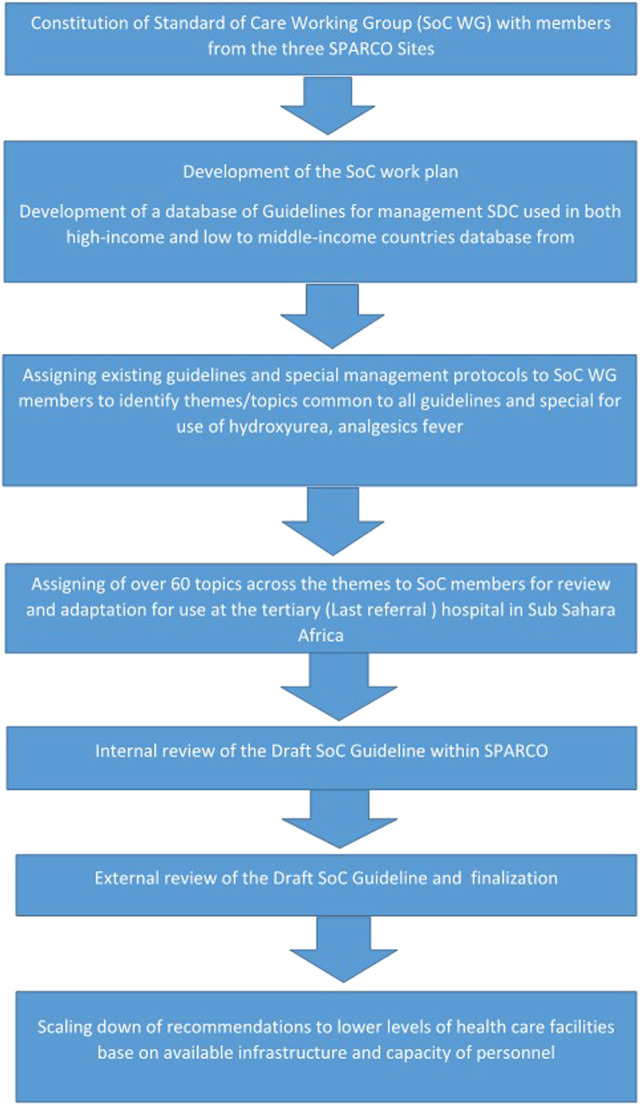
Sickle Cell Disease (SCD) causes significant morbidity and mortality particularly in sub-Saharan Africa (SSA) where it contributes to early childhood deaths. There is need to standardize treatment guidelines to help improve overall SCD patient health outcomes. We set out to review existing guidelines on SCD and to set minimum standards for management of SCD for the different referral levels of healthcare. A standards of care working group (SoC-WG) was established to develop the SoC recommendations. About 15 available SCD management guidelines and protocols were reviewed and themes extracted from them. The first draft was on chosen themes with 64 major headings and subtopics. Using a summarised WHO levels of referral document, we were able to get six different referral levels of healthcare. The highest referral level was the tertiary facilities whilst the lowest level was the home setting. Recommendations for SCD management for the regional, district, sub-districts, health posts and CHPs compounds were also drafted. The results from this review yielded a guidelines document which had recommendations for management of SCD on 64 topics and subtopic for all the six (6) different referral levels. Every child with SCD need to receive comprehensive care that is coordinated at each level. This recommendation is unique in terms of the availability of recommendations for different levels of care as compared to the traditional guidelines which is more focused at the tertiary levels. Patients can access care at any of the other lower referral hospitals and be managed with recommendations that are in keeping with institutional resources at that level. When such patients need care that requires expertise that is not available at that level, the recommendations will be to refer to the appropriate referral level where those expertise are available. This encourages patients to have good clinical care nearer their homes but also having access to specialist screening modalities and expertise at the tertiary hospitals if need be. With this, patient are not limited to a specific referral level when interventions cannot be instituted for them. This SoC recommendations document is a useful material that can be used for consistent standards of treatment in SSA.
镰状细胞病(SCD)会导致严重的发病率和死亡率,尤其是在撒哈拉以南非洲地区(SSA),它是导致儿童早期死亡的原因之一。有必要规范治疗指南,以帮助改善SCD患者的整体健康状况。我们着手审查现有的SCD指南,并为不同转诊级别的医疗保健制定SCD管理的最低标准。成立了护理标准工作组(SoC-WG)来制定SoC建议。审查了约15份现有的SCD管理指南和方案,并从中提取了主题。初稿围绕选定的主题,有64个主要标题和子主题。利用世界卫生组织转诊文件的摘要,我们确定了六个不同的医疗保健转诊级别。最高转诊级别是三级医疗机构,最低级别是家庭环境。还起草了针对地区、县、街道、卫生站和社区卫生中心的SCD管理建议。本次审查的结果产生了一份指南文件,其中包含针对所有六个不同转诊级别的64个主题和子主题的SCD管理建议。每个患有SCD的儿童都需要接受在各级协调的全面护理。与更侧重于三级医疗机构的传统指南相比,这些针对不同护理级别的建议的可用性使得这一建议独具特色。患者可以在任何其他较低转诊级别的医院接受治疗,并根据该级别机构的资源进行管理。当此类患者需要该级别无法提供的专业护理时,建议是转诊到具备这些专业知识的适当转诊级别。这鼓励患者在离家较近的地方获得良好的临床护理,但如果需要,也可以在三级医院获得专科筛查方式和专业知识。这样,当无法为患者实施干预措施时,他们不限于特定的转诊级别。这份SoC建议文件是一份有用的材料,可用于在SSA实现一致的治疗标准。