Kawall Anasha, Lewis Devin S M, Sharma Avini, Chavada Krishna, Deshmukh Rahul, Rayalam Srujana, Mody Vicky, Taval Shashidharamurthy
Department of Biomedical Sciences, Philadelphia College of Osteopathic Medicine-Georgia Campus, Suwanee, GA, United States.
Division of Research, Philadelphia College of Osteopathic Medicine-Georgia Campus, Suwanee, GA, United States.
Front Chem. 2023 Jan 12;10:1100460. doi: 10.3389/fchem.2022.1100460. eCollection 2022.
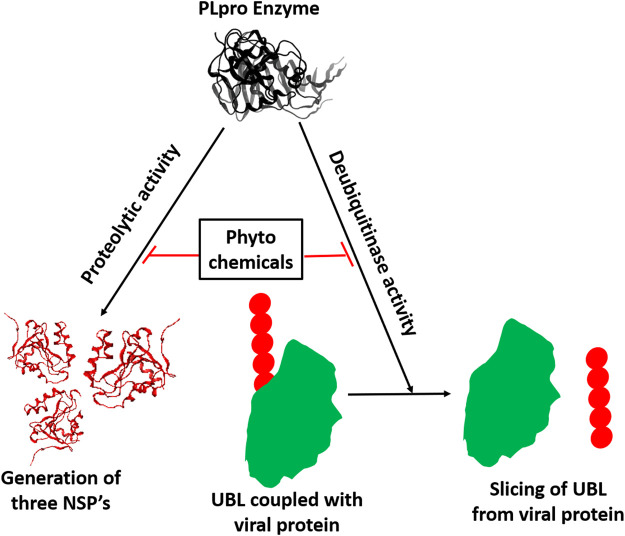
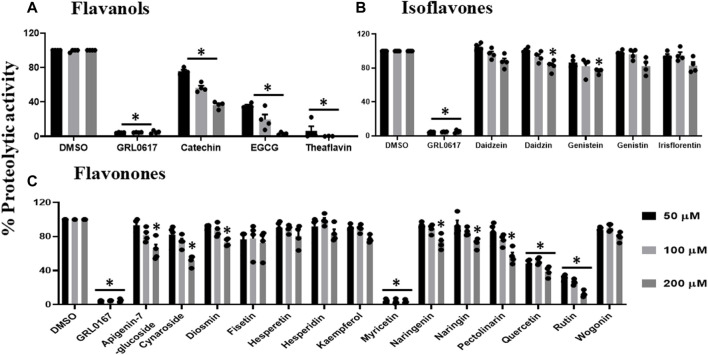
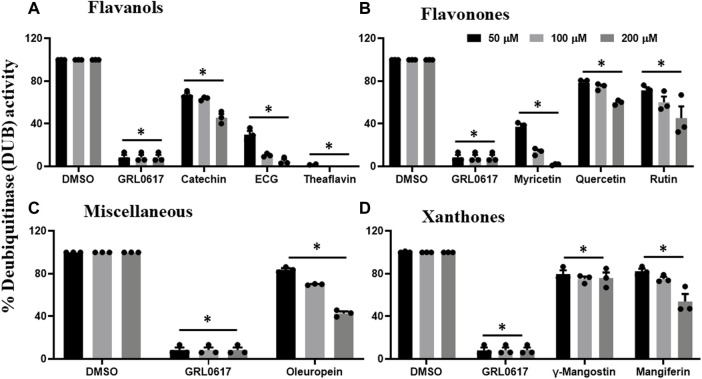
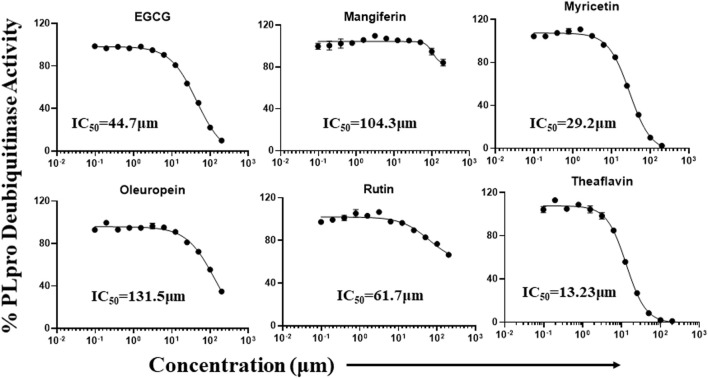
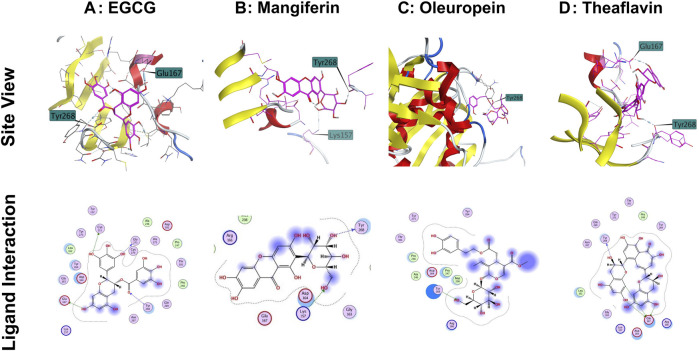
Recent studies have shown that RNA-dependent RNA polymerase (RdRp), 3-chymotrypsin-like protease (3CLpro), and papain-like protease (PLpro) are necessary for SARS-CoV-2 replication. Among these three enzymes, PLpro exhibits both proteolytic and deubiquitinase (DUB) activity and is responsible for disrupting the host's innate immune response against SARS-CoV-2. Because of this unique property of PLpro, we investigated the inhibitory effects of phytochemicals on the SARS-CoV-2 PLpro enzyme. Our data indicates that the phytochemicals such as catechin, epigallocatechin gallate (EGCG), mangiferin, myricetin, rutin, and theaflavin exhibited inhibitory activity with IC values of 14.2, 128.4, 95.3, 12.1, and 43.4, and 7.3 μM, respectively, towards PLpro proteolytic activity. However, the IC values of quercetin, oleuropein, and γ-mangostin are ambiguous. We observed that EGCG, mangiferin, myricetin, oleuropein, rutin, and theaflavin have also inhibited the DUB activity with IC values of 44.7, 104.3, 29.2, 131.5, 61.7, and 13.2 μM, respectively. Mechanistically, the ligand-protein interaction structural modeling suggests that mangiferin, EGCG, theaflavin, and oleuropein shows that these four ligands interact with Glu, and Tyr, however mangiferin and oleuropein showed very weak interaction with Glu as compared to EGCG, and theaflavin which reflects their low IC values for DUB activity. Our data indicate that the phytochemicals mentioned above inhibit the proteolytic and DUB activity of SARS-CoV-2 PLpro, thus preventing viral replication and promoting host innate immune response. However, the therapeutic potential of these phytochemicals needs to be validated by pre-clinical and clinical studies.
最近的研究表明,RNA依赖的RNA聚合酶(RdRp)、3-糜蛋白酶样蛋白酶(3CLpro)和木瓜蛋白酶样蛋白酶(PLpro)对严重急性呼吸综合征冠状病毒2(SARS-CoV-2)的复制是必需的。在这三种酶中,PLpro兼具蛋白水解和去泛素酶(DUB)活性,并负责破坏宿主针对SARS-CoV-2的固有免疫反应。由于PLpro的这种独特特性,我们研究了植物化学物质对SARS-CoV-2 PLpro酶的抑制作用。我们的数据表明,儿茶素、表没食子儿茶素没食子酸酯(EGCG)、芒果苷、杨梅素、芦丁和茶黄素等植物化学物质对PLpro蛋白水解活性表现出抑制活性,其IC值分别为14.2、128.4、95.3、12.1、43.4和7.3μM。然而,槲皮素、橄榄苦苷和γ-山竹黄酮的IC值不明确。我们观察到,EGCG、芒果苷、杨梅素、橄榄苦苷、芦丁和茶黄素也抑制了DUB活性,其IC值分别为44.7、104.3、29.2、131.5、61.7和13.2μM。从机制上讲,配体-蛋白质相互作用结构建模表明,芒果苷、EGCG、茶黄素和橄榄苦苷显示这四种配体与Glu和Tyr相互作用,然而与EGCG和茶黄素相比,芒果苷和橄榄苦苷与Glu的相互作用非常弱,这反映了它们对DUB活性的低IC值。我们的数据表明,上述植物化学物质抑制SARS-CoV-2 PLpro的蛋白水解和DUB活性,从而阻止病毒复制并促进宿主固有免疫反应。然而,这些植物化学物质的治疗潜力需要通过临床前和临床研究来验证。