Institute of Organ Transplantation, Tongji Hospital, Tongji Medical College, Huazhong University of Science and Technology, Wuhan, China.
Key Laboratory of Organ Transplantation, Ministry of Education, Wuhan, China.
Front Immunol. 2023 Jan 11;13:1087597. doi: 10.3389/fimmu.2022.1087597. eCollection 2022.
Late or chronic active antibody-mediated rejection (AMR) associated with donor-specific antibodies (dnDSA) after renal transplantation is a great clinical challenge because it is often resistant to conventional therapies. Daratumumab, an anti-CD38 monoclonal antibody that can deplete plasma cells, may be effective for the treatment of late or chronic active AMR.
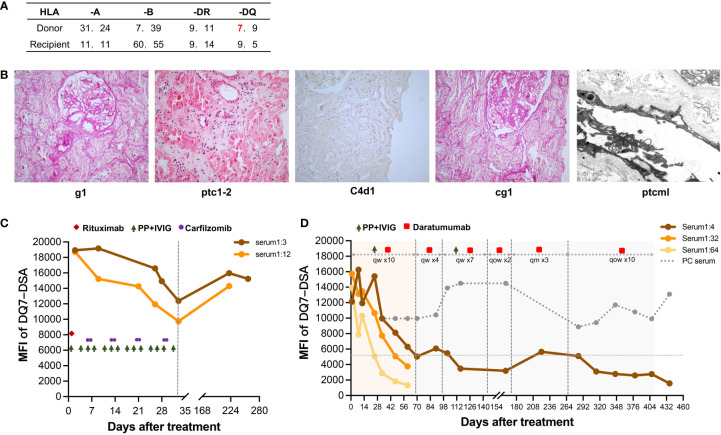
We designed a novel regimen that included early intensive therapy with daratumumab plus plasmapheresis (PP)/intravenous immunoglobulins (IVIG) and later maintenance therapy with daratumumab alone, and used this regimen to treat late or chronic active AMR in two kidney transplant recipients with extremely high levels of anti-DQ7 dnDSA.
Both patients had a limited clinical response to the early treatment with rituximab and PP/IVIG (with or without splenic irradiation); however, they had a remarkable decrease in anti-DQ7 DSA (MFI value from ~20,000 to ~5,000) after 2-3 months of intensive therapy with daratumumab plus PP/IVIG. Over 20 months of follow-up, patient 1 maintained a low DSA (as low as 1,572) and normal renal function on daratumumab maintenance therapy. Patient 2 retained a low DSA and improved renal function and pathological lesions within one year after treatment but then deteriorated because of acute T cell-mediated rejection.
Our daratumumab-based regimen has shown promising results in the treatment of refractory late active or chronic active AMR in renal transplant recipients with high-level dnDSA. This may provide a reference for better use of daratumumab in the treatment of late or chronic active AMR.
肾移植后与供体特异性抗体(dnDSA)相关的晚期或慢性活跃抗体介导的排斥反应(AMR)是一个巨大的临床挑战,因为它通常对常规治疗有抗性。达雷妥尤单抗是一种抗 CD38 单克隆抗体,可耗竭浆细胞,可能对治疗晚期或慢性活跃 AMR 有效。
我们设计了一种新的方案,包括早期使用达雷妥尤单抗联合血浆置换(PP)/静脉注射免疫球蛋白(IVIG)的强化治疗,以及后期单独使用达雷妥尤单抗的维持治疗,并使用该方案治疗两名具有极高抗-DQ7 dnDSA 水平的肾移植受者的晚期或慢性活跃 AMR。
两名患者对利妥昔单抗和 PP/IVIG 的早期治疗(有或没有脾照射)均仅有有限的临床反应;然而,在达雷妥尤单抗联合 PP/IVIG 强化治疗 2-3 个月后,他们的抗-DQ7 DSA 显著下降(MFI 值从约 20,000 降至约 5,000)。在 20 多个月的随访中,患者 1 在达雷妥尤单抗维持治疗中保持低 DSA(低至 1,572)和正常肾功能。患者 2 在治疗后一年内保留低 DSA 和改善的肾功能和病理病变,但随后因急性 T 细胞介导的排斥反应而恶化。
我们的基于达雷妥尤单抗的方案在治疗具有高水平 dnDSA 的肾移植受者的难治性晚期活跃或慢性活跃 AMR 方面显示出有希望的结果。这可能为更好地使用达雷妥尤单抗治疗晚期或慢性活跃 AMR 提供参考。