Kalra Ankur, Kumar Ashish, Nowacki Amy S, Shahadat Amna, Khan Muhammad Shahzeb, Jabri Ahmad, Khan Safi U, Michos Erin D, Califf Robert M, Bhatt Deepak L
Department of Cardiovascular Medicine, Heart, Vascular and Thoracic Institute, Cleveland Clinic, 224 West Exchange St, Suite 225, Akron, OH 44302, USA.
Section of Cardiovascular Research, Heart, Vascular and Thoracic Department, Cleveland Clinic Akron General, Akron, OH, USA.
Eur Heart J Digit Health. 2021 Jun 2;2(3):374-378. doi: 10.1093/ehjdh/ztab049. eCollection 2021 Sep.
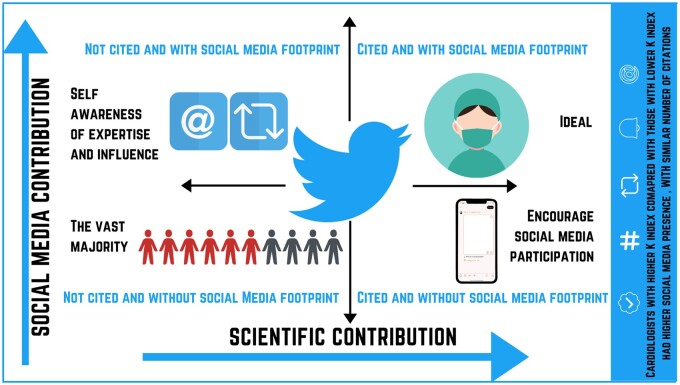
The increasing importance placed by medical journals for dissemination of published articles on social media, such as posting Altmetric scores, has further expedited the need for differentiating science from pseudo-science. The 'Kardashian index' (a.k.a., K-index) was suggested, which correlates the citations of a scientist with his/her Twitter followers.
From a list of top 100 cardiology hospitals in accordance with the most recent US News and World Report rankings, 1500 cardiologists were selected based on institutional physician profile pages complete with cardiologists' headshots. The K-index of cardiologists, and variables like all-time posts, and posts for the past 12 months (1 June 2019 to 31 May 2020) from cardiologists were documented and analysed. The K-index of cardiologists in our study was stratified into the following categories (upper boundary inclusive); K-index 0-1 ( = 104); K-index 1-2 ( = 30); K-index 2-3 ( = 24); K-index 3-4 ( = 14); K-index 4-5 ( = 5); and K-index >5 ( = 22). There was no statistically significant difference ( = 0.94) in the citation number across the K-index categories (no consistent pattern observed, median citations ranging from 237 to 610). However, cardiologists with higher K-index categories had a higher number of 12-month posts (median 14 vs. 392 for K-index categories 0-1 and >5, respectively; -value <0.001).
Considering no evidence of a difference in the number of citations across K-index categories, the stigma associated with higher K-index needs to be reconsidered.
医学期刊愈发重视在社交媒体上传播已发表的文章,比如公布阿尔特梅特评分,这进一步加速了区分科学与伪科学的需求。有人提出了“卡戴珊指数”(又称K指数),该指数将科学家的被引次数与其推特粉丝数量关联起来。
根据最新的《美国新闻与世界报道》排名,从100家顶尖心脏病医院名单中,基于包含心脏病专家头像的机构医生简介页面挑选出1500名心脏病专家。记录并分析了心脏病专家的K指数,以及他们的总发帖数和过去12个月(2019年6月1日至2020年5月31日)的发帖数等变量。我们研究中心脏病专家的K指数被分为以下几类(包含上限);K指数0 - 1(= 104);K指数1 - 2(= 30);K指数2 - 3(= 24);K指数3 - 4(= 14);K指数4 - 5(= 5);K指数>5(= 22)。K指数各分类间的被引次数无统计学显著差异(= 0.94)(未观察到一致模式,被引次数中位数在237至610之间)。然而,K指数较高分类的心脏病专家过去12个月的发帖数更多(K指数0 - 1和>5分类的中位数分别为14和392;-值<0.001)。
鉴于没有证据表明K指数各分类间的被引次数存在差异,与较高K指数相关的污名需要重新审视。