Tranos James A, Das Ayesha, Zhang Jin, Hafeez Sonia, Arvanitakis Georgios N, Thomson Stuart A J, Khan Suleiman, Pandya Neelam, Kim Sungheon Gene, Wadghiri Youssef Z
Center for Biomedical Imaging (CBI), Center for Advanced Imaging Innovation and Research (CAI2R), Department of Radiology, NYU Grossman School of Medicine, New York, New York 10016, United States.
Department of Radiology, Weill Cornell Medical College, New York, New York 10065, United States.
ACS Omega. 2023 Jan 9;8(3):2907-2914. doi: 10.1021/acsomega.2c05040. eCollection 2023 Jan 24.
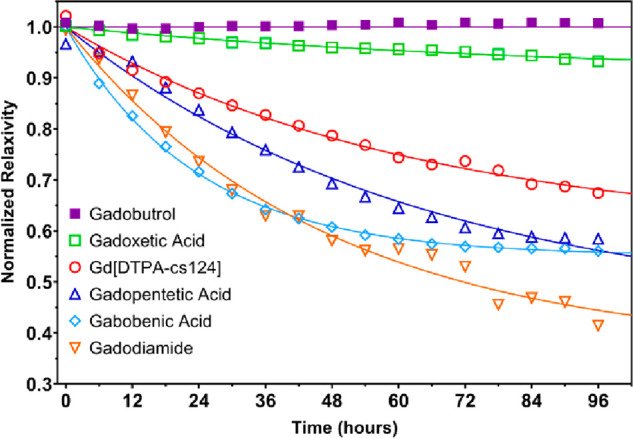
Gadolinium (Gd) based contrast agents (GBCAs) are widely used in magnetic resonance imaging (MRI) and are paramount to cancer diagnostics and tumor pharmacokinetic analysis. Accurate quantification of gadolinium concentration is essential to monitoring the biodistribution, clearance, and pharmacodynamics of GBCAs. However, current methods of quantifying gadolinium in blood or plasma (biological media) are both low throughput and clinically unavailable. Here, we have demonstrated the use of a sensitized gadolinium chelate, Gd[DTPA-cs124], as an MRI contrast agent that can be used to measure the concentration of gadolinium via luminescence quantification in biological media following transmetalation with a terbium salt. Gd[DTPA-cs124] was synthesized by conjugating carbostyril-124 (cs124) to diethylenetriaminepentaacetic acid (DTPA) and chelating to gadolinium. We report increases in both stability and relaxivity compared to the clinically approved analog Gd[DTPA] (gadopentetic acid or Magnevist). In vivo MRI experiments were conducted using C57BL6 mice in order to further illustrate the performance of Gd[DTPA-cs124] as an MRI contrast agent in comparison to Magnevist. Our results indicate that similar chemical modification to existing clinically approved GBCA may likewise provide favorable property changes, with the ability to be used in a gadolinium quantification assay. Furthermore, our assay provides a straightforward and high-throughput method of measuring gadolinium in biological media using a standard laboratory plate reader.
钆(Gd)基造影剂(GBCAs)广泛应用于磁共振成像(MRI),对癌症诊断和肿瘤药代动力学分析至关重要。准确量化钆浓度对于监测GBCAs的生物分布、清除率和药效学至关重要。然而,目前在血液或血浆(生物介质)中量化钆的方法通量低且临床不可用。在此,我们展示了使用一种敏化钆螯合物Gd[DTPA-cs124]作为MRI造影剂,在与铽盐进行金属转移后,可通过生物介质中的发光量化来测量钆浓度。Gd[DTPA-cs124]是通过将咔唑124(cs124)与二乙烯三胺五乙酸(DTPA)共轭并与钆螯合而合成的。我们报告称,与临床批准的类似物Gd[DTPA](钆喷酸或马根维显)相比,其稳定性和弛豫率均有所提高。使用C57BL6小鼠进行了体内MRI实验,以进一步说明Gd[DTPA-cs124]作为MRI造影剂与马根维显相比的性能。我们的结果表明,对现有的临床批准的GBCA进行类似的化学修饰同样可能带来有利的性质变化,并能够用于钆定量分析。此外,我们的分析提供了一种使用标准实验室酶标仪在生物介质中测量钆的直接且高通量的方法。