Lachant Daniel, Light Allison, Hannon Kevin, Abbas Farrukh, Lachant Michael, White R James
Division of Pulmonary and Critical Care Medicine, University of Rochester Medical Center, 601 Elmwood Ave, Box 692, Rochester, NY 14620, USA.
Department of Internal Medicine, University of Rochester Medical Center, 601 Elmwood Ave, Rochester, NY 14620, USA.
Eur Heart J Digit Health. 2021 Nov 2;3(1):90-97. doi: 10.1093/ehjdh/ztab095. eCollection 2022 Mar.
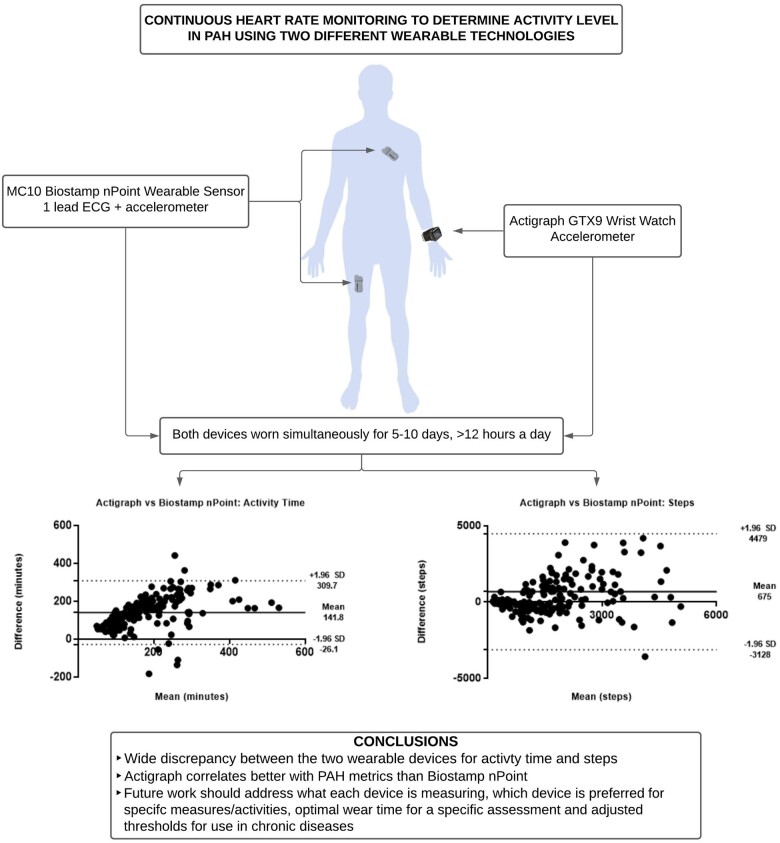
Activity trackers for clinical trials and remote monitoring are appealing as they provide objective data outside of the clinic setting. Algorithms determine physical activity intensity and count steps. Multiple studies show physical inactivity in pulmonary arterial hypertension (PAH). There are no studies comparing different activity trackers worn on different parts of the body in PAH. We had patients with PAH simultaneously wear two different accelerometers, compared measures between the two devices, and correlated the measures with standard clinical metrics in PAH.
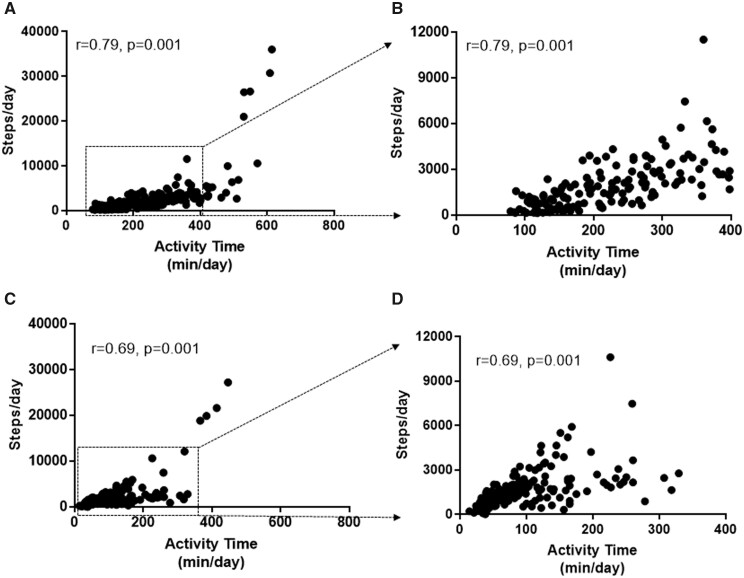
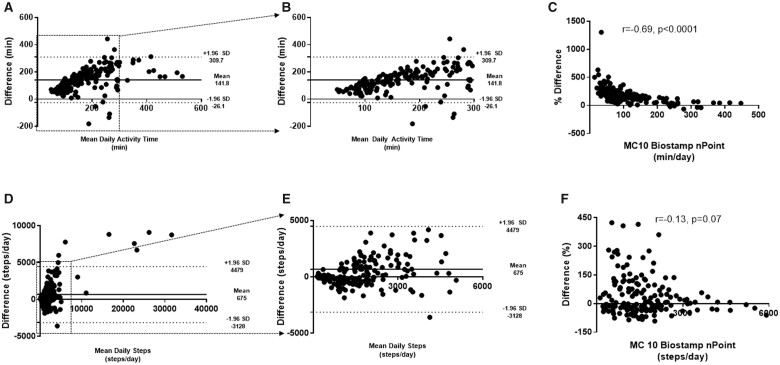
This was a single-centre, prospective observational study. Daily physical activity and daily total steps were measured using Actigraph GT9X Link and MC10 Biostamp nPoint for 5-10 days. Actigraph was worn on the non-dominant hand and the MC10 Biostamp nPoint was worn on the chest and leg with disposable adhesives. Twenty-two participants wore both accelerometers >12 h/day for an average 7.8 days. The average activity time measured by Actigraph was significantly higher than that measured by MC10 (251 ± 25 min vs. 113 ± 18 min, = 0.0001). Actigraph's algorithm reported more time in light activity than moderate (190 ± 62 min vs. 60 ± 56 min, = 0.0001). REVEAL 2.0 scores correlated highly with activity time measured using either device. Invasively measured haemodynamics within 7 days did not correlate with activity time or daily steps.
Different activity trackers yield discordant results in PAH patients. Further studies are needed in determining the best device, optimal wear time, and different thresholds for activities in chronic diseases.
用于临床试验和远程监测的活动追踪器很有吸引力,因为它们能在临床环境之外提供客观数据。算法可确定身体活动强度并计算步数。多项研究表明肺动脉高压(PAH)患者存在身体活动不足的情况。目前尚无研究比较PAH患者佩戴在身体不同部位的不同活动追踪器。我们让PAH患者同时佩戴两种不同的加速度计,比较两种设备的测量结果,并将这些测量结果与PAH的标准临床指标进行关联。
这是一项单中心前瞻性观察研究。使用Actigraph GT9X Link和MC10 Biostamp nPoint测量每日身体活动和每日总步数,为期5至10天。Actigraph佩戴在非优势手上,MC10 Biostamp nPoint使用一次性粘合剂分别佩戴在胸部和腿部。22名参与者每天佩戴两种加速度计超过12小时,平均佩戴7.8天。Actigraph测量的平均活动时间显著高于MC10测量的时间(251±25分钟对113±18分钟,P = 0.0001)。Actigraph的算法报告轻度活动时间多于中度活动时间(190±62分钟对60±56分钟,P = 0.0001)。REVEAL 2.0评分与使用任何一种设备测量的活动时间高度相关。7天内有创测量的血流动力学与活动时间或每日步数无关。
不同的活动追踪器在PAH患者中产生不一致的结果。需要进一步研究以确定最佳设备、最佳佩戴时间以及慢性病活动的不同阈值。