Ghasemi Shima, Oveisi-Oskouei Laleh, Torab Ali, Salehi-Pourmehr Hanieh, Babaloo Amirreza, Vahed Nafiseh, Abolhasanpour Nasrin, Taghilou Sina, Ghasemi Atieh
Department of Prosthodontics, Faculty of Dentistry, Tabriz University of Medical Sciences, Tabriz, Iran.
Student Research Committee, Tabriz University of Medical Sciences, Tabriz, Iran.
J Adv Periodontol Implant Dent. 2022 Nov 12;14(2):119-133. doi: 10.34172/japid.2022.023. eCollection 2022.
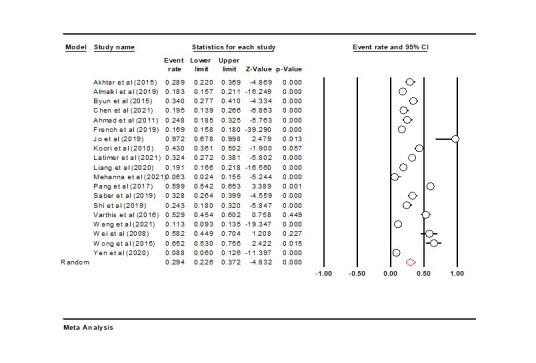
This systematic review and meta-analysis investigated the prevalence of proximal contact loss and its associated factors. A bibliographic search was conducted in June 2021 with no limitation in the article date or language and updated in January 2022 by hand searching. There was no time limit on the search to retrieve all studies. The search included randomized controlled trials or quasi-experiments, and cross-sectional or cohort studies were included in the absence of these studies. Two authors screened the title and abstract. After evaluating the full texts of selected articles, irrelevant studies and or non-English papers that were impossible to translate were excluded. Disagreements between the re-viewers' selection process were resolved by debate on the eligibility of studies. Standardized critical appraisal instruments from the Joanna Briggs Institute for different types of studies were used to assess the studies' quality. Comprehensive Meta-Analysis (CMA) software (Version 2.2; Biostat, Englewood, NJ) was used for data analysis. The proximal contact loss (PCL) frequency was %29. According to the results, the frequencies of PCL for the distal and mesial aspects were %7 and %21, respectively. The meta-analysis results showed that the contact loss events on the mesial aspect were statistically higher than on the distal aspect (P<0.0001). There were no significant differences between other associated factors such as the mandibular or maxillary arch, retention type, opposing dentition, implant type, molar or non-molar, parafunction behaviors, and vitality of adjacent teeth. There was a significant association between bone loss and PCL, and in individuals with bone loss >%50, the proximal contact loss was higher (OR: %95[ 2.43 CI: 4.03‒1.47], P=0.0006). The PCL in the anterior area was lower than in the posterior area (P=0.004). Although the frequency of contact loss in females was higher than in males, this rate was not statistically significant. The PCL on the mesial aspect and the posterior area was high. In individuals with bone loss >%50, the proximal contact loss was higher than in others.
本系统评价和荟萃分析调查了近端接触丧失的患病率及其相关因素。2021年6月进行了文献检索,对文章日期或语言没有限制,并于2022年1月通过手工检索进行了更新。检索没有时间限制以获取所有研究。检索包括随机对照试验或准实验,在没有这些研究的情况下纳入横断面或队列研究。两名作者筛选了标题和摘要。在评估所选文章的全文后,排除了无关研究和/或无法翻译的非英文论文。评审员选择过程中的分歧通过对研究资格的辩论来解决。使用乔安娜·布里格斯研究所针对不同类型研究的标准化批判性评估工具来评估研究质量。使用综合荟萃分析(CMA)软件(版本2.2;Biostat,恩格尔伍德,新泽西州)进行数据分析。近端接触丧失(PCL)频率为29%。根据结果,远中面和近中面的PCL频率分别为7%和21%。荟萃分析结果表明,近中面的接触丧失事件在统计学上高于远中面(P<0.0001)。在下颌或上颌牙弓、固位类型、对颌牙列、种植体类型、磨牙或非磨牙、功能异常行为以及邻牙活力等其他相关因素之间没有显著差异。骨丧失与PCL之间存在显著关联,在骨丧失>50%的个体中,近端接触丧失更高(比值比:95%[可信区间2.43:4.03‒1.47],P=0.0006)。前部区域的PCL低于后部区域(P=0.004)。虽然女性接触丧失的频率高于男性,但该比率在统计学上并不显著。近中面和后部区域的PCL较高。在骨丧失>50%的个体中,近端接触丧失高于其他个体。