Talsma Carl J, Solander Kurt C, Mudunuru Maruti K, Crawford Brandon, Powell Michelle R
Los Alamos National Laboratory, Earth and Environmental Sciences Division, Los Alamos, NM, United States.
Carbon Solutions LLC, Bloomington, IN, United States.
Front Artif Intell. 2023 Jan 12;5:963781. doi: 10.3389/frai.2022.963781. eCollection 2022.
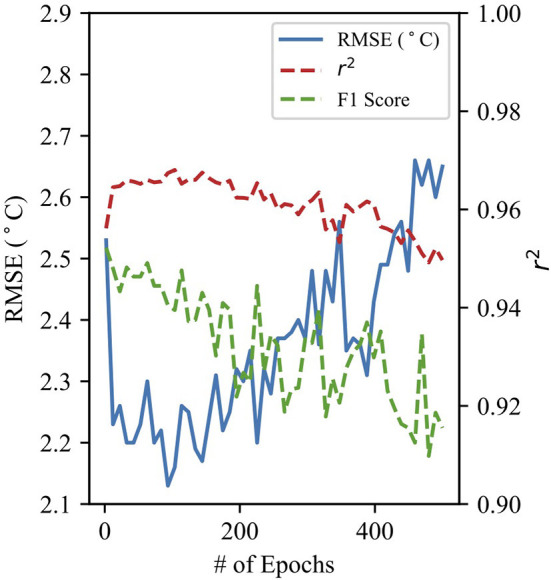
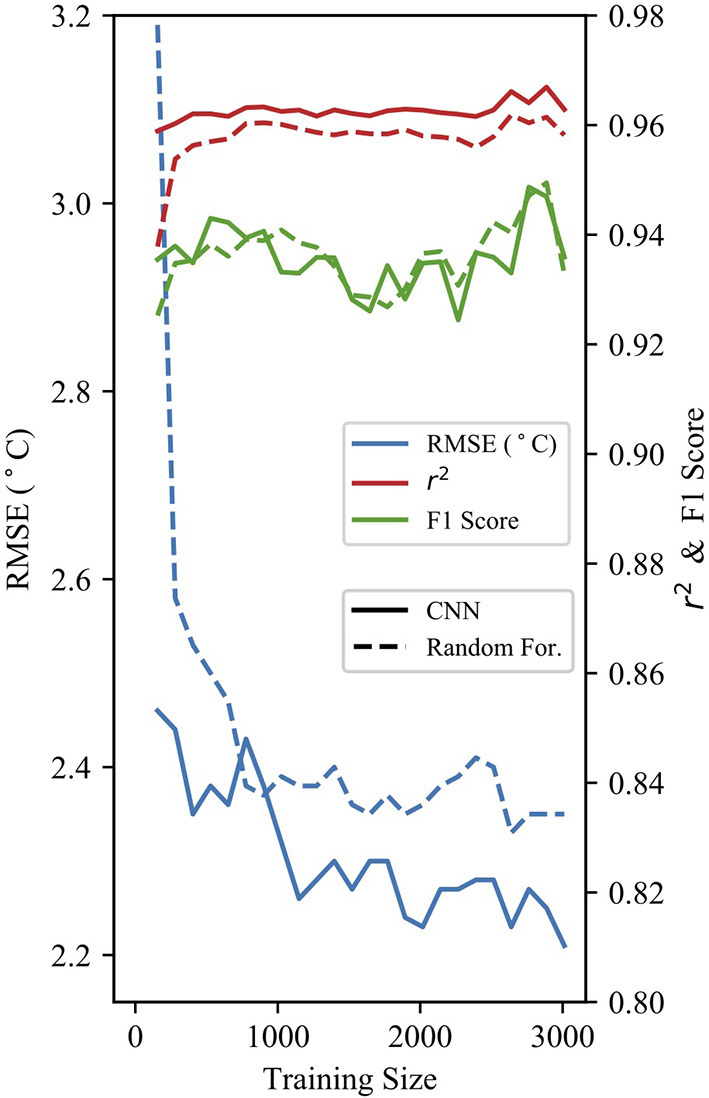
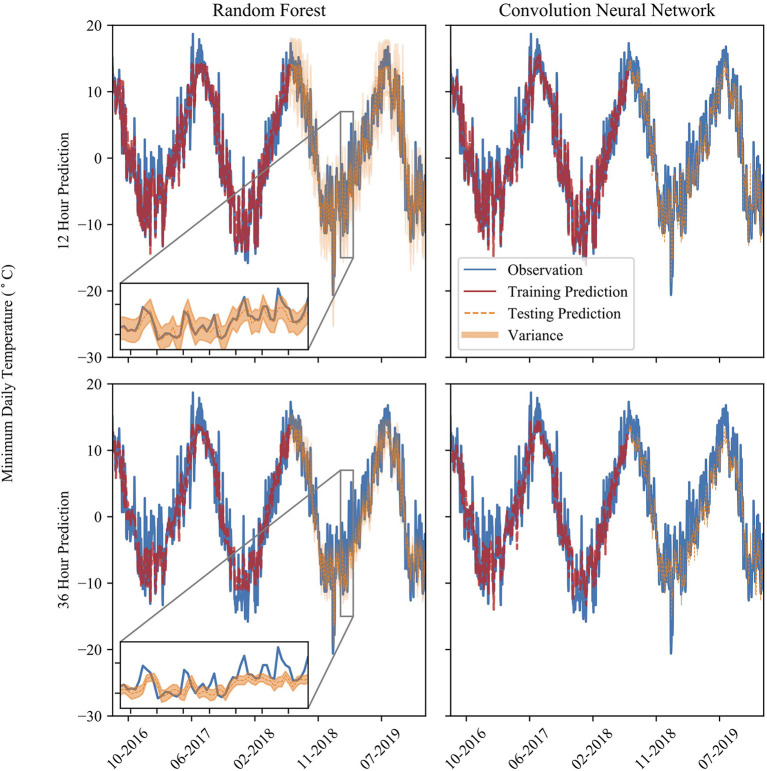
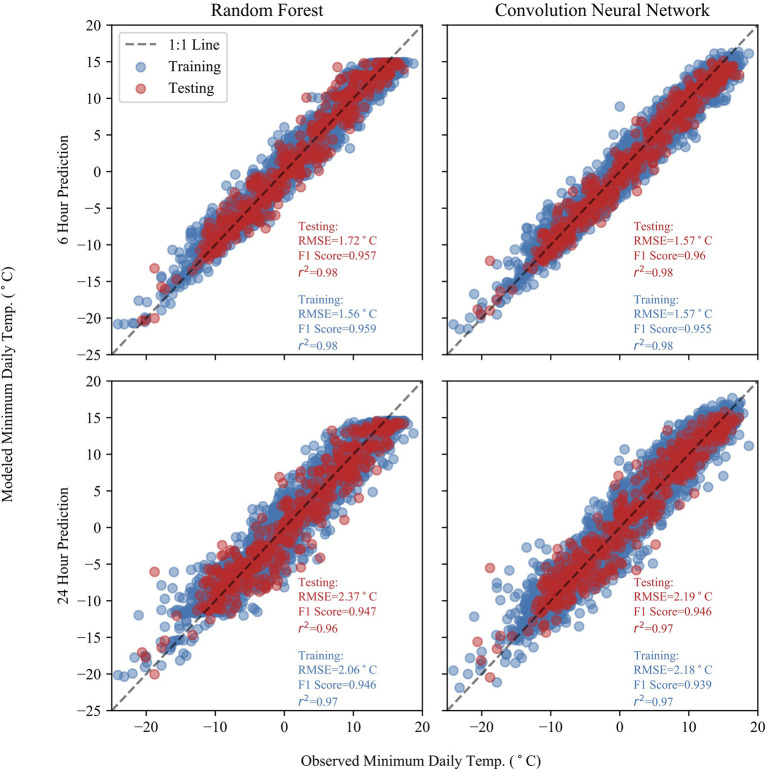
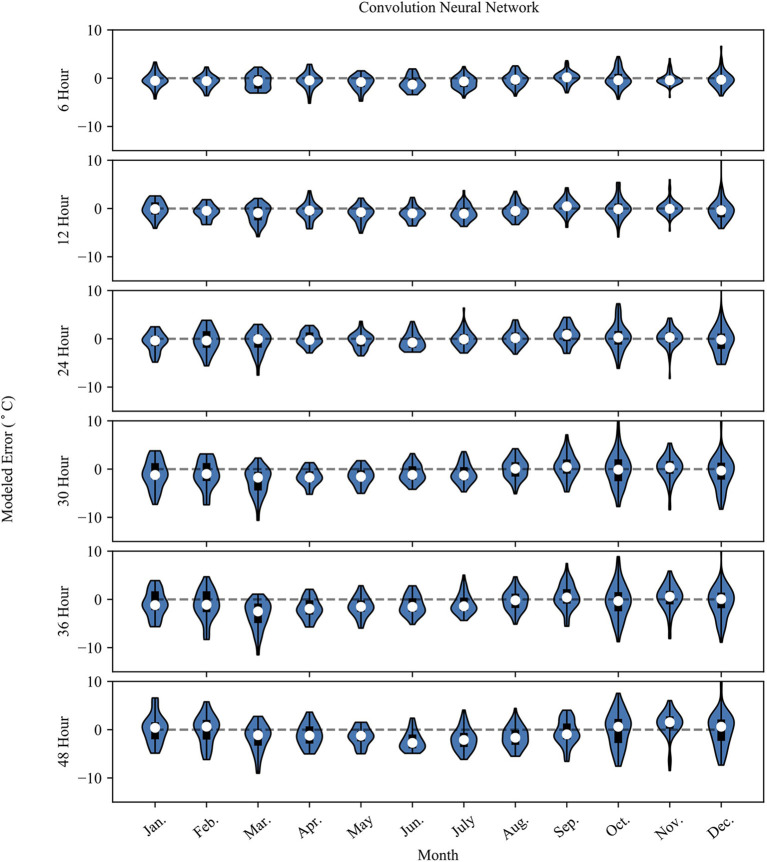
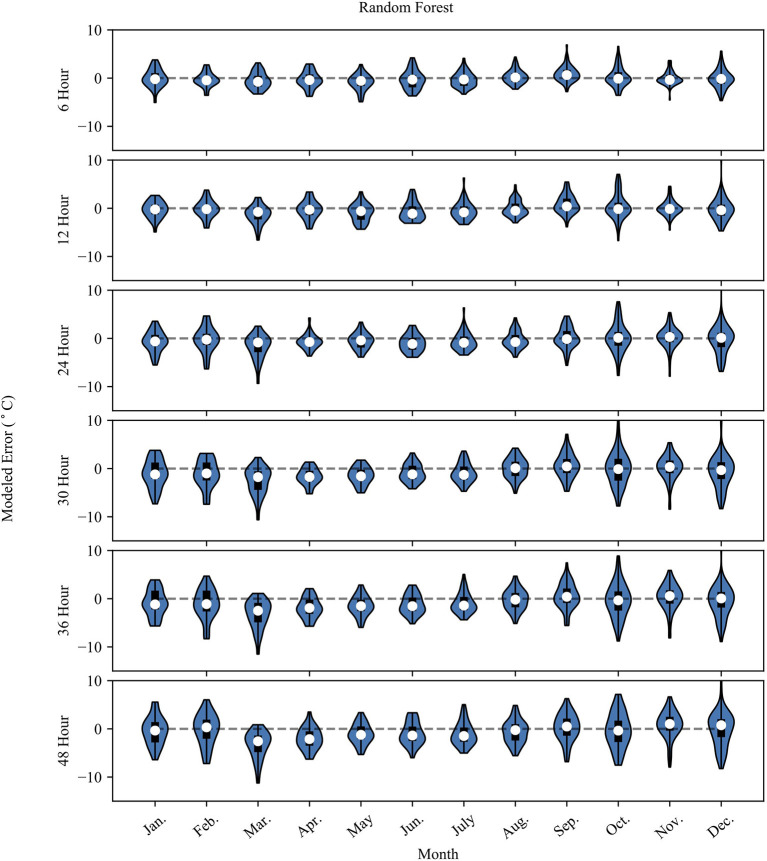
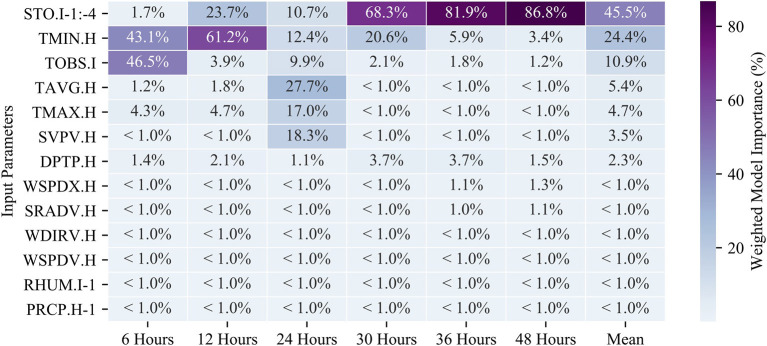
This study describes accurate, computationally efficient models that can be implemented for practical use in predicting frost events for point-scale agricultural applications. Frost damage in agriculture is a costly burden to farmers and global food security alike. Timely prediction of frost events is important to reduce the cost of agricultural frost damage and traditional numerical weather forecasts are often inaccurate at the field-scale in complex terrain. In this paper, we developed machine learning (ML) algorithms for the prediction of such frost events near Alcalde, NM at the point-scale. ML algorithms investigated include deep neural network, convolution neural networks, and random forest models at lead-times of 6-48 h. Our results show promising accuracy (6-h prediction RMSE = 1.53-1.72°C) for use in frost and minimum temperature prediction applications. Seasonal differences in model predictions resulted in a slight negative bias during Spring and Summer months and a positive bias in Fall and Winter months. Additionally, we tested the model transferability by continuing training and testing using data from sensors at a nearby farm. We calculated the feature importance of the random forest models and were able to determine which parameters provided the models with the most useful information for predictions. We determined that soil temperature is a key parameter in longer term predictions (>24 h), while other temperature related parameters provide the majority of information for shorter term predictions. The model error compared favorable to previous ML based frost studies and outperformed the physically based High Resolution Rapid Refresh forecasting system making our ML-models attractive for deployment toward real-time monitoring of frost events and damage at commercial farming operations.
本研究描述了准确、计算效率高的模型,这些模型可用于实际预测点尺度农业应用中的霜冻事件。农业中的霜冻灾害对农民和全球粮食安全来说都是代价高昂的负担。及时预测霜冻事件对于降低农业霜冻灾害成本很重要,而传统数值天气预报在复杂地形的田间尺度上往往不准确。在本文中,我们开发了机器学习(ML)算法,用于在新墨西哥州阿尔卡德附近进行点尺度的此类霜冻事件预测。所研究的ML算法包括深度神经网络、卷积神经网络和随机森林模型,预测提前期为6至48小时。我们的结果显示,在霜冻和最低温度预测应用中具有可观的准确率(6小时预测均方根误差=1.53-1.72°C)。模型预测的季节差异导致春季和夏季月份有轻微负偏差,秋季和冬季月份有正偏差。此外,我们通过使用附近农场传感器的数据继续训练和测试来检验模型的可转移性。我们计算了随机森林模型的特征重要性,并能够确定哪些参数为模型提供了最有用的预测信息。我们确定土壤温度是长期预测(>24小时)的关键参数,而其他与温度相关的参数为短期预测提供了大部分信息。与之前基于ML的霜冻研究相比,该模型误差较小,并且优于基于物理的高分辨率快速更新预报系统,这使得我们的ML模型在商业农场运营中用于实时监测霜冻事件和损害方面具有吸引力。