Ying Weihai
1954 Huashan Road, Shanghai, 200030 China Med-X Research Institute and School of Biomedical Engineering, Shanghai Jiao Tong University.
Shanghai, 200043 China Collaborative Innovation Center for Genetics and Development.
Phenomics. 2023 Jan 5;3(3):285-299. doi: 10.1007/s43657-022-00089-4. eCollection 2023 Jun.
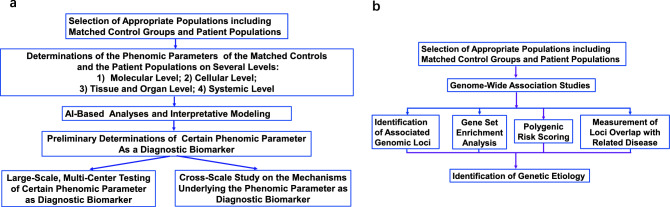
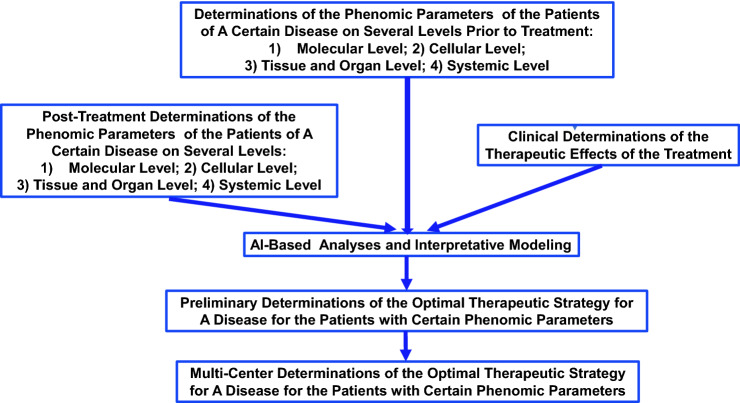
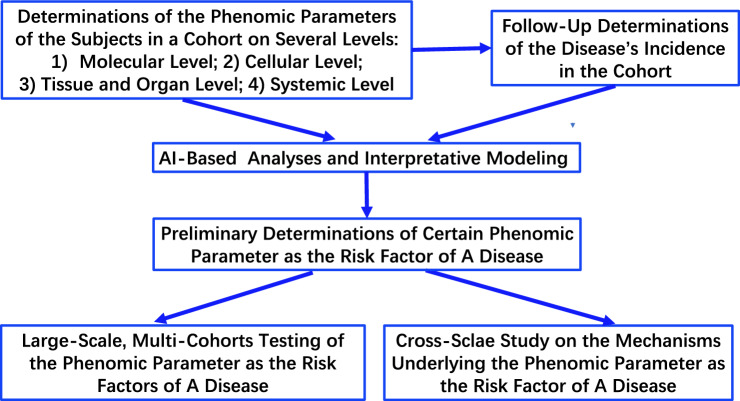
The rapid development of such research field as multi-omics and artificial intelligence (AI) has made it possible to acquire and analyze the multi-dimensional big data of human phenomes. Increasing evidence has indicated that phenomics can provide a revolutionary strategy and approach for discovering new risk factors, diagnostic biomarkers and precision therapies of diseases, which holds profound advantages over conventional approaches for realizing precision medicine: first, the big data of patients' phenomes can provide remarkably richer information than that of the genomes; second, phenomic studies on diseases may expose the correlations among cross-scale and multi-dimensional phenomic parameters as well as the mechanisms underlying the correlations; and third, phenomics-based studies are big data-driven studies, which can significantly enhance the possibility and efficiency for generating novel discoveries. However, phenomic studies on human diseases are still in early developmental stage, which are facing multiple major challenges and tasks: first, there is significant deficiency in analytical and modeling approaches for analyzing the multi-dimensional data of human phenomes; second, it is crucial to establish universal standards for acquirement and management of phenomic data of patients; third, new methods and devices for acquirement of phenomic data of patients under clinical settings should be developed; fourth, it is of significance to establish the regulatory and ethical guidelines for phenomic studies on diseases; and fifth, it is important to develop effective international cooperation. It is expected that phenomic studies on diseases would profoundly and comprehensively enhance our capacity in prevention, diagnosis and treatment of diseases.
多组学和人工智能(AI)等研究领域的迅速发展,使得获取和分析人类表型组的多维大数据成为可能。越来越多的证据表明,表型组学可为发现疾病的新风险因素、诊断生物标志物和精准治疗方法提供革命性的策略和途径,与传统方法相比,在实现精准医学方面具有显著优势:其一,患者表型组的大数据能够提供比基因组数据丰富得多的信息;其二,对疾病的表型组学研究可能揭示跨尺度和多维表型组参数之间的相关性及其潜在机制;其三,基于表型组学的研究是大数据驱动的研究,能够显著提高产生新发现的可能性和效率。然而,人类疾病的表型组学研究仍处于早期发展阶段,面临着多项重大挑战和任务:其一,在分析人类表型组多维数据的分析和建模方法方面存在重大不足;其二,为患者表型组数据的获取和管理建立通用标准至关重要;其三,应开发在临床环境下获取患者表型组数据的新方法和设备;其四,为疾病的表型组学研究建立监管和伦理准则具有重要意义;其五,开展有效的国际合作很重要。预计疾病的表型组学研究将全面而深刻地提升我们预防、诊断和治疗疾病的能力。