Krassnig Sarah Ceylan, Mäser Marina, Probst Nicola Anna, Werner Jens, Schlett Charlotte, Schumann Nina, von Scheven Gudrun, Mangerich Aswin, Bürkle Alexander
Molecular Toxicology, Department of Biology, University of Konstanz, D-78464 Konstanz, Germany.
Nutritional Toxicology, Institute of Nutritional Science, University of Potsdam, D-14558 Nuthetal, Germany.
Toxicol Rep. 2023 Jan 20;10:171-189. doi: 10.1016/j.toxrep.2023.01.010. eCollection 2023.
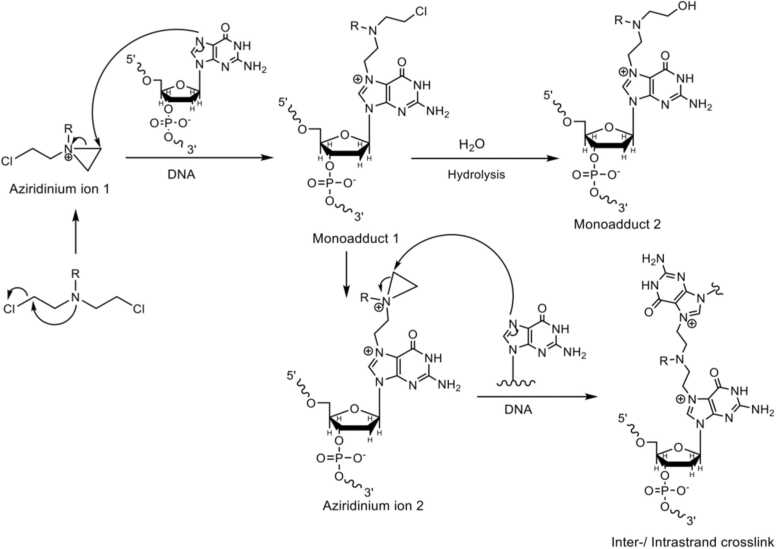
Chlorambucil (CLB) belongs to the class of nitrogen mustards (NMs), which are highly reactive bifunctional alkylating agents and were the first chemotherapeutic agents developed. They form DNA interstrand crosslinks (ICLs), which cause a blockage of DNA strand separation, inhibiting essential processes in DNA metabolism like replication and transcription. In fast replicating cells, e.g., tumor cells, this can induce cell death. The upregulation of ICL repair is thought to be a key factor for the resistance of tumor cells to ICL-inducing cytostatic agents including NMs. To monitor induction and repair of CLB-induced ICLs, we adjusted the automated reversed fluorometric analysis of alkaline DNA unwinding assay (rFADU) for the detection of ICLs in adherent cells. For the detection of monoalkylated DNA bases we established an LC-MS/MS method. We performed a comparative analysis of adduct formation and removal in five human cell lines and in peripheral blood mononuclear cells (PBMCs) after treatment with CLB. Dose-dependent increases in adduct formation were observed, and suitable treatment concentrations were identified for each cell line, which were then used for monitoring the kinetics of adduct formation. We observed significant differences in the repair kinetics of the cell lines tested. For example, in A2780 cells, hTERT immortalized VH10 cells, and in PBMCs a time-dependent repair of the two main monoalkylated DNA-adducts was confirmed. Regarding ICLs, repair was observed in all cell systems except for PBMCs. In conclusion, LC-MS/MS analyses combined with the rFADU technique are powerful tools to study the molecular mechanisms of NM-induced DNA damage and repair. By applying these methods to a spectrum of human cell systems of different origin and transformation status, we obtained insight into the cell-type specific repair of different CLB-induced DNA lesions, which may help identify novel resistance mechanisms of tumors and define molecular targets for therapeutic interventions.
苯丁酸氮芥(CLB)属于氮芥类(NMs),氮芥是高反应性双功能烷基化剂,是最早开发的化疗药物。它们形成DNA链间交联(ICLs),导致DNA链分离受阻,抑制DNA代谢中的关键过程,如复制和转录。在快速复制的细胞(如肿瘤细胞)中,这可诱导细胞死亡。ICL修复的上调被认为是肿瘤细胞对包括氮芥在内的ICL诱导性细胞抑制剂产生抗性的关键因素。为了监测CLB诱导的ICL的诱导和修复,我们调整了碱性DNA解旋分析(rFADU)的自动反向荧光分析,以检测贴壁细胞中的ICL。为了检测单烷基化DNA碱基,我们建立了一种液相色谱-串联质谱(LC-MS/MS)方法。在用CLB处理后,我们对五种人类细胞系和外周血单核细胞(PBMCs)中的加合物形成和去除进行了比较分析。观察到加合物形成呈剂量依赖性增加,并确定了每个细胞系的合适处理浓度,然后用于监测加合物形成的动力学。我们观察到所测试细胞系的修复动力学存在显著差异。例如,在A2780细胞、hTERT永生化VH10细胞和PBMCs中,证实了两种主要单烷基化DNA加合物的时间依赖性修复。关于ICL,除PBMCs外,在所有细胞系统中均观察到修复。总之,LC-MS/MS分析与rFADU技术相结合是研究氮芥诱导的DNA损伤和修复分子机制的有力工具。通过将这些方法应用于一系列不同来源和转化状态的人类细胞系统,我们深入了解了不同CLB诱导的DNA损伤的细胞类型特异性修复,这可能有助于识别肿瘤的新抗性机制并确定治疗干预的分子靶点。