Zhang Lu, Zhang Fen, Wang Yuan, Ma Xiao, Shen Yuanpeng, Wang Xiaozhong, Yang Huaiyu, Zhang Wei, Lakshmanan Prakash, Hu Yuncai, Xu Jiuliang, Chen Xinping, Deng Yan
Interdisciplinary Research Center for Agriculture Green Development in Yangtze River Basin, College of Resources and Environment, Southwest University, Chongqing, China.
Key Laboratory of Low-carbon Green Agriculture in Southwestern China, Ministry of Agriculture and Rural Affairs, Southwest University, Chongqing, China.
Front Plant Sci. 2023 Jan 13;13:1049785. doi: 10.3389/fpls.2022.1049785. eCollection 2022.
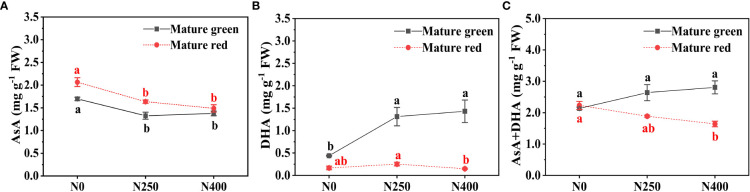
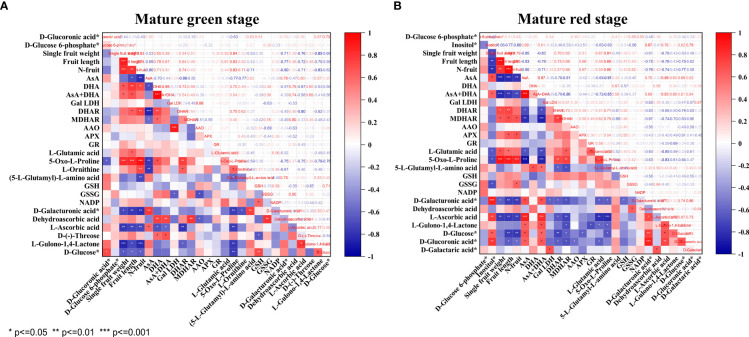
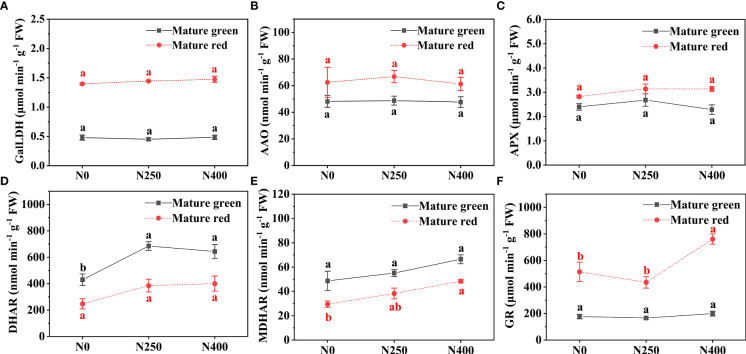
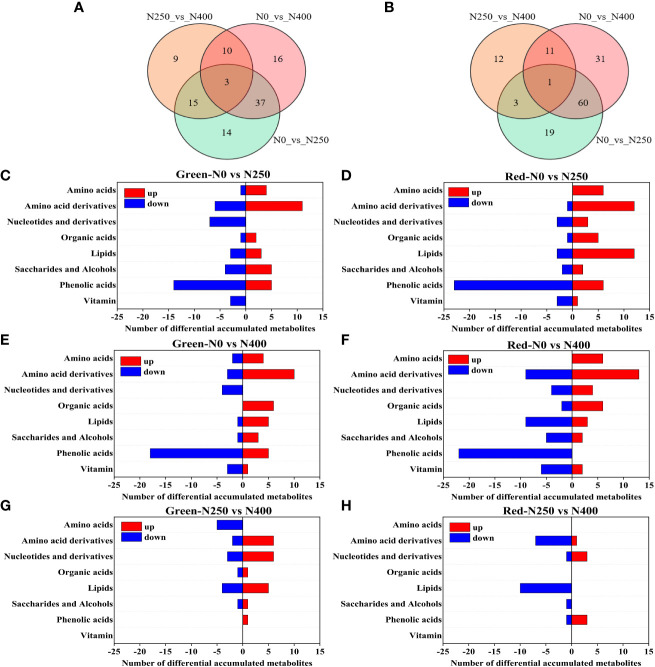
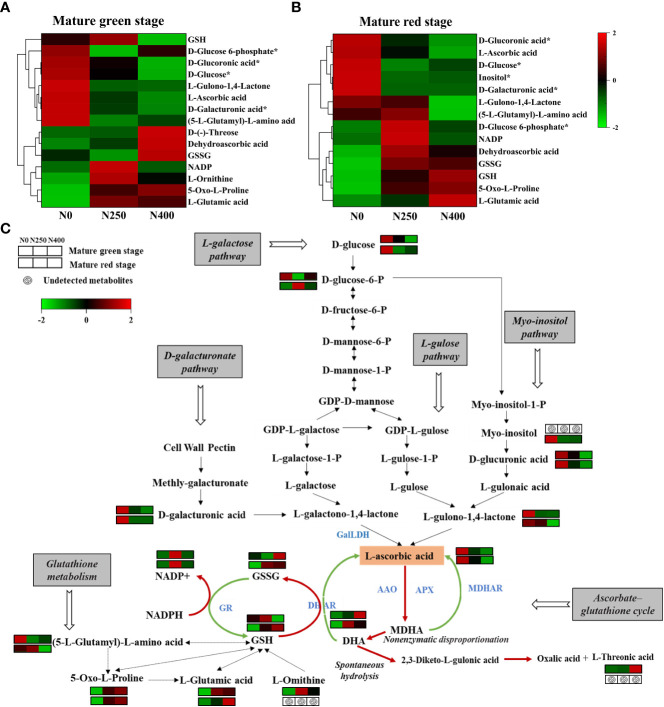
Pepper is one of the most vitamin C enriched vegetables worldwide. Although applying nitrogen (N) fertilizer is an important practice for high fruit yield in pepper production, it is still unclear how N application regulates pepper fruit vitamin C anabolism at different maturity stage. To further the understanding, we combined physiological and metabolomic analysis to investigate the fruit vitamin C content (including ascorbic acid (AsA) and dehydroascorbic acid (DHA)), related enzyme activity and non-targeted metabolites of field-grown chili pepper produced under different N levels at mature green and red stages. The results showed that increasing N application reduced AsA content in pepper fruit at both maturity stages, but highly elevated DHA content only at mature green stage. Regardless of N application level, AsA content displayed an increasing trend while DHA content was reduced as pepper fruit maturity advanced, resulting in a higher content of total vitamin C at the mature green stage. The L-galactose pathway, D-galacturonate pathway, and myo-inositol pathway were identified for AsA biosynthesis. The involved precursor metabolites were mainly negatively regulated by increasing N application, and their accumulation increased when pepper fruit developed from green to red stage. Meanwhile, the activities of key enzymes and metabolites in relation to degradation and recycling processes of AsA and DHA were increased or did not change with increasing N application, and they were differently influenced as fruit maturing. As a result, the recommended N application level (250 kg N ha) could maintain relatively high total vitamin C content in pepper fruits without yield loss at both maturity stages. These findings highlight the importance of optimizing N application level to maximize vitamin C content in pepper fruits, and provide a better understanding of the maturity stage-dependent N regulation on vitamin C anabolism.
辣椒是全球维生素C含量最丰富的蔬菜之一。虽然施用氮肥是辣椒生产中实现高产的一项重要措施,但氮肥施用如何在不同成熟阶段调节辣椒果实维生素C的合成仍不清楚。为了进一步了解这一情况,我们结合生理和代谢组学分析,研究了在不同氮水平下田间种植的辣椒在绿熟期和红熟期的果实维生素C含量(包括抗坏血酸(AsA)和脱氢抗坏血酸(DHA))、相关酶活性和非靶向代谢产物。结果表明,增加氮肥施用量在两个成熟阶段均降低了辣椒果实中的AsA含量,但仅在绿熟期显著提高了DHA含量。无论氮肥施用量如何,随着辣椒果实成熟,AsA含量呈增加趋势,而DHA含量降低,导致绿熟期总维生素C含量更高。确定了AsA生物合成的L-半乳糖途径、D-半乳糖醛酸途径和肌醇途径。所涉及的前体代谢产物主要受到氮肥施用量增加的负调控,当辣椒果实从绿色发育到红色阶段时,它们的积累增加。同时,与AsA和DHA降解及循环过程相关的关键酶活性和代谢产物随氮肥施用量增加而增加或不变,并且它们在果实成熟时受到不同影响。因此,推荐的氮肥施用量(250 kg N/ha)可以在两个成熟阶段保持辣椒果实中相对较高的总维生素C含量而不损失产量。这些发现突出了优化氮肥施用量以最大化辣椒果实中维生素C含量的重要性,并为氮肥对维生素C合成的成熟阶段依赖性调控提供了更好的理解。