Department of Paediatrics, Yong Loo Lin School of Medicine, National University of Singapore, Singapore.
Khoo Teck Puat-National University Children's Medical Institute, National University Health System, Singapore.
JAMA Pediatr. 2023 Mar 1;177(3):311-318. doi: 10.1001/jamapediatrics.2022.5674.
Research evidence is mounting for the association between infant screen use and negative cognitive outcomes related to attention and executive functions. The nature, timing, and persistence of screen time exposure on neural functions are currently unknown. Electroencephalography (EEG) permits elucidation of the neural correlates associated with cognitive impairments.
To examine the associations between infant screen time, EEG markers, and school-age cognitive outcomes using mediation analysis with structural equation modeling.
DESIGN, SETTING, AND PARTICIPANTS: This prospective maternal-child dyad cohort study included participants from the population-based study Growing Up in Singapore Toward Healthy Outcomes (GUSTO). Pregnant mothers were enrolled in their first trimester from June 2009 through December 2010. A subset of children who completed neurodevelopmental visits at ages 12 months and 9 years had EEG performed at age 18 months. Data were reported from 3 time points at ages 12 months, 18 months, and 9 years. Mediation analyses were used to investigate how neural correlates were involved in the paths from infant screen time to the latent construct of attention and executive functioning. Data for this study were collected from November 2010 to March 2020 and were analyzed between October 2021 and May 2022.
Parent-reported screen time at age 12 months.
Power spectral density from EEG was collected at age 18 months. Child attention and executive functions were measured with teacher-reported questionnaires and objective laboratory-based tasks at age 9 years.
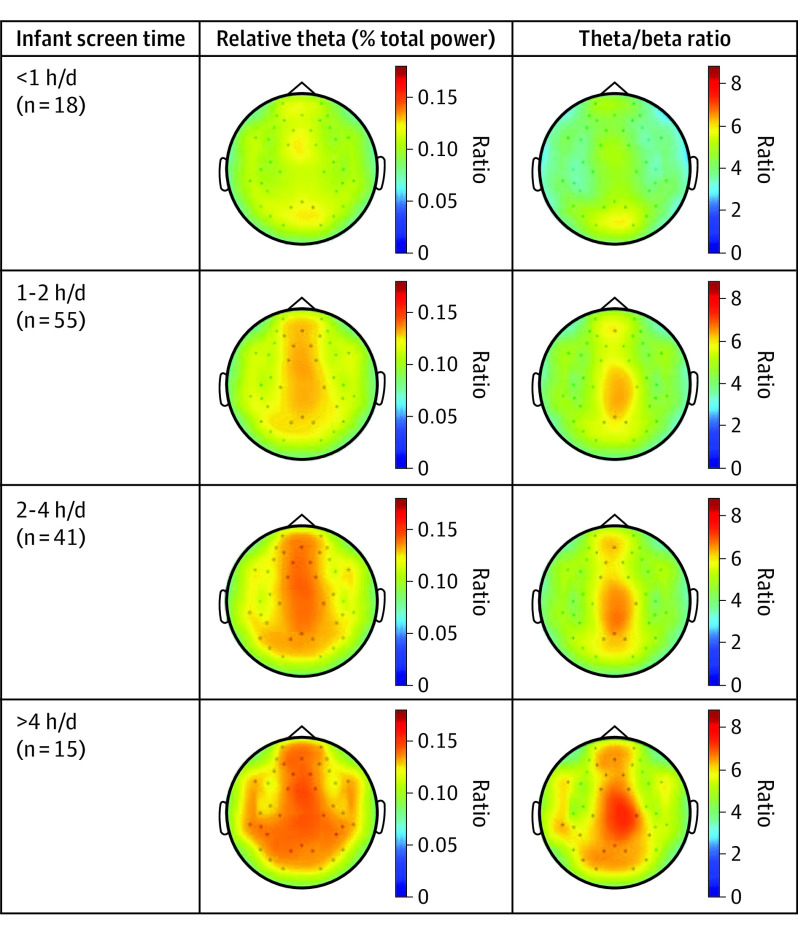
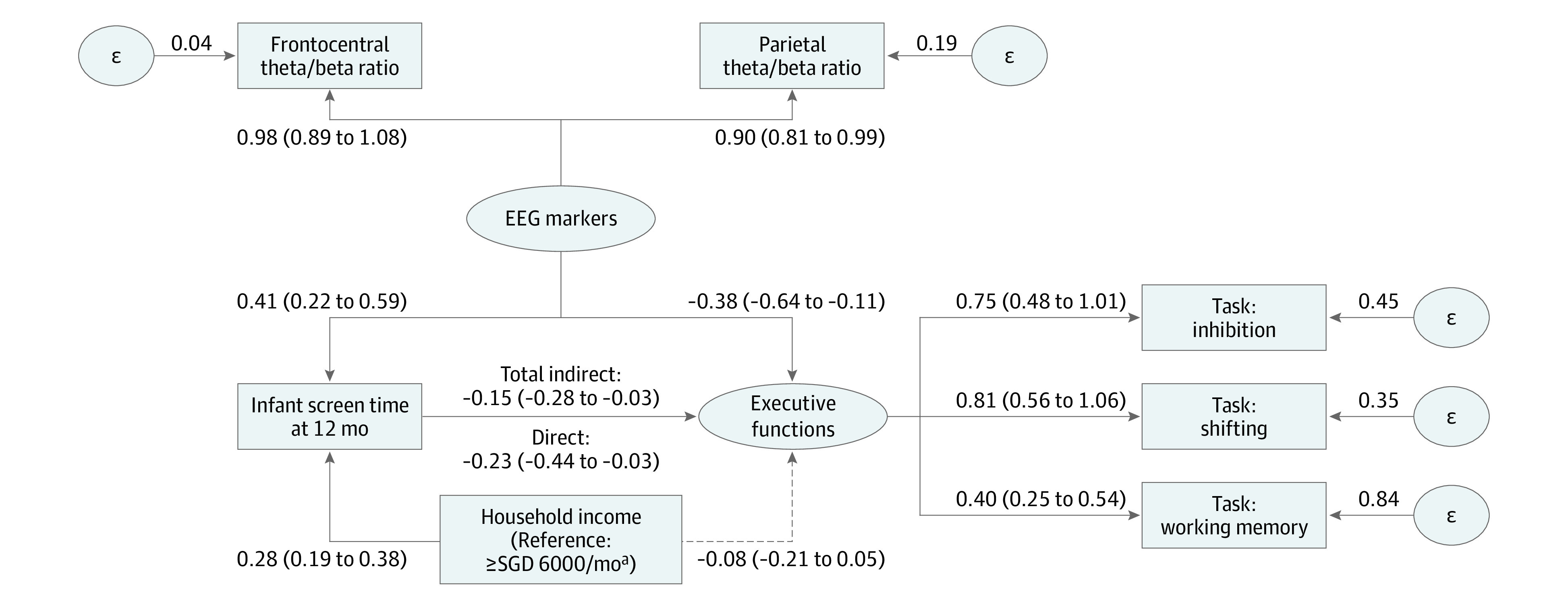
In this sample of 437 children, the mean (SD) age at follow-up was 8.84 (0.07) years, and 227 children (51.9%) were male. The mean (SD) amount of daily screen time at age 12 months was 2.01 (1.86) hours. Screen time at age 12 months contributed to multiple 9-year attention and executive functioning measures (η2, 0.03-0.16; Cohen d, 0.35-0.87). A subset of 157 children had EEG performed at age 18 months; EEG relative theta power and theta/beta ratio at the frontocentral and parietal regions showed a graded correlation with 12-month screen use (r = 0.35-0.37). In the structural equation model accounting for household income, frontocentral and parietal theta/beta ratios partially mediated the association between infant screen time and executive functioning at school age (exposure-mediator β, 0.41; 95% CI, 0.22 to 0.59; mediator-outcome β, -0.38; 95% CI, -0.64 to -0.11), forming an indirect path that accounted for 39.4% of the association.
In this study, infant screen use was associated with altered cortical EEG activity before age 2 years; the identified EEG markers mediated the association between infant screen time and executive functions. Further efforts are urgently needed to distinguish the direct association of infant screen use compared with family factors that predispose early screen use on executive function impairments.
越来越多的研究证据表明,婴儿屏幕使用与注意力和执行功能相关的认知障碍之间存在关联。目前尚不清楚屏幕时间暴露对神经功能的性质、时间和持续性。脑电图(EEG)可以阐明与认知障碍相关的神经相关性。
通过结构方程模型的中介分析,研究婴儿屏幕时间、脑电图标志物与学龄期认知结果之间的关联。
设计、地点和参与者:这是一项基于人群的前瞻性母婴对子队列研究,参与者来自新加坡儿童健康结果研究(GUSTO)。在 2009 年 6 月至 2010 年 12 月期间,孕妇在妊娠早期入组。一部分在 12 个月和 9 岁时完成神经发育访视的儿童在 18 个月时进行脑电图检查。数据来自 12 个月、18 个月和 9 岁时的 3 个时间点。使用中介分析来研究神经相关性如何参与从婴儿屏幕时间到注意力和执行功能的潜在结构的路径。本研究的数据收集于 2010 年 11 月至 2020 年 3 月,分析于 2021 年 10 月至 2022 年 5 月进行。
12 个月时父母报告的屏幕时间。
18 个月时采集脑电图的功率谱密度。9 岁时,使用教师报告的问卷和客观实验室任务测量儿童的注意力和执行功能。
在这个 437 名儿童的样本中,随访时的平均(SD)年龄为 8.84(0.07)岁,227 名儿童(51.9%)为男性。12 个月时的平均(SD)每日屏幕时间为 2.01(1.86)小时。12 个月时的屏幕时间与多项 9 岁时的注意力和执行功能测量结果相关(η2,0.03-0.16;Cohen d,0.35-0.87)。157 名儿童进行了脑电图检查;额中央和顶叶的脑电图相对θ功率和θ/β 比值与 12 个月的屏幕使用呈梯度相关(r=0.35-0.37)。在考虑家庭收入的结构方程模型中,额中央和顶叶的θ/β 比值部分中介了婴儿屏幕时间与学龄期执行功能之间的关联(暴露-中介 β,0.41;95%CI,0.22 至 0.59;中介-结果 β,-0.38;95%CI,-0.64 至-0.11),形成了一个占关联 39.4%的间接路径。
在这项研究中,婴儿屏幕使用与 2 岁前的皮质脑电图活动改变有关;确定的脑电图标志物介导了婴儿屏幕时间与执行功能之间的关联。迫切需要进一步努力区分婴儿屏幕使用的直接关联与易导致早期屏幕使用的家庭因素与执行功能障碍之间的关联。