Rochford Ben, Pendse Sachin, Kumar Neha, De Choudhury Munmun
School of Interactive Computing, College of Computing, Georgia Institute of Technology, Atlanta, GA, United States.
JMIR Ment Health. 2023 Jan 30;10:e43253. doi: 10.2196/43253.
In the United States, 1 out of every 3 people lives in a mental health professional shortage area. Shortage areas tend to be rural, have higher levels of poverty, and have poor mental health outcomes. Previous work has demonstrated that these poor outcomes may arise from interactions between a lack of resources and lack of recognition of mental illness by medical professionals.
We aimed to understand the differences in how people in shortage and nonshortage areas search for information about mental health on the web.
We analyzed search engine log data related to health from 2017-2021 and examined the differences in mental health search behavior between shortage and nonshortage areas. We analyzed several axes of difference, including shortage versus nonshortage comparisons, urban versus rural comparisons, and temporal comparisons.
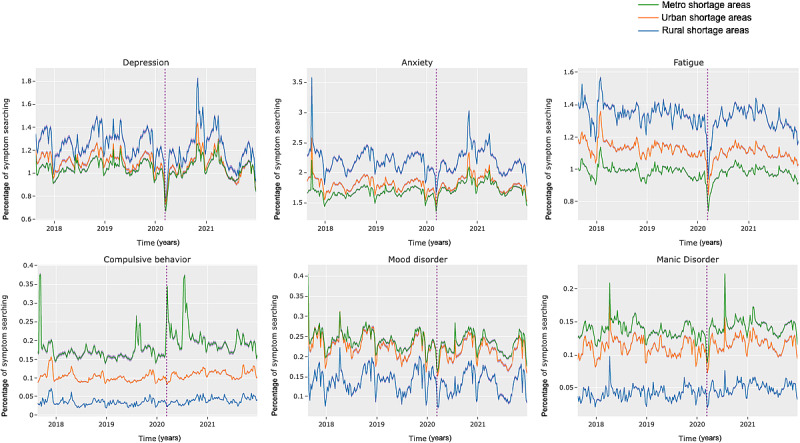
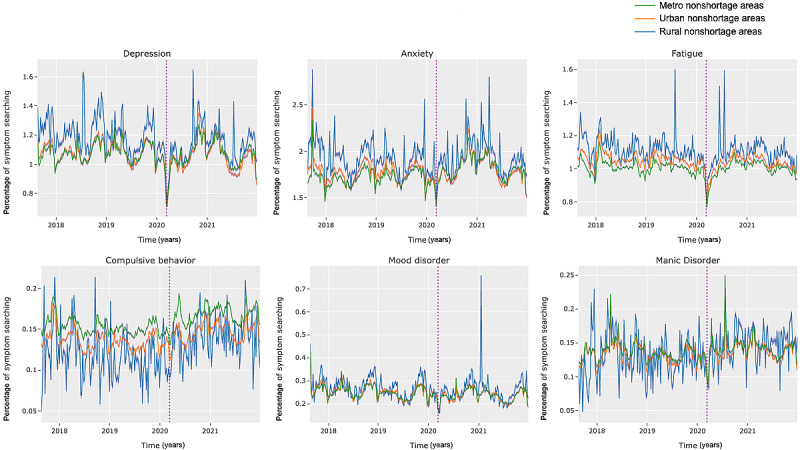
We found specific differences in search behavior between shortage and nonshortage areas. In shortage areas, broader and more general mental health symptom categories, namely anxiety (mean 2.03%, SD 0.44%), depression (mean 1.15%, SD 0.27%), fatigue (mean 1.21%, SD 0.28%), and headache (mean 1.03%, SD 0.23%), were searched significantly more often (Q<.0003). In contrast, specific symptom categories and mental health disorders such as binge eating (mean 0.02%, SD 0.02%), psychosis (mean 0.37%, SD 0.06%), and attention-deficit/hyperactivity disorder (mean 0.77%, SD 0.10%) were searched significantly more often (Q<.0009) in nonshortage areas. Although suicide rates are consistently known to be higher in shortage and rural areas, we see that the rates of suicide-related searching are lower in shortage areas (mean 0.05%, SD 0.04%) than in nonshortage areas (mean 0.10%, SD 0.03%; Q<.0003), more so when a shortage area is rural (mean 0.024%, SD 0.029%; Q<2 × 10).
This study demonstrates differences in how people from geographically marginalized groups search on the web for mental health. One main implication of this work is the influence that search engine ranking algorithms and interface design might have on the kinds of resources that individuals use when in distress. Our results support the idea that search engine algorithm designers should be conscientious of the role that structural factors play in expressions of distress and they should attempt to design search engine algorithms and interfaces to close gaps in care.
在美国,每三个人中就有一人生活在心理健康专业人员短缺的地区。短缺地区往往是农村地区,贫困程度较高,心理健康状况较差。先前的研究表明,这些不良后果可能源于资源匮乏与医疗专业人员对精神疾病认识不足之间的相互作用。
我们旨在了解短缺地区和非短缺地区的人们在网上搜索心理健康信息的方式有何不同。
我们分析了2017年至2021年与健康相关的搜索引擎日志数据,并研究了短缺地区和非短缺地区在心理健康搜索行为上的差异。我们分析了几个差异轴,包括短缺地区与非短缺地区的比较、城市与农村的比较以及时间上的比较。
我们发现短缺地区和非短缺地区在搜索行为上存在特定差异。在短缺地区,更广泛、更一般的心理健康症状类别,即焦虑(平均2.03%,标准差0.44%)、抑郁(平均1.15%,标准差0.27%)、疲劳(平均1.21%,标准差0.28%)和头痛(平均1.03%,标准差0.23%)的搜索频率显著更高(Q<0.0003)。相比之下,特定症状类别和精神健康障碍,如暴饮暴食(平均0.02%,标准差0.02%)、精神病(平均0.37%,标准差0.06%)和注意力缺陷多动障碍(平均0.77%,标准差0.10%)在非短缺地区的搜索频率显著更高(Q<0.0009)。尽管一直以来短缺地区和农村地区的自杀率较高,但我们发现短缺地区与自杀相关的搜索率(平均0.05%,标准差0.04%)低于非短缺地区(平均0.10%,标准差0.03%;Q<0.0003),当短缺地区为农村时更是如此(平均0.024%,标准差0.029%;Q<2×10)。
本研究表明地理上边缘化群体的人们在网上搜索心理健康信息的方式存在差异。这项工作的一个主要启示是搜索引擎排名算法和界面设计可能对处于困境中的个人所使用的资源类型产生影响。我们的结果支持这样一种观点,即搜索引擎算法设计者应该意识到结构因素在痛苦表达中所起的作用,并且他们应该尝试设计搜索引擎算法和界面以缩小护理差距。