Andric Zoran, Gálffy Gabriella, Cobo Dols Manuel, Szima Barna, Stojanovic Goran, Petrovic Marina, Felip Enriqueta, Vicente Baz David, Ponce Aix Santiago, Juan-Vidal Oscar, Szalai Zsuzsanna, Losonczy Gyorgy, Calles Blanco Antonio, Bernabe Reyes, García Ledo Gema, Aguilar Hernández Andrés, Duecker Klaus, Zhou Dongli, Schroeder Andreas, Guezel Guelseren, Ciardiello Fortunato
Department of Medical Oncology, Clinical Hospital Center Bezanijska Kosa, Belgrade, Serbia.
Pulmonology Hospital Törökbálint, Törökbálint, Hungary.
JTO Clin Res Rep. 2023 Jan 2;4(2):100461. doi: 10.1016/j.jtocrr.2022.100461. eCollection 2023 Feb.
We present the results of a phase 2a trial of first-line avelumab (anti-programmed death-ligand 1 antibody) plus cetuximab (anti-EGFR antibody) in patients with advanced squamous NSCLC.
Patients with recurrent or metastatic squamous NSCLC received avelumab 800 mg (d 1 and 8), cetuximab 250 mg/m (d 1) and 500 mg/m (d 8), cisplatin 75 mg/m (d 1), and gemcitabine 1250 mg/m (d 1 and 8) for four 3-week cycles, followed by avelumab 800 mg and cetuximab 500 mg/m every 2 weeks. The primary end point was the best overall response; the secondary end points were progression-free survival, duration of response, overall survival, and safety. Efficacy analyses were reported from an updated data cutoff.
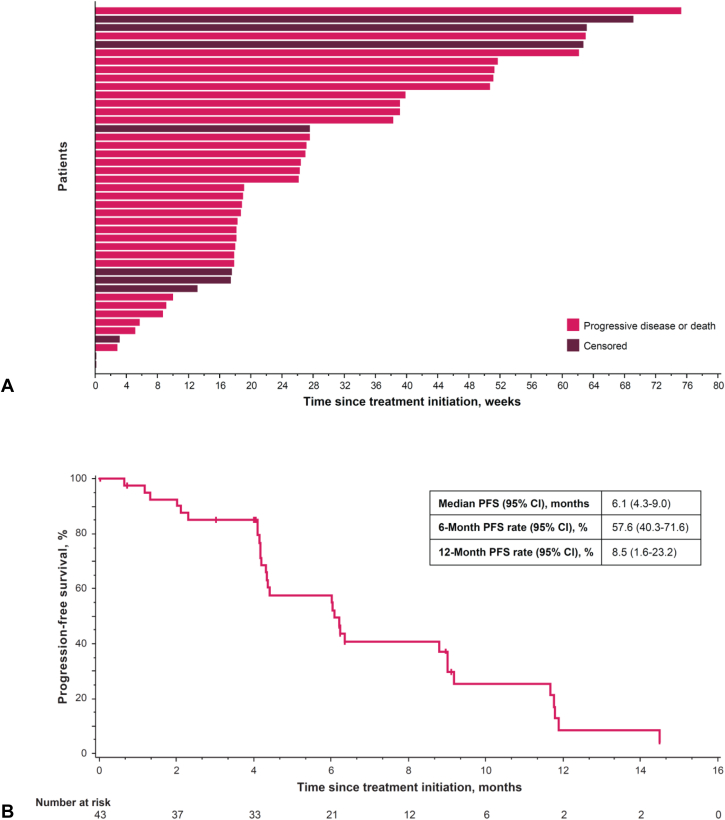
A total of 43 patients were enrolled. The median follow-up was 6.6 months for the primary analyses and 9.2 months for the efficacy analyses. In the efficacy analyses, 15 patients had a confirmed partial response (objective response rate, 34.9% [95% confidence interval: 21.0%-50.9%]), and the median duration of response was 7.1 months (95% confidence interval: 4.2-12.5 mo). The median progression-free survival and overall survival were 6.1 months and 10.0 months, respectively. In the safety analyses (primary analysis), 38 patients (88.4%) had a treatment-related adverse event, of whom 24 (55.8%) had a grade 3 or higher treatment-related adverse event.
The combination of avelumab + cetuximab and chemotherapy showed antitumor activity and tolerable safety; however, the ORR was not improved compared with those reported for current standards of care (NCT03717155).
我们公布了一项2a期试验的结果,该试验针对晚期鳞状非小细胞肺癌(NSCLC)患者,使用一线阿维鲁单抗(抗程序性死亡配体1抗体)联合西妥昔单抗(抗表皮生长因子受体抗体)进行治疗。
复发或转移性鳞状NSCLC患者接受阿维鲁单抗800mg(第1天和第8天)、西妥昔单抗250mg/m²(第1天)和500mg/m²(第8天)、顺铂75mg/m²(第1天)以及吉西他滨1250mg/m²(第1天和第8天)治疗,为期四个3周周期,之后每2周给予阿维鲁单抗800mg和西妥昔单抗500mg/m²。主要终点为最佳总体缓解;次要终点为无进展生存期、缓解持续时间、总生存期和安全性。疗效分析基于更新的数据截止点进行报告。
共纳入43例患者。主要分析的中位随访时间为6.6个月,疗效分析的中位随访时间为9.2个月。在疗效分析中,15例患者获得确认的部分缓解(客观缓解率为34.9%[95%置信区间:21.0%-50.9%]),中位缓解持续时间为7.1个月(95%置信区间:4.2-12.5个月)。中位无进展生存期和总生存期分别为6.1个月和10.0个月。在安全性分析(主要分析)中,38例患者(88.4%)发生了与治疗相关的不良事件,其中24例(55.8%)发生了3级或更高级别的与治疗相关的不良事件。
阿维鲁单抗+西妥昔单抗与化疗联合显示出抗肿瘤活性且安全性可耐受;然而,与当前护理标准报告的客观缓解率相比,并未得到改善(NCT03717155)。