Department of Psychology, Drexel University, Philadelphia, Pennsylvania, USA.
Center for Weight Eating and Lifestyle Science (WELL Center), Drexel University, Philadelphia, Pennsylvania, USA.
Int J Eat Disord. 2023 May;56(5):1001-1010. doi: 10.1002/eat.23901. Epub 2023 Jan 31.
Individuals with eating disorders (EDs) often engage in maladaptive exercise (e.g., feeling driven, or to "compensate" for eating) which maintains eating pathology. Maladaptive exercise has been theorized to help individuals with EDs regulate emotions by enhancing positive affect (PA) and reducing negative affect (NA) associated with binge episodes and poor body image. However, no research has considered the presence of non-maladaptive exercise or evaluated this theory in binge-spectrum EDs.
This study evaluated affective trajectories pre- and post-exercise and examined exercise type (maladaptive or non-maladaptive) as a moderator. We recruited adults with binge-spectrum EDs (N = 107; n = 84 endorsed exercise) to complete a 7- to 14-day ecological momentary assessment protocol assessing NA (anxiety, guilt, and sadness), PA (excitement and cheerfulness), and exercise.
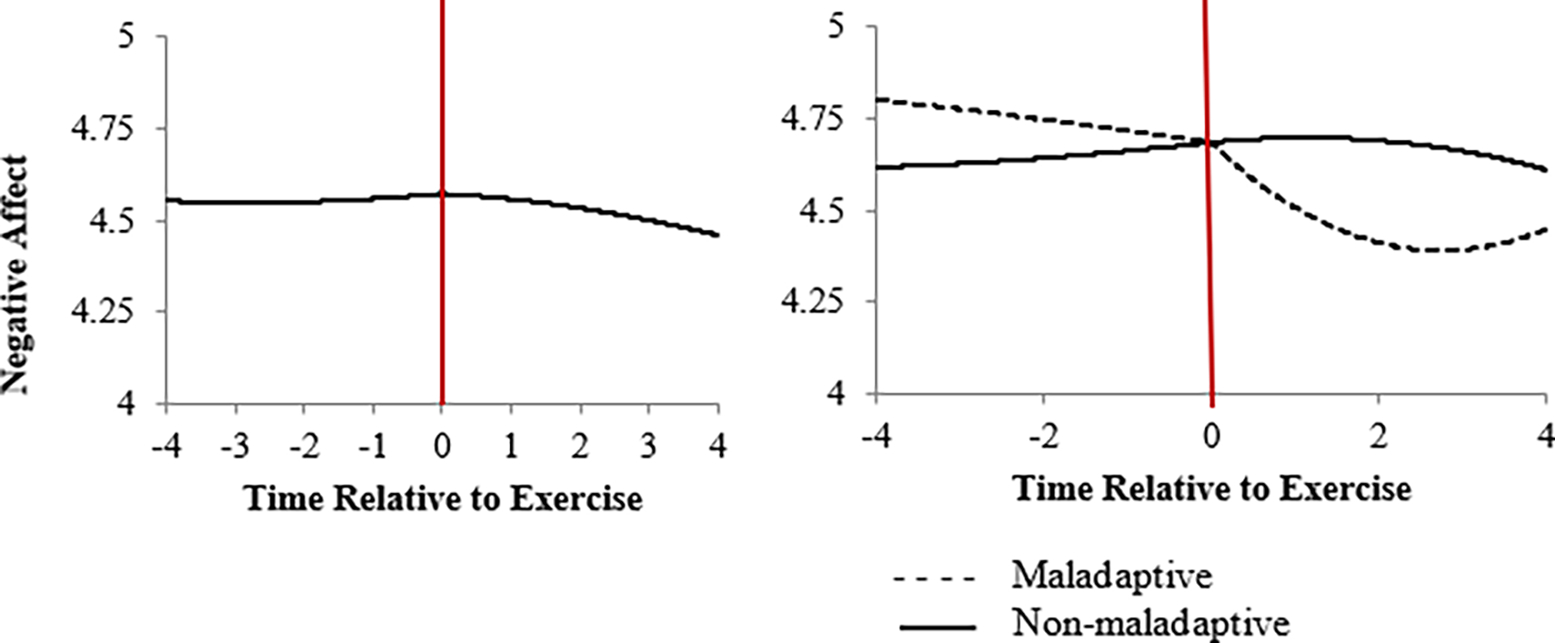
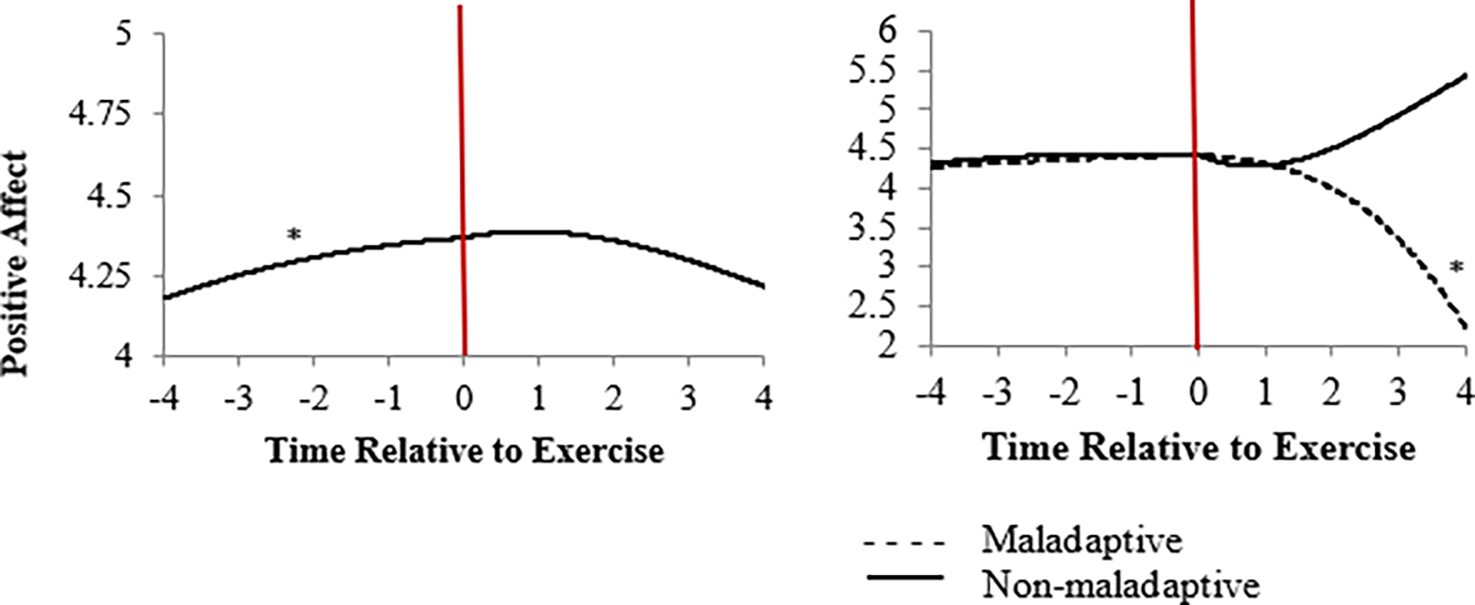
There was a significant quadratic trajectory of PA pre-exercise, suggesting that the upward trajectory of PA leveled out as it moved closer to an exercise episode. Exercise type significantly moderated the cubic trajectory of PA post-exercise, such that the upward trajectory of PA accelerated in the hours following non-maladaptive exercise episodes while the downward trajectory of PA accelerated in the hours following maladaptive exercise episodes. No trajectories of NA demonstrated significant effects.
Pre-exercise trajectories of PA may reflect positive expectancies around exercise. Post-exercise trajectories of PA suggest that non-maladaptive exercise promotes increased PA. Future research should evaluate when, and for whom, exercise serves to regulate affect and examine other momentary risk factors of exercise in EDs.
Individuals with EDs often engage in maladaptive exercise (e.g., feeling driven, or to "compensate" for eating). Maladaptive exercise has been theorized to help individuals with EDs regulate emotions. This study evaluated affective trajectories pre- and post-exercise and examined whether exercise type (maladaptive or non-maladaptive) changed these trajectories. Pre-exercise trajectories of PA may reflect positive expectancies around exercise. Post-exercise trajectories of PA suggest that non-maladaptive exercise promotes increased PA.
患有饮食失调症(ED)的个体经常进行不良的运动(例如,感觉被驱使,或“补偿”进食),这会维持进食障碍。不良运动被认为可以通过增强与暴食发作和不良身体形象相关的正性情绪(PA)和减少负性情绪(NA)来帮助 ED 患者调节情绪。然而,目前尚无研究考虑非不良运动的存在,也没有评估这一理论在暴食症谱 ED 中的作用。
本研究评估了运动前后的情感轨迹,并将运动类型(不良或非不良)作为一个调节变量进行研究。我们招募了患有暴食症谱 ED 的成年人(N=107;n=84 人报告运动),让他们完成一项 7 至 14 天的生态瞬时评估方案,评估 NA(焦虑、内疚和悲伤)、PA(兴奋和愉快)和运动。
运动前 PA 存在显著的二次轨迹,表明 PA 水平的上升轨迹在接近运动发作时趋于平稳。运动类型显著调节了运动后 PA 的三次轨迹,使得非不良运动发作后 PA 的上升轨迹加速,而不良运动发作后 PA 的下降轨迹加速。NA 无轨迹显示出显著影响。
运动前 PA 的轨迹可能反映了对运动的积极期望。运动后 PA 的轨迹表明非不良运动促进了 PA 的增加。未来的研究应该评估何时以及对哪些人来说,运动有助于调节情绪,并检查 ED 中运动的其他即时风险因素。
患有 ED 的个体经常进行不良的运动(例如,感觉被驱使,或“补偿”进食)。不良运动被认为可以帮助 ED 患者调节情绪。本研究评估了运动前后的情感轨迹,并研究了运动类型(不良或非不良)是否改变了这些轨迹。运动前 PA 的轨迹可能反映了对运动的积极期望。运动后 PA 的轨迹表明,非不良运动促进了 PA 的增加。