Department of Interventional Neuroradiology, Beijing Tiantan Hospital, Capital Medical University, Beijing, China.
China National Clinical Research Center for Neurological Diseases, Beijing Tiantan Hospital, Capital Medical University, Beijing, China.
Stroke Vasc Neurol. 2023 Aug;8(4):318-326. doi: 10.1136/svn-2022-001765. Epub 2023 Jan 31.
An analysis of the ASTER 2 trial revealed similar final recanalisation levels and clinical outcomes in acute large vessel occlusion (LVO) stroke between stent retrieval (SR) alone as a first-line mechanical thrombectomy (MT) technique (SR alone first-line) and concomitant use of contact aspiration (CA) plus SR as a first-line MT technique (SR+CA first-line). The purpose of the present study was to compare the safety and efficacy of SR+CA first-line with those of SR alone first-line for patients with LVO in China.
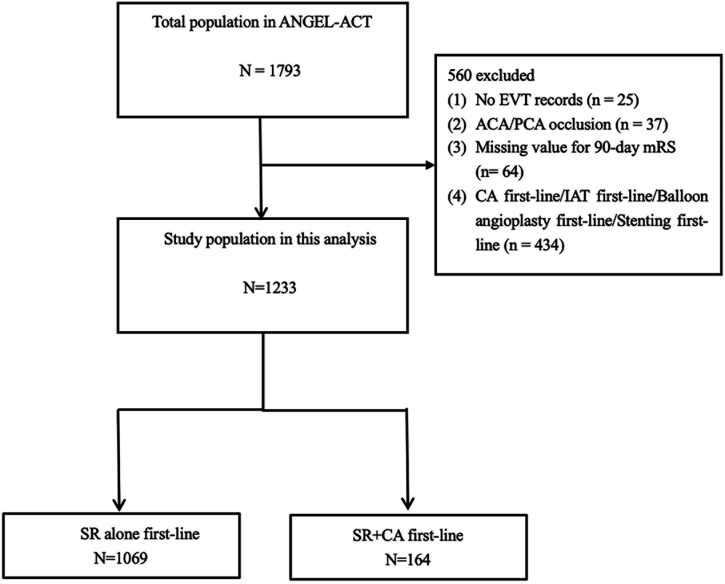
We conducted the present study by using the data from the ANGEL-ACT registry. We divided the selected patients into SR+CA first-line and SR alone first-line groups. We performed logistic regression and generalised linear models with adjustments to compare the angiographic and clinical outcomes, including successful/complete recanalisation after the first technique alone and all procedures, first-pass successful/complete recanalisation, number of passes, 90-day modified Rankin Scale, procedure duration, rescue treatment and intracranial haemorrhage within 24 hours.
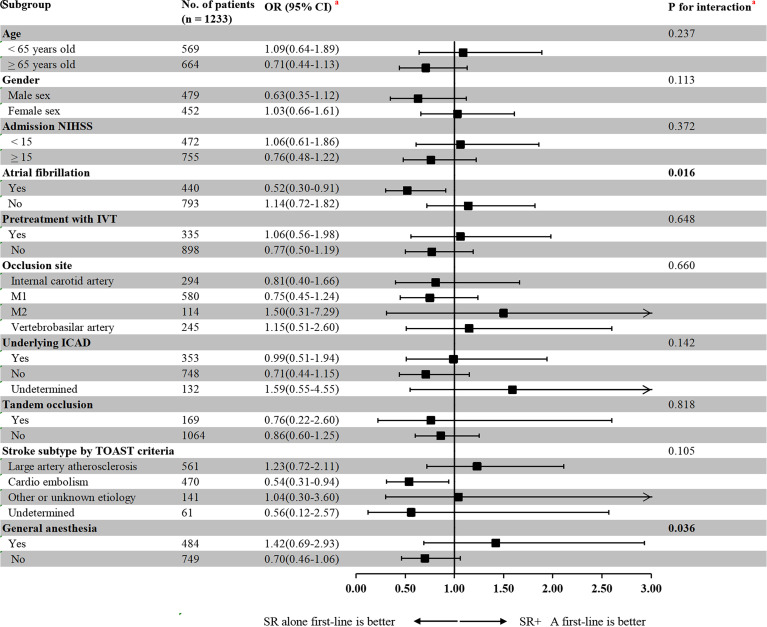
Of the 1233 enrolled patients, 1069 (86.7%) received SR alone first-line, and 164 (13.3%) received SR+CA first-line. SR+CA first-line was associated with more thrombectomy passes (3 (2-4) vs 2 (1-2); β=1.77, 95% CI=1.55 to 1.99, p<0.001), and longer procedure duration (86 (60-129) min vs 80 (50-122) min; β=10.76, 95% CI=1.08 to 20.43, p=0.029) than SR alone first-line group. Other outcomes were comparable (all p>0.05) between the two groups.
Patients undergoing SR+CA first-line had more thrombectomy passes and longer procedure duration than patients undergoing SR alone first-line. Additionally, we suggested that SR+CA first-line was not superior to SR alone first-line in final recanalisation level, first-pass recanalisation level and 90-day clinical outcomes in the Chinese population.
对 ASTER 2 试验的分析显示,在急性大血管闭塞(LVO)卒中患者中,支架回收(SR)作为一线机械血栓切除术(MT)技术(SR 作为一线技术)与接触抽吸(CA)联合 SR 作为一线 MT 技术(SR+CA 作为一线技术)之间,最终再通水平和临床结局相似。本研究的目的是比较中国 LVO 患者中 SR+CA 一线治疗与 SR 单独一线治疗的安全性和疗效。
我们使用 ANGEL-ACT 登记研究的数据进行了本研究。我们将选定的患者分为 SR+CA 一线治疗组和 SR 单独一线治疗组。我们进行了逻辑回归和广义线性模型分析,并进行了调整,以比较血管造影和临床结局,包括首次单独技术和所有操作后的成功/完全再通率、首次通过成功/完全再通率、通过次数、90 天改良 Rankin 量表评分、操作时间、挽救治疗和 24 小时内的颅内出血。
在纳入的 1233 例患者中,1069 例(86.7%)接受了 SR 单独一线治疗,164 例(13.3%)接受了 SR+CA 一线治疗。SR+CA 一线治疗与更多的血栓切除术通过次数相关(3(2-4)次比 2(1-2)次;β=1.77,95%置信区间=1.55 至 1.99,p<0.001),且操作时间更长(86(60-129)min 比 80(50-122)min;β=10.76,95%CI=1.08 至 20.43,p=0.029)。两组其他结局相似(均 p>0.05)。
与 SR 单独一线治疗组相比,接受 SR+CA 一线治疗的患者的血栓切除术通过次数更多,操作时间更长。此外,我们认为在中国人群中,SR+CA 一线治疗在最终再通水平、首次通过再通水平和 90 天临床结局方面并不优于 SR 单独一线治疗。