U.S. Centers for Disease Control and Prevention, Atlanta, GA, USA.
ACAPS, Geneva, Switzerland.
Global Health. 2023 Jan 31;19(1):7. doi: 10.1186/s12992-023-00907-y.
Those responding to humanitarian crises have an ethical imperative to respond most where the need is greatest. Metrics are used to estimate the severity of a given crisis. The INFORM Severity Index, one such metric, has become widely used to guide policy makers in humanitarian response decision making. The index, however, has not undergone critical statistical review. If imprecise or incorrect, the quality of decision making for humanitarian response will be affected. This analysis asks, how precise and how well does this index reflect the severity of conditions for people affected by disaster or war?
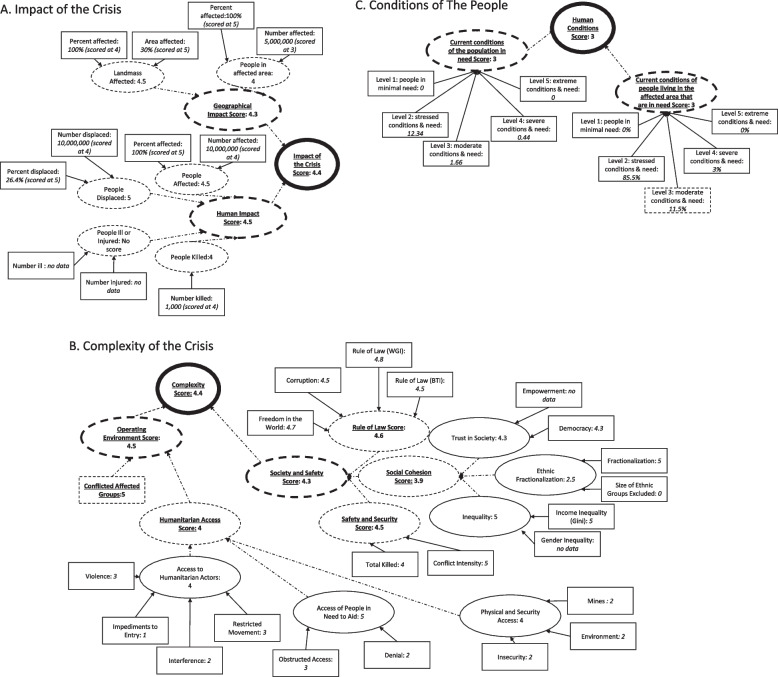
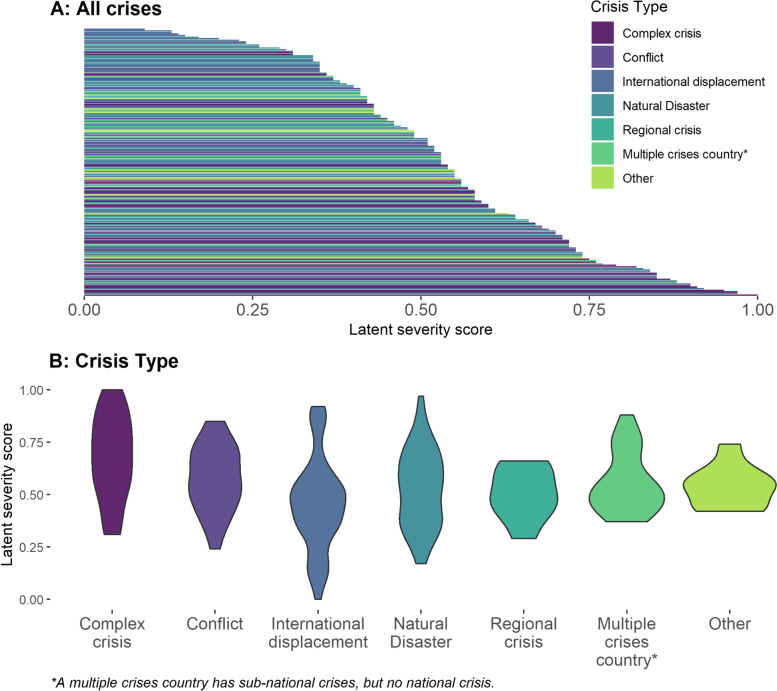
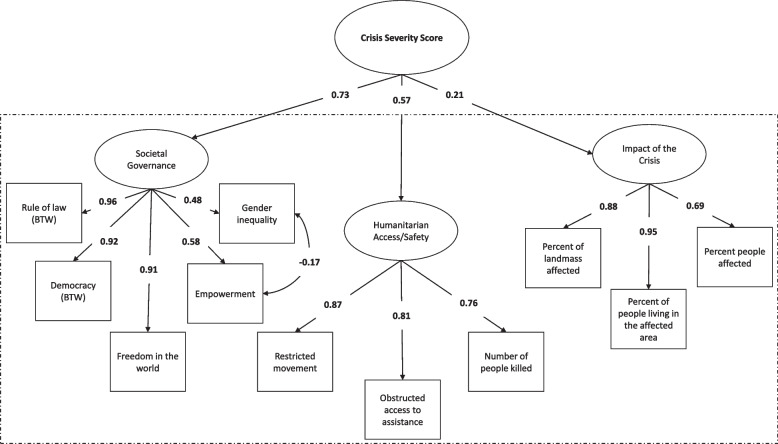
The INFORM Severity Index is calculated from 35 publicly available indicators, which conceptually reflect the severity of each crisis. We used 172 unique global crises from the INFORM Severity Index database that occurred January 1 to November 30, 2019 or were ongoing by this date. We applied exploratory factor analysis (EFA) to determine common factors within the dataset. We then applied a second-order confirmatory factor analysis (CFA) to predict crisis severity as a latent construct. Model fit was assessed via chi-square goodness-of-fit statistic, Comparative Fit Index (CFI), Tucker-Lewis Index (TLI), and Root Mean Square Error of Approximation (RMSEA). The EFA models suggested a 3- or 4- factor solution, with 46 and 53% variance explained in each model, respectively. The final CFA was parsimonious, containing three factors comprised of 11 indicators, with reasonable model fit (Chi-squared = 107, with 40 degrees of freedom, CFI = 0.94, TLI = 0.92, RMSEA = 0.10). In the second-order CFA, the magnitude of standardized factor-loading on the 'societal governance' latent construct had the strongest association with the latent construct of 'crisis severity' (0.73), followed by the 'humanitarian access/safety' construct (0.56).
A metric of crisis-severity is a critical step towards improving humanitarian response, but only when it reflects real life conditions. Our work is a first step in refining an existing framework to better quantify crisis severity.
应对人道主义危机的人员有责任在需求最大的地方做出最积极的回应。各种指标被用来估计特定危机的严重程度。其中一个指标是 INFORM 严重程度指数,该指数已被广泛用于指导人道主义应对决策制定者的决策。然而,该指数尚未经过严格的统计审查。如果不准确或不正确,人道主义应对决策的质量将受到影响。本分析旨在探讨该指数在多大程度上准确反映了受灾或受战争影响人群的状况严重程度?
INFORM 严重程度指数由 35 个公开指标计算得出,这些指标从概念上反映了每个危机的严重程度。我们使用了 INFORM 严重程度指数数据库中 2019 年 1 月 1 日至 11 月 30 日期间发生的或在此日期仍在进行的 172 个独特的全球危机。我们应用探索性因素分析(EFA)来确定数据集中的共同因素。然后,我们应用二阶验证性因素分析(CFA)来预测危机严重程度作为潜在结构。通过卡方拟合优度统计量、比较拟合指数(CFI)、塔克-刘易斯指数(TLI)和均方根误差近似值(RMSEA)来评估模型拟合度。EFA 模型表明存在 3 或 4 个因素解决方案,每个模型分别解释了 46%和 53%的方差。最终的 CFA 是简约的,包含由 11 个指标组成的三个因素,具有合理的模型拟合度(卡方=107,自由度为 40,CFI=0.94,TLI=0.92,RMSEA=0.10)。在二阶 CFA 中,“社会治理”潜在结构的标准化因子负荷与“危机严重程度”的潜在结构的关联度最强(0.73),其次是“人道主义准入/安全”结构(0.56)。
衡量危机严重程度是改善人道主义应对的关键步骤,但前提是它反映了现实生活条件。我们的工作是完善现有框架以更好地量化危机严重程度的第一步。