School of Physics, The University of New South Wales, Sydney, New South Wales, Australia.
School of Biotechnology and Biomolecular Sciences, The University of New South Wales, Sydney, New South Wales, Australia.
Protein Sci. 2023 Mar;32(3):e4586. doi: 10.1002/pro.4586.
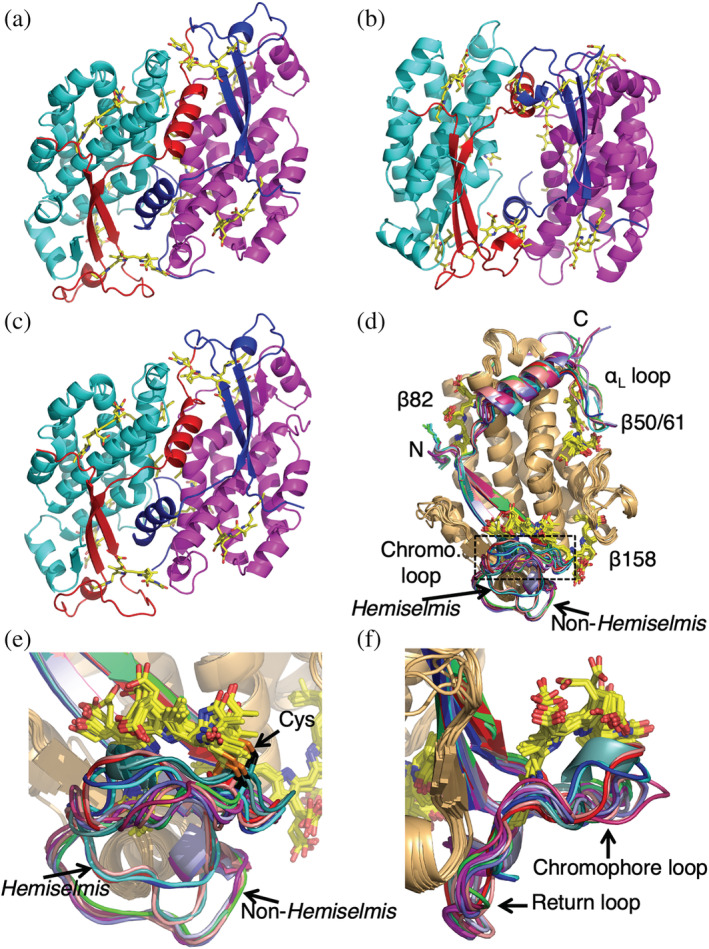
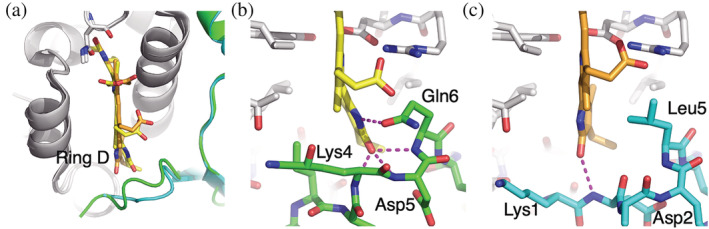
In addition to their membrane-bound chlorophyll a/c light-harvesting antenna, the cryptophyte algae have evolved a unique phycobiliprotein antenna system located in the thylakoid lumen. The basic unit of this antenna consists of two copies of an αβ protomer where the α and β subunits scaffold different combinations of a limited number of linear tetrapyrrole chromophores. While the β subunit is highly conserved, encoded by a single plastid gene, the nuclear-encoded α subunits have evolved diversified multigene families. It is still unclear how this sequence diversity results in the spectral diversity of the mature proteins. By careful examination of three newly determined crystal structures in comparison with three previously obtained, we show how the α subunit amino acid sequences control chromophore conformations and hence spectral properties even when the chromophores are identical. Previously we have shown that α subunits control the quaternary structure of the mature αβ.αβ complex (either open or closed), however, each species appeared to only harbor a single quaternary form. Here we show that species of the Hemiselmis genus contain expressed α subunit genes that encode both distinct quaternary structures. Finally, we have discovered a common single-copy gene (expressed into protein) consisting of tandem copies of a small α subunit that could potentially scaffold pairs of light harvesting units. Together, our results show how the diversity of the multigene α subunit family produces a range of mature cryptophyte antenna proteins with differing spectral properties, and the potential for minor forms that could contribute to acclimation to varying light regimes.
除了它们的膜结合叶绿素 a/c 光捕获天线外,隐藻还进化出了一种独特的藻胆蛋白天线系统,位于类囊体腔中。这个天线的基本单元由两个αβ原聚体组成,其中α和β亚基支架不同数量的有限数量的线性四吡咯发色团的组合。虽然β亚基高度保守,由单个质体基因编码,但核编码的α亚基已经进化出多样化的多基因家族。目前尚不清楚这种序列多样性如何导致成熟蛋白的光谱多样性。通过仔细检查与三个之前获得的晶体结构相比的三个新确定的晶体结构,我们展示了α亚基氨基酸序列如何控制发色团构象,从而控制光谱特性,即使发色团是相同的。以前我们已经表明,α亚基控制成熟的αβ.αβ 复合物的四级结构(无论是开放的还是闭合的),然而,每个物种似乎只含有一种单一的四级形式。在这里,我们表明,Hemiselmis 属的物种含有表达的α亚基基因,这些基因编码两种不同的四级结构。最后,我们发现了一个常见的单拷贝基因(表达为蛋白质),由小α亚基的串联拷贝组成,这些拷贝可能支架对光捕获单元。总之,我们的研究结果表明,多基因α亚基家族的多样性如何产生一系列具有不同光谱特性的成熟隐藻天线蛋白,以及潜在的可能有助于适应不同光照条件的小形式。