Department of Earth Science and Engineering, Imperial College London, London, UK.
School of Environmental Sciences, University of East Anglia, Norwich, UK.
Sci Adv. 2023 Feb 3;9(5):eadd2143. doi: 10.1126/sciadv.add2143. Epub 2023 Feb 1.
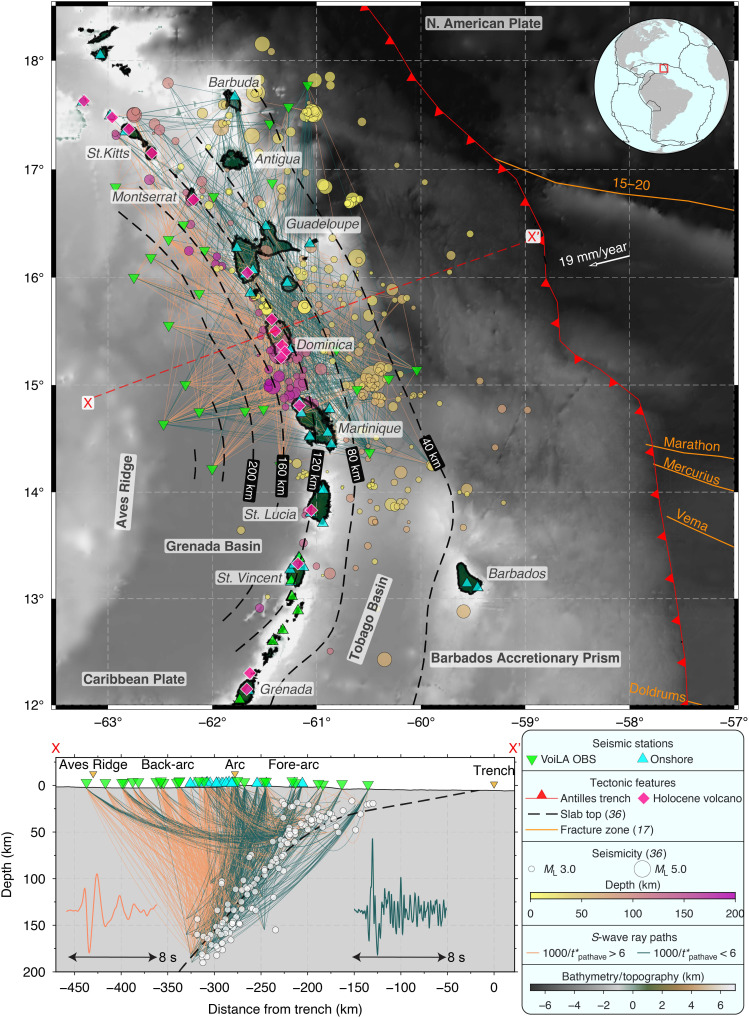
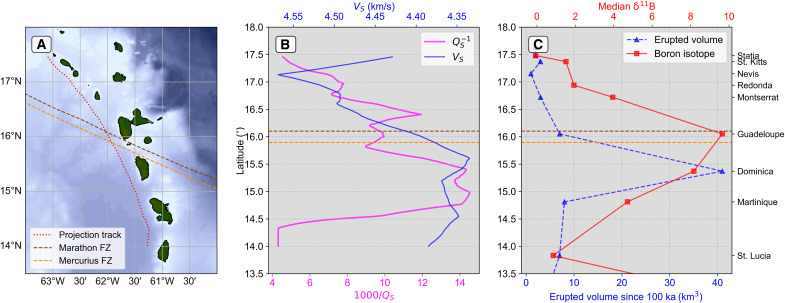
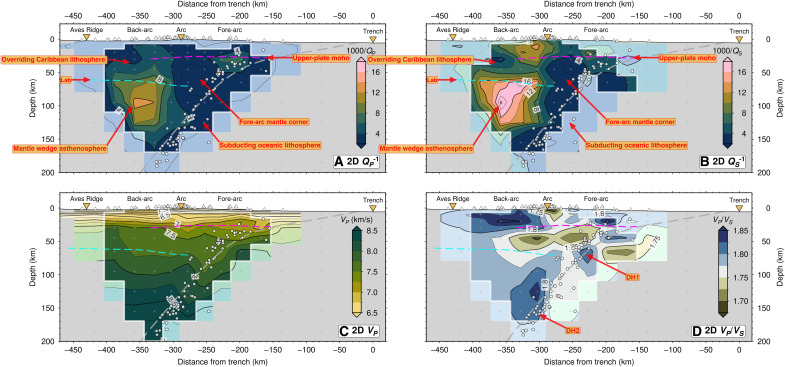
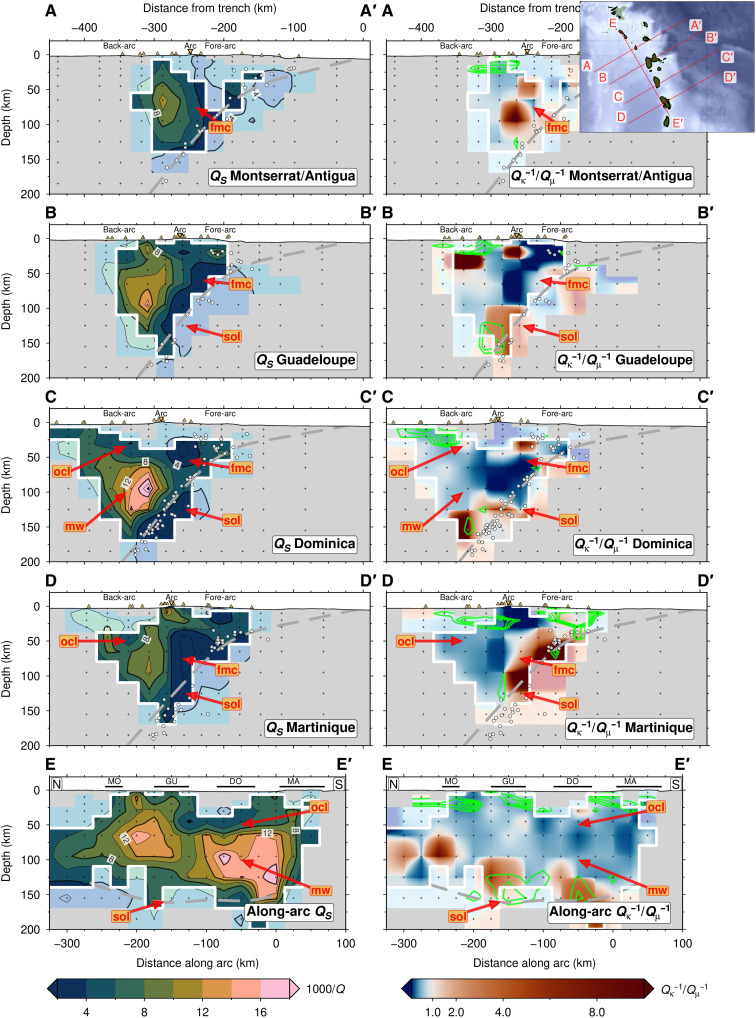
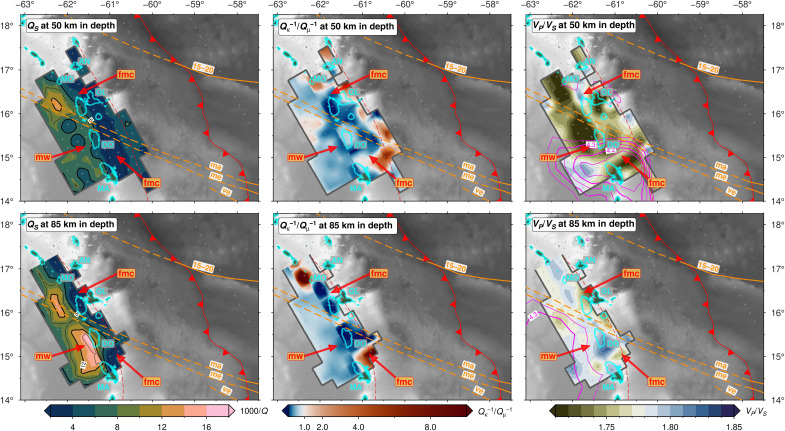
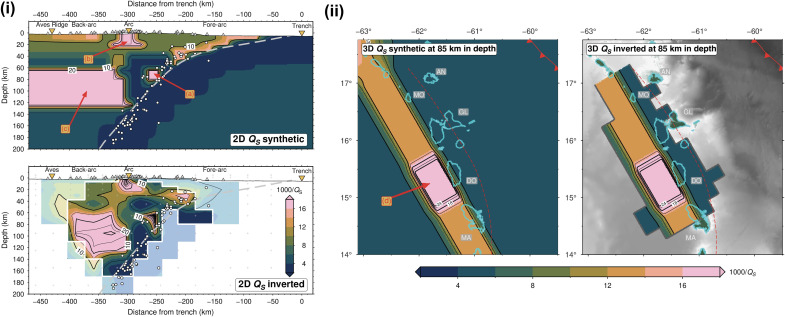
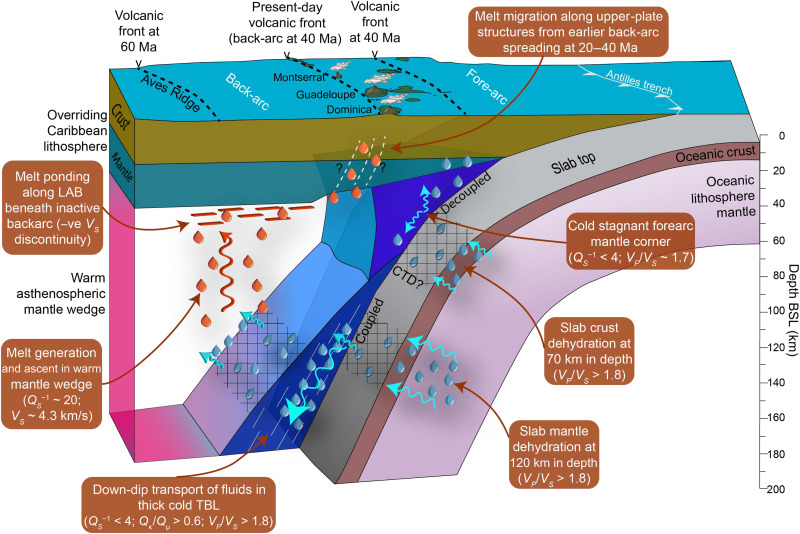
Volatiles expelled from subducted plates promote melting of the overlying warm mantle, feeding arc volcanism. However, debates continue over the factors controlling melt generation and transport, and how these determine the placement of volcanoes. To broaden our synoptic view of these fundamental mantle wedge processes, we image seismic attenuation beneath the Lesser Antilles arc, an end-member system that slowly subducts old, tectonized lithosphere. Punctuated anomalies with high ratios of bulk-to-shear attenuation (/ > 0.6) and / (>1.83) lie 40 km above the slab, representing expelled fluids that are retained in a cold boundary layer, transporting fluids toward the back-arc. The strongest attenuation (1000/ ~ 20), characterizing melt in warm mantle, lies beneath the back-arc, revealing how back-arc mantle feeds arc volcanoes. Melt ponds under the upper plate and percolates toward the arc along structures from earlier back-arc spreading, demonstrating how slab dehydration, upper-plate properties, past tectonics, and resulting melt pathways collectively condition volcanism.
俯冲板块释放的挥发物促进了上覆暖地幔的熔融,从而引发火山弧活动。然而,关于控制熔体产生和传输的因素,以及这些因素如何决定火山位置的争论仍在继续。为了更全面地了解这些基本的地幔楔形过程,我们对小安的列斯弧下方的地震衰减进行了成像,该弧是一个缓慢俯冲的古老、构造化岩石圈的极端系统。在板块上方 40 公里处存在具有高体积到剪切衰减比(/ > 0.6)和 /(> 1.83)的突发异常,代表被保留在冷边界层中的排出的流体,将流体输送到后弧。最强的衰减(1000/ > 20),特征为暖地幔中的熔融,位于后弧下方,揭示了后弧地幔如何为火山弧提供火山物质。上板块下的熔融池沿着早期后弧扩张的构造向火山弧渗透,表明了板块脱水、上板块性质、过去的构造以及由此产生的熔体路径如何共同影响火山作用。