Department of Immunology, Genetics and Pathology, Uppsala University, Rudbeck Laboratory, 751 85 Uppsala, Sweden.
Department of Oncology-Pathology, Cancer Center Karolinska, Karolinska Institutet, Karolinska vägen, A2:07, 171 64 Solna, Sweden.
EBioMedicine. 2023 Feb;88:104452. doi: 10.1016/j.ebiom.2023.104452. Epub 2023 Jan 30.
Cancer immunity is based on the interaction of a multitude of cells in the spatial context of the tumour tissue. Clinically relevant immune signatures are therefore anticipated to fundamentally improve the accuracy in predicting disease progression.
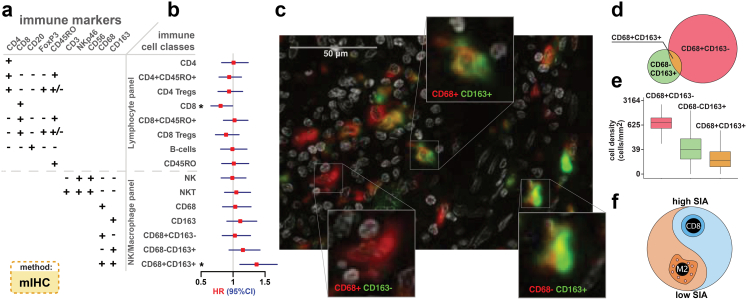
Through a multiplex in situ analysis we evaluated 15 immune cell classes in 1481 tumour samples. Single-cell and bulk RNAseq data sets were used for functional analysis and validation of prognostic and predictive associations.
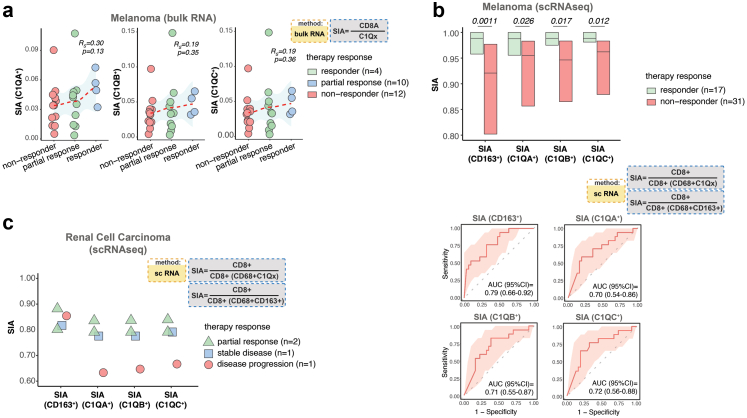
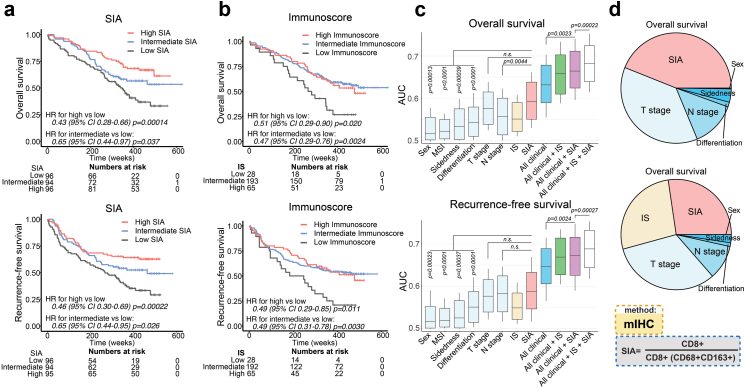
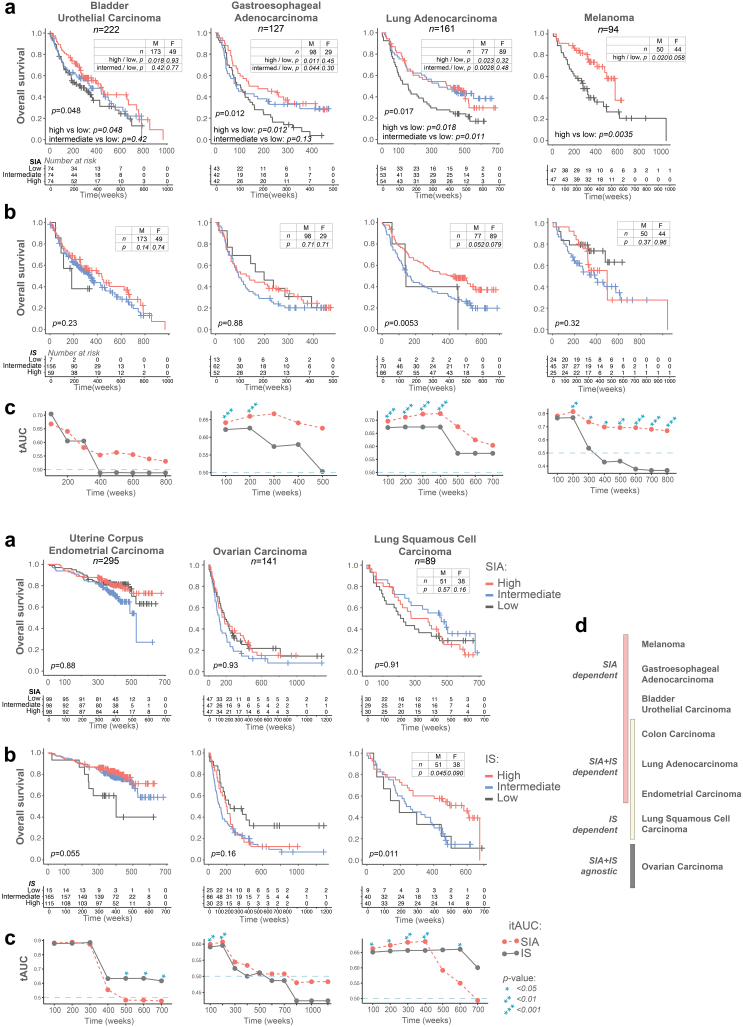
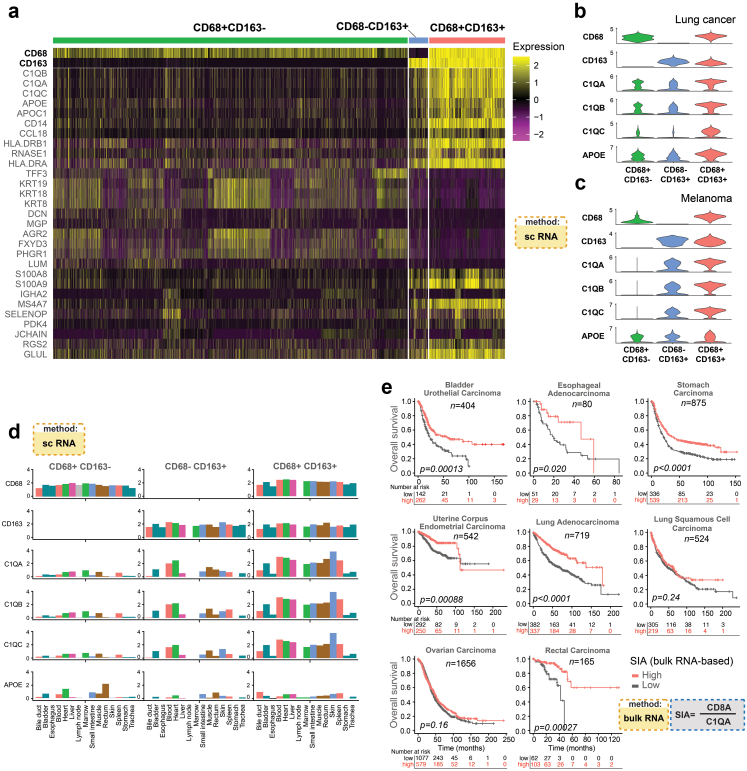
By combining the prognostic information of anti-tumoural CD8 lymphocytes and tumour supportive CD68CD163 macrophages in colorectal cancer we generated a signature of immune activation (SIA). The prognostic impact of SIA was independent of conventional parameters and comparable with the state-of-art immune score. The SIA was also associated with patient survival in oesophageal adenocarcinoma, bladder cancer, lung adenocarcinoma and melanoma, but not in endometrial, ovarian and squamous cell lung carcinoma. We identified CD68CD163 macrophages as the major producers of complement C1q, which could serve as a surrogate marker of this macrophage subset. Consequently, the RNA-based version of SIA (ratio of CD8A to C1QA) was predictive for survival in independent RNAseq data sets from these six cancer types. Finally, the CD8A/C1QA mRNA ratio was also predictive for the response to checkpoint inhibitor therapy.
Our findings extend current concepts to procure prognostic information from the tumour immune microenvironment and provide an immune activation signature with high clinical potential in common human cancer types.
Swedish Cancer Society, Lions Cancer Foundation, Selanders Foundation, P.O. Zetterling Foundation, U-CAN supported by SRA CancerUU, Uppsala University and Region Uppsala.
癌症免疫基于肿瘤组织空间背景下多种细胞的相互作用。因此,临床上相关的免疫特征有望从根本上提高预测疾病进展的准确性。
通过多重原位分析,我们评估了 1481 个肿瘤样本中的 15 种免疫细胞类型。单细胞和批量 RNAseq 数据集用于功能分析和验证预后及预测相关性。
通过结合结直肠癌中抗肿瘤 CD8 淋巴细胞和肿瘤支持性 CD68CD163 巨噬细胞的预后信息,我们生成了一个免疫激活特征(SIA)。SIA 的预后影响独立于常规参数,与最先进的免疫评分相当。SIA 也与食管腺癌、膀胱癌、肺腺癌和黑色素瘤患者的生存相关,但与子宫内膜癌、卵巢癌和鳞状细胞肺癌无关。我们发现 CD68CD163 巨噬细胞是补体 C1q 的主要产生者,C1q 可以作为该巨噬细胞亚群的替代标志物。因此,基于 RNA 的 SIA(CD8A 与 C1QA 的比值)在来自这六种癌症类型的独立 RNAseq 数据集中对生存具有预测性。最后,CD8A/C1QA mRNA 比值也可预测对检查点抑制剂治疗的反应。
我们的发现扩展了当前的概念,以从肿瘤免疫微环境中获取预后信息,并提供了一个在常见人类癌症类型中具有高临床潜力的免疫激活特征。
瑞典癌症协会、狮子癌症基金会、塞兰德基金会、P.O. 采特林基金会、U-CAN 由 SRA CancerUU、乌普萨拉大学和乌普萨拉地区支持。