• 文献检索
  • 文档翻译
  • 深度研究
  • 学术资讯
  • Suppr Zotero 插件Zotero 插件
  • 邀请有礼
  • 套餐&价格
  • 历史记录
应用&插件
Suppr Zotero 插件Zotero 插件浏览器插件Mac 客户端Windows 客户端微信小程序
定价
高级版会员购买积分包购买API积分包
服务
文献检索文档翻译深度研究API 文档MCP 服务
关于我们
关于 Suppr公司介绍联系我们用户协议隐私条款
关注我们

Suppr 超能文献

核心技术专利:CN118964589B侵权必究
粤ICP备2023148730 号-1Suppr @ 2026

文献检索

告别复杂PubMed语法,用中文像聊天一样搜索,搜遍4000万医学文献。AI智能推荐,让科研检索更轻松。

立即免费搜索

文件翻译

保留排版,准确专业,支持PDF/Word/PPT等文件格式,支持 12+语言互译。

免费翻译文档

深度研究

AI帮你快速写综述,25分钟生成高质量综述,智能提取关键信息,辅助科研写作。

立即免费体验

极性分子的场关联共振。

Field-linked resonances of polar molecules.

机构信息

Max-Planck-Institut für Quantenoptik, Garching, Germany.

Munich Center for Quantum Science and Technology, München, Germany.

出版信息

Nature. 2023 Feb;614(7946):59-63. doi: 10.1038/s41586-022-05651-8. Epub 2023 Feb 1.

DOI:10.1038/s41586-022-05651-8
PMID:36725996
原文链接:https://pmc.ncbi.nlm.nih.gov/articles/PMC9891998/
Abstract

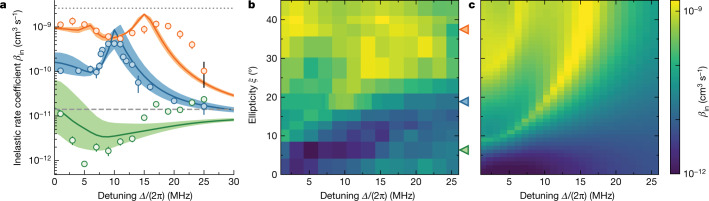
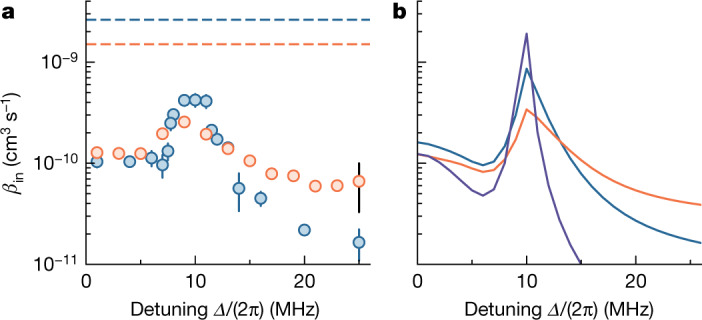
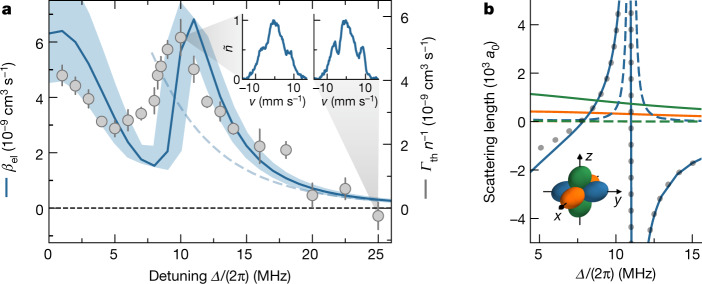
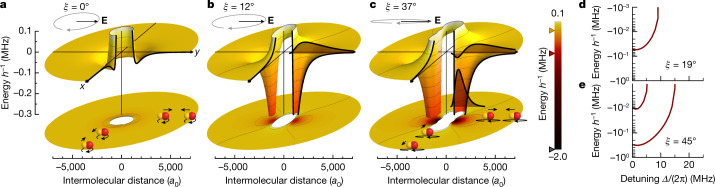
Scattering resonances are an essential tool for controlling the interactions of ultracold atoms and molecules. However, conventional Feshbach scattering resonances, which have been extensively studied in various platforms, are not expected to exist in most ultracold polar molecules because of the fast loss that occurs when two molecules approach at a close distance. Here we demonstrate a new type of scattering resonance that is universal for a wide range of polar molecules. The so-called field-linked resonances occur in the scattering of microwave-dressed molecules because of stable macroscopic tetramer states in the intermolecular potential. We identify two resonances between ultracold ground-state sodium-potassium molecules and use the microwave frequencies and polarizations to tune the inelastic collision rate by three orders of magnitude, from the unitary limit to well below the universal regime. The field-linked resonance provides a tuning knob to independently control the elastic contact interaction and the dipole-dipole interaction, which we observe as a modification in the thermalization rate. Our result provides a general strategy for resonant scattering between ultracold polar molecules, which paves the way for realizing dipolar superfluids and molecular supersolids, as well as assembling ultracold polyatomic molecules.

摘要

散射共振是控制超冷原子和分子相互作用的重要工具。然而,由于当两个分子接近时会发生快速损失,因此在大多数超冷极性分子中,预期不会存在传统的 Feshbach 散射共振。在这里,我们展示了一种新型的散射共振,它对广泛的极性分子都是通用的。由于分子间势中的稳定宏观四聚体状态,所谓的场关联共振出现在微波修饰分子的散射中。我们在超冷基态钠钾分子之间识别出两个共振,并使用微波频率和极化来将非弹性碰撞速率调谐三个数量级,从单位极限调谐到远低于通用范围。场关联共振提供了一个调谐旋钮,可以独立控制弹性接触相互作用和偶极-偶极相互作用,我们观察到这会导致热化速率发生改变。我们的结果为超冷极性分子之间的共振散射提供了一种通用策略,为实现偶极超流和分子超固体以及组装超冷多原子分子铺平了道路。
https://cdn.ncbi.nlm.nih.gov/pmc/blobs/c6a9/9891998/3cea1db6f7d1/41586_2022_5651_Fig9_ESM.jpg
https://cdn.ncbi.nlm.nih.gov/pmc/blobs/c6a9/9891998/d6a9b4396129/41586_2022_5651_Fig1_HTML.jpg
https://cdn.ncbi.nlm.nih.gov/pmc/blobs/c6a9/9891998/7e5ea32020db/41586_2022_5651_Fig2_HTML.jpg
https://cdn.ncbi.nlm.nih.gov/pmc/blobs/c6a9/9891998/1d4660b46ae1/41586_2022_5651_Fig3_HTML.jpg
https://cdn.ncbi.nlm.nih.gov/pmc/blobs/c6a9/9891998/c302d18d0bf4/41586_2022_5651_Fig4_HTML.jpg
https://cdn.ncbi.nlm.nih.gov/pmc/blobs/c6a9/9891998/29d83d34f40d/41586_2022_5651_Fig5_ESM.jpg
https://cdn.ncbi.nlm.nih.gov/pmc/blobs/c6a9/9891998/78763b58bc19/41586_2022_5651_Fig6_ESM.jpg
https://cdn.ncbi.nlm.nih.gov/pmc/blobs/c6a9/9891998/6ae1557fe0b7/41586_2022_5651_Fig7_ESM.jpg
https://cdn.ncbi.nlm.nih.gov/pmc/blobs/c6a9/9891998/5b10ff983896/41586_2022_5651_Fig8_ESM.jpg
https://cdn.ncbi.nlm.nih.gov/pmc/blobs/c6a9/9891998/3cea1db6f7d1/41586_2022_5651_Fig9_ESM.jpg
https://cdn.ncbi.nlm.nih.gov/pmc/blobs/c6a9/9891998/d6a9b4396129/41586_2022_5651_Fig1_HTML.jpg
https://cdn.ncbi.nlm.nih.gov/pmc/blobs/c6a9/9891998/7e5ea32020db/41586_2022_5651_Fig2_HTML.jpg
https://cdn.ncbi.nlm.nih.gov/pmc/blobs/c6a9/9891998/1d4660b46ae1/41586_2022_5651_Fig3_HTML.jpg
https://cdn.ncbi.nlm.nih.gov/pmc/blobs/c6a9/9891998/c302d18d0bf4/41586_2022_5651_Fig4_HTML.jpg
https://cdn.ncbi.nlm.nih.gov/pmc/blobs/c6a9/9891998/29d83d34f40d/41586_2022_5651_Fig5_ESM.jpg
https://cdn.ncbi.nlm.nih.gov/pmc/blobs/c6a9/9891998/78763b58bc19/41586_2022_5651_Fig6_ESM.jpg
https://cdn.ncbi.nlm.nih.gov/pmc/blobs/c6a9/9891998/6ae1557fe0b7/41586_2022_5651_Fig7_ESM.jpg
https://cdn.ncbi.nlm.nih.gov/pmc/blobs/c6a9/9891998/5b10ff983896/41586_2022_5651_Fig8_ESM.jpg
https://cdn.ncbi.nlm.nih.gov/pmc/blobs/c6a9/9891998/3cea1db6f7d1/41586_2022_5651_Fig9_ESM.jpg

相似文献

1
Field-linked resonances of polar molecules.极性分子的场关联共振。
Nature. 2023 Feb;614(7946):59-63. doi: 10.1038/s41586-022-05651-8. Epub 2023 Feb 1.
2
Ultracold field-linked tetratomic molecules.超冷场关联四原子分子。
Nature. 2024 Feb;626(7998):283-287. doi: 10.1038/s41586-023-06986-6. Epub 2024 Jan 31.
3
Dipolar collisions of polar molecules in the quantum regime.量子态下极性分子的偶极子碰撞。
Nature. 2010 Apr 29;464(7293):1324-8. doi: 10.1038/nature08953.
4
Electroassociation of Ultracold Dipolar Molecules into Tetramer Field-Linked States.超冷偶极分子电缔合形成四聚体场关联态
Phys Rev Lett. 2023 Jul 28;131(4):043402. doi: 10.1103/PhysRevLett.131.043402.
5
Observation of magnetically tunable Feshbach resonances in ultracold NaK + K collisions.超冷NaK + K碰撞中磁可调费什巴赫共振的观测
Science. 2019 Jan 18;363(6424):261-264. doi: 10.1126/science.aau5322. Epub 2019 Jan 17.
6
Controlling magnetic Feshbach resonances in polar open-shell molecules with nonresonant light.用光非共振控制极性开壳分子中的磁费什巴赫共振。
Phys Rev Lett. 2014 Mar 21;112(11):113201. doi: 10.1103/PhysRevLett.112.113201. Epub 2014 Mar 20.
7
Exploring Ultracold Collisions in ^{6}Li-^{53}Cr Fermi Mixtures: Feshbach Resonances and Scattering Properties of a Novel Alkali-Transition Metal System.探索⁶Li-⁵³Cr费米混合物中的超冷碰撞:一种新型碱金属-过渡金属系统的费什巴赫共振和散射特性
Phys Rev Lett. 2022 Aug 26;129(9):093402. doi: 10.1103/PhysRevLett.129.093402.
8
Prospects for making polar molecules with microwave fields.利用微波场制备极性分子的前景。
Phys Rev Lett. 2007 Aug 17;99(7):073003. doi: 10.1103/PhysRevLett.99.073003.
9
Observation of Photoassociation Resonances in Ultracold Atom-Molecule Collisions.超冷原子-分子碰撞中光缔合共振的观测
Phys Rev Lett. 2024 Mar 1;132(9):093403. doi: 10.1103/PhysRevLett.132.093403.
10
Observation of Feshbach-like resonances in collisions between ultracold molecules.超冷分子碰撞中类费什巴赫共振的观测
Phys Rev Lett. 2005 Apr 1;94(12):123201. doi: 10.1103/PhysRevLett.94.123201.

引用本文的文献

1
Ultracold field-linked tetratomic molecules.超冷场关联四原子分子。
Nature. 2024 Feb;626(7998):283-287. doi: 10.1038/s41586-023-06986-6. Epub 2024 Jan 31.
2
Ultracold Sticky Collisions: Theoretical and Experimental Status.超冷粘性碰撞:理论和实验现状。
J Phys Chem A. 2023 Jan 26;127(3):729-741. doi: 10.1021/acs.jpca.2c08095. Epub 2023 Jan 9.

本文引用的文献

1
Effective Potential and Superfluidity of Microwave-Shielded Polar Molecules.微波屏蔽极性分子的有效势和超流性。
Phys Rev Lett. 2023 May 5;130(18):183001. doi: 10.1103/PhysRevLett.130.183001.
2
A Feshbach resonance in collisions between triplet ground-state molecules.三重态基态分子间碰撞中的费什巴赫共振。
Nature. 2023 Feb;614(7946):54-58. doi: 10.1038/s41586-022-05635-8. Epub 2023 Feb 1.
3
Dipolar physics: a review of experiments with magnetic quantum gases.偶极物理:对磁量子气体实验的综述。
Rep Prog Phys. 2022 Dec 30;86(2). doi: 10.1088/1361-6633/aca814.
4
Evaporation of microwave-shielded polar molecules to quantum degeneracy.微波屏蔽极性分子的蒸发至量子简并态。
Nature. 2022 Jul;607(7920):677-681. doi: 10.1038/s41586-022-04900-0. Epub 2022 Jul 27.
5
Observation of a molecular bond between ions and Rydberg atoms.观察离子与里德堡原子之间的分子键。
Nature. 2022 May;605(7910):453-456. doi: 10.1038/s41586-022-04577-5. Epub 2022 May 18.
6
Control of reactive collisions by quantum interference.通过量子干涉控制反应性碰撞。
Science. 2022 Mar 4;375(6584):1006-1010. doi: 10.1126/science.abl7257. Epub 2022 Mar 3.
7
Observation of Feshbach resonances between a single ion and ultracold atoms.观察单离子与超冷原子之间的费什巴赫共振。
Nature. 2021 Dec;600(7889):429-433. doi: 10.1038/s41586-021-04112-y. Epub 2021 Dec 15.
8
Bimolecular Chemistry in the Ultracold Regime.极低温状态下的双分子化学
Annu Rev Phys Chem. 2022 Apr 20;73:73-96. doi: 10.1146/annurev-physchem-090419-043244. Epub 2021 Dec 10.
9
Observation of microwave shielding of ultracold molecules.观察超冷分子的微波屏蔽。
Science. 2021 Aug 13;373(6556):779-782. doi: 10.1126/science.abg9502.
10
Resonant collisional shielding of reactive molecules using electric fields.利用电场对反应分子进行共振碰撞屏蔽。
Science. 2020 Dec 11;370(6522):1324-1327. doi: 10.1126/science.abe7370.