Department of Medicine.
Department of Pathology and Laboratory Medicine, University of British Columbia.
AIDS. 2023 Apr 1;37(5):769-778. doi: 10.1097/QAD.0000000000003481. Epub 2023 Feb 2.
We sought to better understand factors associated with ovarian aging in women with HIV (WWH).
HIV has been associated with diminished fertility, younger age at menopause, and shorter leukocyte telomere length (LTL), a marker of cellular aging. We herein examine cross-sectional and longitudinal associations between LTL, anti-Müllerian hormone (AMH), and HIV.
We included WWH and HIV-negative women 12-50 years of age in the CARMA cohort with one or more study visit(s). LTL and AMH were measured by qPCR and ELISA, respectively. Women were analyzed in peak reproductive (<35 years) vs. late reproductive (≥35 years) life phases. Using multivariable mixed-effect linear or logistic regressions, we assessed factors associated with AMH and ΔAMH/year while adjusting for relevant confounders.
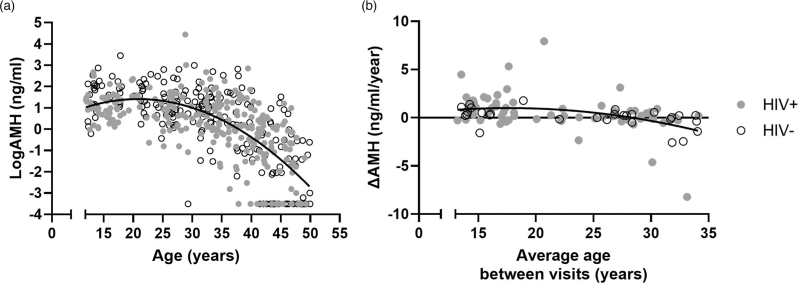
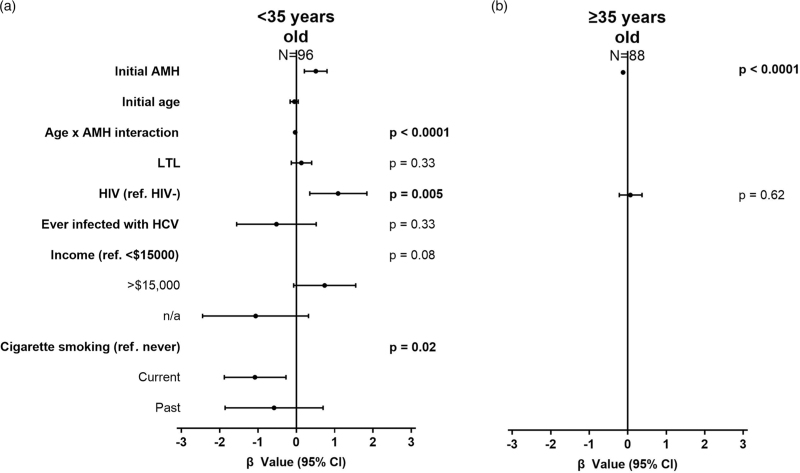
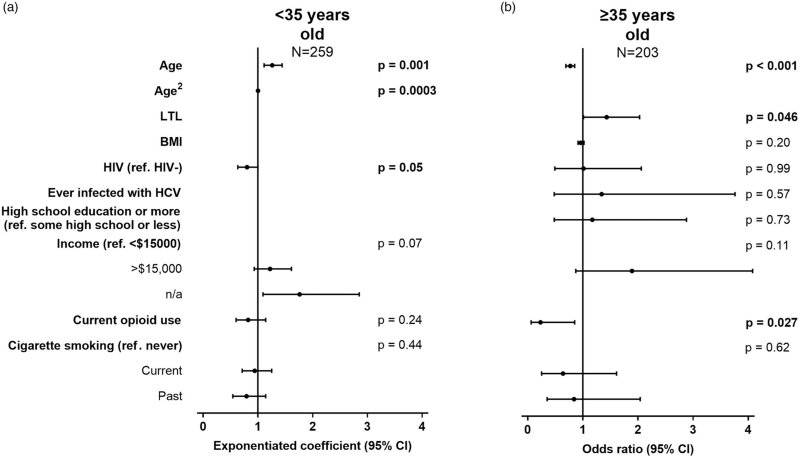
WWH had shorter LTL and lower AMH levels compared to HIV-negative controls despite being of similar age. After adjusting for relevant factors, HIV was associated with 20% lower AMH levels in women under 35 years of age and shorter LTL was associated with AMH levels below 2 ng/ml among women aged 35 years or older. Longitudinally, ΔAMH/year was largely related to initial AMH level among older women, and to age in younger women.
Factors associated with AMH change across women's reproductive lifespan. Lower AMH among peak reproductive aged WWH suggests that HIV may have an initial detrimental effect on ovarian reserve, an observation that may warrant counseling around pregnancy planning. In women aged 35 years or older, the association between shorter LTL and lower AMH suggests that the immune and reproductive aging connections are more important in this age group.
我们试图更好地了解与 HIV 女性(WWH)卵巢衰老相关的因素。
HIV 与生育能力下降、绝经年龄提前以及白细胞端粒长度(LTL)缩短有关,LTL 是细胞衰老的标志物。本研究检测了 LTL、抗苗勒氏管激素(AMH)与 HIV 之间的横断面和纵向相关性。
我们纳入了 CARMA 队列中 12-50 岁、有一次或多次研究访视的 WWH 和 HIV 阴性女性。通过 qPCR 和 ELISA 分别测量 LTL 和 AMH。将女性分为生育高峰期(<35 岁)和生育晚期(≥35 岁)。使用多变量混合效应线性或逻辑回归,我们评估了与 AMH 相关的因素和每年 AMH 的变化量(ΔAMH/年),同时调整了相关混杂因素。
尽管 WWH 与 HIV 阴性对照组的年龄相似,但 LTL 较短,AMH 水平较低。在调整了相关因素后,35 岁以下女性中 HIV 与 AMH 水平降低 20%相关,35 岁及以上女性中 LTL 较短与 AMH 水平低于 2ng/ml 相关。纵向分析显示,ΔAMH/年主要与年龄较大女性的初始 AMH 水平相关,与年轻女性的年龄相关。
与女性生殖寿命相关的因素会影响 AMH 的变化。生育高峰期 WWH 的 AMH 水平较低提示 HIV 可能对卵巢储备有初始的不良影响,这一观察结果可能需要对妊娠计划进行咨询。对于 35 岁及以上的女性,LTL 较短与 AMH 水平较低之间的关联提示在该年龄组中,免疫与生殖衰老的联系更为重要。