Cohn Eli G, McVilly Keith R, Harrison Matthew J
Faculty of Arts, The University of Melbourne, School of Social and Political Sciences, Parkville, Melbourne, Australia.
Melbourne Graduate School of Education, The University of Melbourne, Parkville, Melbourne, Australia.
Autism Dev Lang Impair. 2023 Jan 25;8:23969415231151846. doi: 10.1177/23969415231151846. eCollection 2023 Jan-Dec.
Echolalia, the repetition of previous speech, is highly prevalent in Autism. Research into echolalia has historically assumed a clinical standpoint, with two opposing paradigms, behaviourism and developmentalism, offering differing support and intervention programs. These paradigms offer a multitude of clinical operationalised definitions; despite attempts, there continue to be challenges regarding how echolalia is to be defined. Stepping out of the dichotomous clinically orientated literature, we examined how parents summarise and formalise their understanding of echolalia as a communication partner. The objectives of this study were three-fold: (1) to investigate how echolalia is described and defined by parents; (2) to examine if existing clinical definitions align with those of parents; and (3) to begin to consider the implications of such findings for a collaborative approach between clinical perspectives and the parent experience. We bring to the fore the voices of parents, who have historically remained absent from echolalia literature. That is to say, we step outside of the clinical realm and listen to parents: something which has been previously unconsidered but represents a new vital addition to the echolalia literature.
We employed a Grounded Theory approach to document the definitions of 133 parents.
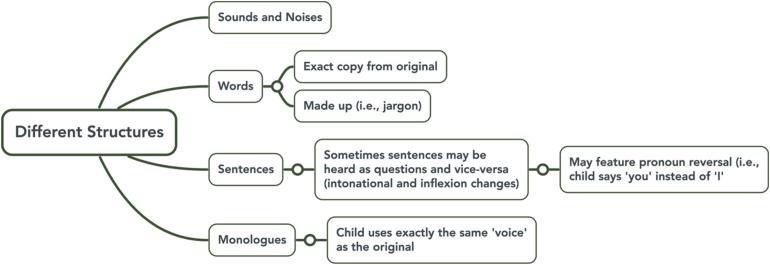
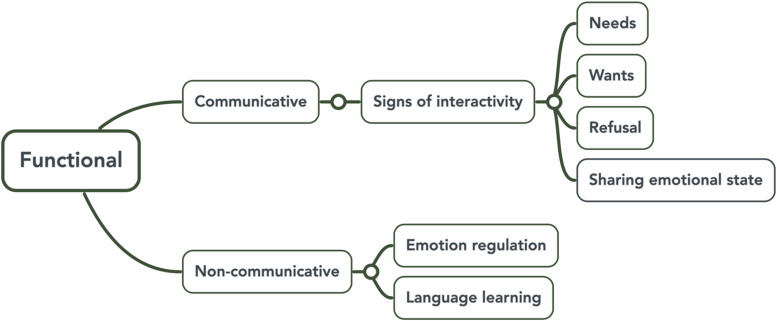
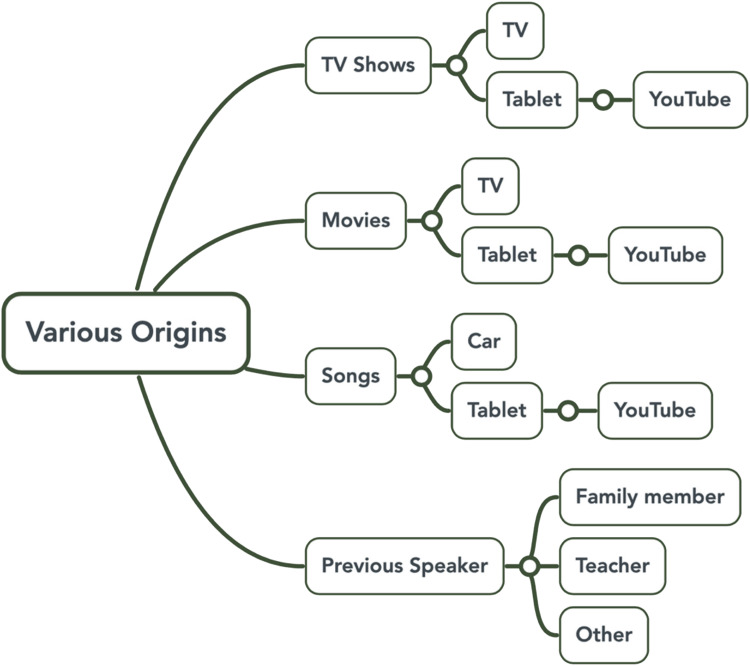
We found that parents reported a multiplicity of important elements that are key to their understanding of echolalia.
Additionally, we found that clinical definitions do not resonate within the parent experience; parents experience echolalia in a different way to that of clinicians and parents can offer insight into our understanding of the phenomena. Our findings show that while some parents might align themselves with either a behavioural or developmental positionality, sometimes there is an overlap depending upon the context in which their child repeats and some parents advance interpretations that are not readily aligned with either of the traditional clinical schools of thought. We present implications for both clinicians and parents in ways that point towards a collaborative approach to support the person with echolalia.
模仿言语,即重复之前的话语,在自闭症中极为常见。历史上,对模仿言语的研究一直从临床角度出发,行为主义和发展主义这两种对立的范式提供了不同的支持和干预方案。这些范式给出了众多临床操作性定义;尽管有所尝试,但在如何定义模仿言语方面仍存在挑战。跳出以临床为导向的二分法文献,我们研究了父母作为沟通伙伴如何总结并规范他们对模仿言语的理解。本研究的目标有三个:(1)调查父母如何描述和定义模仿言语;(2)检验现有的临床定义是否与父母的定义一致;(3)开始思考这些发现对临床观点与父母经验之间合作方法的影响。我们让父母的声音得以凸显,他们在模仿言语的文献中一直未被提及。也就是说,我们走出临床领域,倾听父母的声音:这是之前未被考虑过的,但却是模仿言语文献中一个新的重要补充。
我们采用扎根理论方法记录了133位父母的定义。
我们发现父母报告了许多对他们理解模仿言语至关重要的要素。
此外,我们发现临床定义在父母的经验中并未引起共鸣;父母对模仿言语的体验与临床医生不同,父母能够为我们理解这一现象提供见解。我们的研究结果表明,虽然有些父母可能认同行为主义或发展主义的立场,但有时会因孩子重复话语的情境不同而出现重叠,而且有些父母提出的解释并不容易与传统的临床思想流派中的任何一个相符。我们从临床医生和父母两个角度提出了启示,旨在为支持有模仿言语的人提供一种合作方法。